Abstract
The rapid advancement of information and communication technologies (ICTs) during this decade has increased its importance for individuals, businesses and societies. However, despite efforts to improve digital infrastructure, access, and ownership, the digital divide remains a persistent issue and a barrier to many sectors. Digital divide is not limited to physical access, but it comprises a wide range of factors. The study explores the demographic information and the access to ICT aspects (motivational access, physical access, operational skill access, formal skill access, informational skill access, and strategic skill access) that shape university students’ internet usage diversity. The study conducted an online survey on 351 students who were pursuing their studies in different disciplines at West Malaysian University. The role of demographic variables and ownership of 5 G-enabled devices in digital divide issues was investigated. Results showed that all demographic variables except gender have significantly impacted the dimensions of access to ICT to some extent. Furthermore, the study found that operational skills access, informational skills access, and physical access have predicted students' internet usage diversity. This implies the digital divide persists among university students in terms of operational skills, informational skills, and physical access to internet usage diversity. The findings also indicate that the digital divide persists across two levels of digital divide among university students in Malaysia. The results have strengthened the findings that the original digital divide of physical access has evolved into a divide that includes differences in skills to diversify internet usage.
Keywords
- Digital Divide Search this journal for Digital Divide (opens in a new tab)
- Motivational Access Search this journal for Motivational Access (opens in a new tab)
- Physical Access Search this journal for Physical Access (opens in a new tab)
- Skills Access Search this journal for Skills Access (opens in a new tab)
- Internet Usage Diversity Search this journal for Internet Usage Diversity (opens in a new tab)
References
- Afzal, A., Khan, S., Daud, S., Ahmad, Z., & Butt, A. (2023). Addressing the digital divide: Access and use of technology in education. Journal of Social Sciences Review, 3(2), 883-895. https://doi.org/10.54183/jssr.v3i2.326
- Ahmad, N. A., Ayub, A. F. M., & Khambari, M. N. (2019). Gender digital divide: Digital skills among Malaysian secondary school students. International Journal of Academic Research in Progressive Education and Development, 8(4), 668-687. http://dx.doi.org/10.6007/IJARPED/v8-i4/6692
- Ballesta Pagan, F. J., Lozano Martínez, J., & Cerezo Maiquez, M. C. (2018). Internet use by secondary school students: a digital divide in sustainable societies? Sustainability, 10(10), 3703. https://doi.org/10.3390/su10103703
- Ben Youssef, A., Dahmani, M., & Ragni, L. (2022). ICT use, digital skills and students’ academic performance: Exploring the digital divide. Information, 13(3), 129. https://doi.org/10.3390/info13030129
- Bergdahl, N., Nouri, J., & Fors, U. (2020). Disengagement, engagement and digital skills in technology-enhanced learning. Education and Information Technologies, 25(2), 957-983. https://doi.org/10.1007/s10639-019-09998-w
- Bigné, E., Ruiz, C., Andreu, L., & Hernandez, B. (2015). The role of social motivations, ability, and opportunity in online know-how exchanges: evidence from the airline services industry. Service Business, 9, 209-232. DOI 10.1007/s11628-013-0224-8
- Bonfadelli, H. (2002). The Internet and knowledge gaps: A theoretical and empirical investigation. European Journal of Communication, 17(1), 65-84. https://doi.org/10.1177/0267323102017001607
- Calderón Gómez, D. (2018). The three levels of the digital divide: barriers in access, use and utility of the internet among young people in Spain. https://doi.org/10.31211/interacoes.n34.2018.a4.
- Chang, Y., Wong, S. F., & Park, M. C. (2016). A three-tier ICT access model for intention to participate online: a comparison of developed and developing countries. Information Development, 32(3), 226-242. https://doi.org/10.1177/0266666914529294.
- Che Zainal, C. N. A. S., Adnan, W. H., & Abdul Aziz, A. (2024). The extended Unified Theory of Acceptance and Use of Technology (UTAUT2) and new media literacy: a study on internet usage and youth literacy. E-Journal of Media and Society (e-JOMS), 7(1), 1-13.
- Fischer, C., Malycha, C. P., & Schafmann, E. (2019). The influence of intrinsic motivation and synergistic extrinsic motivators on creativity and innovation. Frontiers in Psychology, 10, 137. https://doi.org/10.3389/fpsyg.2019.00137
- Gen, T. Z., & Gong, R. (2021). Digital platform work: how digital access and competencies affect job-seeking 112. Navigating challenges, realising opportunities of digital transformation, 66.
- Ghobadi, S., & Ghobadi, Z. (2015). How access gaps interact and shape the digital divide: a cognitive investigation. Behaviour & Information Technology, 34(4), 330-340. https://doi.org/10.1080/0144929X.2013.833650
- Hargittai, E. (2002). Second-Level Digital Divide: Differences in People’s Online Skills. First Monday, 7(4). https://doi.org/10.5210/fm.v7i4.942
- Hargittai, E. (2005). Survey measures of web-oriented digital literacy. Social Science Computer Review, 23(3), 371-379. DOI: 10.1177/0894439305275911
- Internet Users Survey 2022. Malaysian Communications and Multimedia Commission. ISSN 1823-2523. http://www.mcmc.gov.my
- Johan, A. (2024, March 20). 5G in Malaysia - Single Wholesale Network Driving Regional Leadership | Ookla®. Ookla-Providing Network Intelligence to Enable Modern Connectivity. https://www.ookla.com/articles/malaysia-5g-swn-q4-2023
- Kalmus, V., Realo, A., & Siibak, A. (2011). Motives for Internet use and their relationships with personality traits and socio-demographic factors. Trames: A Journal of the Humanities and Social Sciences, 15(4), 385. DOI: 10.3176/tr.2011.4.04
- Kemp, S. (2024, February 23). Digital 2024: Malaysia — DataReportal – Global Digital Insights. DataReportal – Global Digital Insights. https://datareportal.com/reports/digital-2024-malaysia
- Lau, Y. L., Loi, C. K., Ku, C. J., Yap, T. K., Nasir, E., & Yong, Z. H. (2023). A catalyst for the 5G era, a green economy, and inclusive growth: Closing Malaysia's digital divide. In 5G, artificial intelligence, and next generation internet of things: Digital Innovation for Green and Sustainable Economies (pp. 1-26). IGI Global. DOI: 10.4018/978-1-6684-8634-4.ch001
- Lepper, M. R., Corpus, J. H., & Iyengar, S. S. (2005). Intrinsic and extrinsic motivational orientations in the classroom: Age differences and academic correlates. Journal of Educational Psychology, 97(2), 184. DOI: 10.1037/0022-0663.97.2.184
- Li, Y., & Ranieri, M. (2013). Educational and social correlates of the digital divide for rural and urban children: A study on primary school students in a provincial city of China. Computers & Education, 60(1), 197-209. https://doi.org/10.1016/j.compedu.2012.08.001
- Li, X., Hsieh, J. P. A., & Rai, A. (2013). Motivational differences across post-acceptance information system usage behaviors: An investigation in the business intelligence systems context. Information Systems Research, 24(3), 659-682. https://doi.org/10.1287/isre.1120.0456
- Lythreatis, S., Singh, S. K., & El-Kassar, A. N. (2022). The digital divide: A review and future research agenda. Technological Forecasting and Social Change, 175, 121359. https://doi.org/10.1016/j.techfore.2021.121359
- Ojo, A. O., & Raman, M. (2017). Differences in individual usage of the internet: Cognitive, motivational and contextual aspects of the digital divide. https://aisel.aisnet.org/pacis2017/104
- Ojo, A. O., Alias, M., Dorasamy, M., Sarwar, A., & Ojo, O. T. (2022). Moderating effects of opportunity on the cognitive and motivational factors of internet engagement: A Study of the digital divide in Malaysia. International Journal of Technology and Human Interaction (IJTHI), 18(1), 1-17. https://dx.doi.org/10.4018/IJTHI.299353
- Ragnedda, M., Ruiu, M. L., & Calderón-Gómez, D. (2024). Examining the Interplay of Sociodemographic and Sociotechnical Factors on Users’ Perceived Digital Skills. Media and Communication, 12. https://doi.org/10.17645/mac.8167
- Shen, D., Cho, M. H., Tsai, C. L., & Marra, R. (2013). Unpacking online learning experiences: Online learning self-efficacy and learning satisfaction. The Internet and Higher Education, 19, 10-17. https://doi.org/10.1016/j.iheduc.2013.04.001
- Soomro, K. A., Kale, U., Curtis, R., Akcaoglu, M., & Bernstein, M. (2018). Development of an instrument to measure Faculty’s information and communication technology access (FICTA). Education and Information Technologies, 23, 253-269. doi: 10.1007/s10639-017-9599-9.
- Soomro, K. A., Kale, U., Curtis, R., Akcaoglu, M., & Bernstein, M. (2020). Digital divide among higher education faculty. International Journal of Educational Technology in Higher Education, 17, 1-16. https://doi.org/10.1186/s41239-020-00191-5
- Subramaniam, L., Yap, C. S., Jalaludin, F. W., & Hen, K. W. (2024). Digital divide and university students’ online learning amidst covid-19 pandemic in Malaysia. Libri, (0). https://doi.org/10.1515/libri-2023-0115
- Umar, I. N., & Yusoff, M. T. M. (2014). A study on Malaysian teachers’ level of ICT skills and practices, and its impact on teaching and learning. Procedia-Social and Behavioral Sciences, 116, 979-984. https://doi.org/10.1016/j.sbspro.2014.01.331
- Van Dijk, J. A. (2005). The deepening divide: Inequality in the information society. Sage Publications.
- Van Deursen, A., & Van Dijk, J. (2011). Internet skills and the digital divide. New Media & Society, 13(6), 893-911. https://doi.org/10.1177/1461444810386774
- Van Dijk, J. A. (2012). The evolution of the digital divide turns to inequality of skills and usage. In Digital Enlightenment Yearbook 2012 (pp. 57-75). IOS Press.
- Van Deursen, A. J., Görzig, A., Van Delzen, M., Perik, H. T., & Stegeman, A. G. (2014). Primary school children's internet skills: a report on performance tests of operational, formal, information, and strategic internet skills. International Journal of Communication, 8, 1343-1365.
- Van Deursen, A. J., & Van Dijk, J. A. (2015). Toward a multifaceted model of internet access for understanding digital divides: An empirical investigation. The Information Society, 31(5), 379-391. http://dx.doi.org/10.1080/01972243.2015.1069770
- Van Deursen, A. J., & Van Dijk, J. A. (2015). Internet skill levels increase, but gaps widen: A longitudinal cross-sectional analysis (2010–2013) among the Dutch population. Information, Communication & Society, 18(7), 782-797. http://dx.doi.org/10.1080/1369118X.2014.994544
- Van Dijk, J. A. G. M. (2017). Digital divide: Impact of access. The International Encyclopaedia of Media Effects, 1, 1-11. https://doi.org/10.1002/ 9781118783764.wbieme0043. https://doi.org/10.1002/ 9781118783764.wbieme0043.
- Wei, L. (2012). Number matters: The multimodality of Internet use as an indicator of the digital inequalities. Journal of Computer-Mediated Communication, 17(3), 303-318. https://doi.org/10.1111/j.1083-6101.2012.01578.x
Downloads
No downloads have been recorded for this article yet. Figures appear here once readers begin downloading the full text.
How to Cite
Share this article
License
Copyright (c) 2025 Siti Fairus Fuzi, Nurul Emyza Zahidi, Bushra Abdul Halim, Siti Nursyahira Zainudin, Siti Ramizah Jama, Nordianah Jusoh, Wan Hartini Wan Hassan (Author)

This work is licensed under a Creative Commons Attribution 4.0 International License.
Author (s) should affirm that the material has not been published previously. It has not been submitted and it is not under consideration by any other journal. At the same time author (s) need to execute a publication permission agreement to assume the responsibility of the submitted content and any omissions and errors therein. After submission of revised paper in the light of suggestions of the reviewers, the editorial team edits and formats manuscripts to bring uniformity and standardization in published material.
This work will be licensed under Creative Commons Attribution 4.0 International (CC BY 4.0) and under condition of the license, users are free to read, copy, remix, transform, redistribute, download, print, search or link to the full texts of articles and even build upon their work as long as they credit the author for the original work. Moreover, as per journal policy author (s) hold and retain copyrights without any restrictions.
Keywords
- Digital Divide Search this journal for Digital Divide (opens in a new tab)
- Motivational Access Search this journal for Motivational Access (opens in a new tab)
- Physical Access Search this journal for Physical Access (opens in a new tab)
- Skills Access Search this journal for Skills Access (opens in a new tab)
- Internet Usage Diversity Search this journal for Internet Usage Diversity (opens in a new tab)
Section
Published in
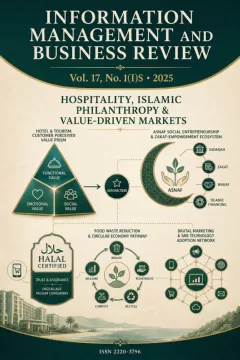 Vol. 17 No. 1(I)S (2025)
Hospitality, Islamic Philanthropy & Value-Driven Markets
View issue contents
Published
Submissions
Have research to publish? Information Management and Business Review welcomes submissions.
Make a Submission