Abstract
This conceptual paper examines how emerging technologies and tax education influence tax compliance among small and medium-sized enterprises (SMEs) in Malaysia, with a particular focus on the role of electronic taxation systems. Despite the Malaysian government's efforts to digitalize its tax infrastructure, many SMEs remain non-compliant due to limited knowledge, insufficient support, and low adoption of digital platforms. The study integrates the Technology Adoption Model (TAM) and the Theory of Planned Behavior (TPB) to explore how factors such as tax education, tax knowledge, tax resources, technology quality, and information quality contribute to tax compliance through the mediating role of electronic taxation adoption. The target population includes SMEs in the food and beverage sector located in the southern region of Peninsular Malaysia. A mixed-method research design is proposed, combining quantitative analysis using SPSS and SmartPLS with qualitative interviews analyzed through NVivo. The study aims to bridge gaps in the current literature by highlighting the behavioral and systemic barriers to digital tax adoption among SMEs. It also offers practical insights for policymakers and tax authorities seeking to improve voluntary compliance through better education, system design, and support strategies tailored to the SME sector.
Keywords
- Tax Compliance Search this journal for Tax Compliance (opens in a new tab)
- Electronic Taxation Search this journal for Electronic Taxation (opens in a new tab)
- Tax Education Search this journal for Tax Education (opens in a new tab)
- SMEs in Malaysia Search this journal for SMEs in Malaysia (opens in a new tab)
- LHDN Search this journal for LHDN (opens in a new tab)
References
- Abdinur, M. A., & Karcioglu, R. (2025). Factors Affecting Tax Compliance among Small and Medium-Sized Enterprises in Lasanod, SSC-Khaatumo, Somalia. International Journal of Academic Research in Accounting, Finance and Management Sciences, 15(1). https://doi.org/10.6007/ijarafms/v15-i1/24364
- Abdul Wahab, N. S., & Chin, S. F. (2024). Navigating The Digital Economy and Tax Challenges For SMEs. Retrieved April 15, 2025, from https://www.bernama.com/en/thoughts/news.php?id=2374395
- Abdullah, W. R. W., & Kahar, N. A. (2024). Factors Influencing Tax Awareness among E-Commerce SMEs in Malaysia: An Empirical Investigation. International Journal of Research and Innovation in Social Science, VIII(X), 2492–2503. https://doi.org/10.47772/ijriss.2024.8100207
- Abdulrazaq, O. (2024, September 12). The importance of tax education for Business Owners: Enhancing financial health and compliance. Retrieved from https://www.linkedin.com/pulse/importance-tax-education-business-owners-enhancing-abdulrazaq-s8bbf/
- Abu-Silake, S. A., Alshurafat, H., Alaqrabawi, M., & Shehadeh, M. (2024). Exploring the key factors influencing the actual usage of digital tax platforms. Discover Sustainability, 5(1). https://doi.org/10.1007/s43621-024-00241-2
- Adela, V., Agyei, S. K., Frimpong, S., Awisome, D. B., Bossman, A., Abosompim, R. O., . . . Ahmed, A. M. A. (2023). Bookkeeping practices and SME performance: The intervening role of owners’ accounting skills. Heliyon, 10(1), e23911. https://doi.org/10.1016/j.heliyon.2023.e23911
- Ajzen, I. (1991). The theory of planned behavior. Organizational Behavior and Human Decision Processes, 50(2), 179–211. https://doi.org/10.1016/0749-5978(91)90020-t
- Ajzen, I. (2002). Perceived behavioral control, Self?Efficacy, locus of control, and the theory of planned behavior1. Journal of Applied Social Psychology, 32(4), 665–683. https://doi.org/10.1111/j.1559-1816.2002.tb00236.x
- Albert, A., & Fadjarenie, R. A. (2022). Early tax education: Could it change the future compliance behavior? International Journal of Evaluation and Research in Education (IJERE), 11(4), 1912. https://doi.org/10.11591/ijere.v11i4.22241
- Allsop, D. B., Chelladurai, J. M., Kimball, E. R., Marks, L. D., & Hendricks, J. J. (2022). Qualitative Methods with NVivo Software: A Practical Guide for Analyzing Qualitative Data. Psych, 4(2), 142–159. https://doi.org/10.3390/psych4020013
- Amin, S. N., Buhari, P. Z. A., Yaacob, A. S., & Iddy, Z. (2022). Exploring the influence of tax knowledge in increasing tax compliance by introducing tax education at tertiary-level institutions. Open Journal of Accounting, 11(02), 57–70. https://doi.org/10.4236/ojacct.2022.112004
- Anesa, M., & Bressan, A. (2023). SMEs tax minimization is a shared responsibility. Critical Perspectives on Accounting, 98, 102698. https://doi.org/10.1016/j.cpa.2023.102698
- Annapoorna. (2024, September 10). What is Tax Compliance: Meaning, Types, Procedures, Examples. Retrieved from https://cleartax.in/s/tax-compliance
- Appiah, T., Domeher, D., & Agana, J. A. (2024a). Tax knowledge, trust in government, and voluntary tax compliance: Insights from an Emerging economy. SAGE Open, 14(2). https://doi.org/10.1177/21582440241234757
- Appiah, T., Domeher, D., & Agana, J. A. (2024b). Tax knowledge, trust in government, and voluntary tax compliance: Insights from an Emerging economy. SAGE Open, 14(2). https://doi.org/10.1177/21582440241234757
- Appiah, T., Domeher, D., & Agana, J. A. (2024c). Tax knowledge, trust in government, and voluntary tax compliance: Insights from an Emerging economy. SAGE Open, 14(2). https://doi.org/10.1177/21582440241234757
- Ariyibi, N. K. O., Bello, N. O. F., Ekundayo, N. T. F., Gupta, N. R., Samuel, N. E. O., Oluwabusolami, N. O., & Odumuwagun, N. O. O. (2024). Addressing the challenges of taxation E-commerce and digital services in the globalized economy. World Journal of Advanced Research and Reviews, 24(2), 1445–1453. https://doi.org/10.30574/wjarr.2024.24.2.3460
- Asmah, A., Ampong, K. O., Bibi, D., & Ofori, W. (2025). Exploring the drivers of digital technology adoption for enhancing domestic tax mobilization in Ghana. International Journal of Information Management Data Insights, 5(1), 100327. https://doi.org/10.1016/j.jjimei.2025.100327
- Azmi, D. a. W. M., & Daud, S. a. M. M. (2024). Reconceptualizing Tax Compliance Behavior: A Theoretical Matrix Approach. Accounting and Finance Research, 13(1), 67. https://doi.org/10.5430/afr.v13n1p67
- Bakar, S. a. N. A., Sapari, A., & Tanggamani, V. (2023). Technological advancements: Does it really matter in tax education? International Journal of Academic Research in Business and Social Sciences, 13(11). https://doi.org/10.6007/ijarbss/v13-i11/19197
- Bassey, E., Mulligan, E., & Ojo, A. (2022). A conceptual framework for digital tax administration - A systematic review. Government Information Quarterly, 39(4), 101754. https://doi.org/10.1016/j.giq.2022.101754
- Benitez, J., Henseler, J., Castillo, A., & Schuberth, F. (2019). How to perform and report an impactful analysis using partial least squares: Guidelines for confirmatory and explanatory IS research. Information & Management, 57(2), 103168. https://doi.org/10.1016/j.im.2019.05.003
- Bird, R. M. (1992). Improving tax administration in developing countries. International Monetary Fund eBooks. https://doi.org/10.5089/9781557753175.071
- Bolodeoku, P. B., Igbinoba, E., Salau, P. O., Chukwudi, C. K., & Idia, S. E. (2022). Perceived usefulness of technology and multiple salient outcomes: the improbable case of oil and gas workers. Heliyon, 8(4), e09322. https://doi.org/10.1016/j.heliyon.2022.e09322
- Bosnjak, M., Ajzen, I., & Schmidt, P. (2020). The theory of planned behavior: Selected recent advances and applications. Europe’s Journal of Psychology, 16(3), 352–356. https://doi.org/10.5964/ejop.v16i3.3107
- Cleartax. (2024, June 13). e-Services Malaysia: Online Government Services implemented by IRBM. Retrieved April 15, 2025, from https://www.cleartax.com/my/en/e-services-malaysia
- Estevão, M. (2024, March 16). Why tax administrations are embracing digital transformation. Retrieved from https://blogs.worldbank.org/en/voices/why-tax-administrations-are-embracing-digital-transformation
- Faiz, F., Le, V., & Masli, E. K. (2024). Determinants of digital technology adoption in innovative SMEs. Journal of Innovation & Knowledge, 9(4), 100610. https://doi.org/10.1016/j.jik.2024.100610
- Faruque, M. O., Chowdhury, S. N., Rabbani, M. G., & Khan, N. A. (2024). Technology adoption and digital transformation in small businesses: Trends, challenges, and opportunities. International Journal for Multidisciplinary Research, 6(5). https://doi.org/10.36948/ijfmr.2024.v06i05.29207
- Faster Capital. (2025). The importance of tax compliance for individuals - FasterCapital. Retrieved April 15, 2025, from https://fastercapital.com/topics/the-importance-of-tax-compliance-for-individuals.html
- Ferida, Y. (2023). Analysis of the role of tax consultants as tax intermediaries in the implementation of cooperative compliance. Asian Journal of Accounting and Finance. https://doi.org/10.55057/ajafin.2022.4.4.2
- Gonidakis, F. K., Asonitou, S., Kottara, C., Kavalieraki-Foka, D., & Gkotsina, E. (2024). The contribution of education to the creation of tax awareness and compliance. In Springer proceedings in business and economics (pp. 571–583). https://doi.org/10.1007/978-3-031-51038-0_62
- Hamid, N. A., Ibrahim, N. A., Ariffin, N., Taharin, R., & Jelani, F. A. (2019). Factors Affecting Tax Compliance among Malaysian SMEs in E-Commerce Business. International Journal of Asian Social Science, 9(1), 74–85. https://doi.org/10.18488/journal.1.2019.91.74.85
- Hamid, N. A., Ismail, I. S., Yunus, N., Jali, M. N., & Rosly, A. S. (2022). Taxpayer Perceptions of Tax Awareness, Tax Education, and Tax Complexity among Small and Medium Enterprises in Malaysia: A Quadrant Analysis Approach. Universal Journal of Accounting and Finance, 10(1), 231–242. https://doi.org/10.13189/ujaf.2022.100124
- Hassan, N. S. A., Palil, M. R., Ramli, R., & Maelah, R. (2022a). Enhancing tax compliance in Malaysia: Does tax learning and education matter? International Business Education Journal, 15(1), 18–29. https://doi.org/10.37134/ibej.vol15.1.2.2022
- Hassan, N. S. A., Palil, M. R., Ramli, R., & Maelah, R. (2022b). Enhancing tax compliance in Malaysia: Does tax learning and education matter? International Business Education Journal, 15(1), 18–29. https://doi.org/10.37134/ibej.vol15.1.2.2022
- He, Y., & Yi, Y. (2023). Digitalization of tax administration and corporate performance: Evidence from China. International Review of Financial Analysis, 90, 102859. https://doi.org/10.1016/j.irfa.2023.102859
- Hesami, S., Jenkins, H., & Jenkins, G. P. (2024). Digital Transformation of Tax Administration and Compliance: A Systematic Literature Review on E-Invoicing and Prefilled Returns. Digital Government Research and Practice, 5(3), 1–20. https://doi.org/10.1145/3643687
- Jiang, G., Liu, F., Liu, W., Liu, S., Chen, Y., & Xu, D. (2021). Effects of information quality on information adoption on social media review platforms: moderating role of perceived risk. Data Science and Management, 1(1), 13–22. https://doi.org/10.1016/j.dsm.2021.02.004
- Kamarudin, S. N., Mohamad, A., Nasir, N. E. M., & Malak, S. S. D. A. (2024). E-Tax Services and Their Evolution: The Case of Malaysia. Advances in Social Sciences Research Journal, 11(9.2), 79–90. https://doi.org/10.14738/assrj.119.2.17396
- Kumar, A. (2024, March 27). E-invoicing compliance in Malaysia. Retrieved April 15, 2025, from https://www.complyance.io/resources/blog/e-invoicing-compliance-in-malaysia
- Lee, A. T., Ramasamy, R. K., & Subbarao, A. (2025). Understanding Psychosocial Barriers to Healthcare Technology Adoption: A Review of TAM Technology Acceptance Model and Unified Theory of Acceptance and Use of Technology and UTAUT Frameworks. Healthcare, 13(3), 250. https://doi.org/10.3390/healthcare13030250
- Li, X., Dai, J., Zhu, X., Li, J., He, J., Huang, Y., . . . Shen, Q. (2023). Mechanism of attitude, subjective norms, and perceived behavioral control influence the green development behavior of construction enterprises. Humanities and Social Sciences Communications, 10(1). https://doi.org/10.1057/s41599-023-01724-9
- Li, Y., Zin, N. M., & Paino, H. (2024). The potential of information technology on tax voluntary compliance. International Journal of Academic Research in Business and Social Sciences, 14(10). https://doi.org/10.6007/ijarbss/v14-i10/23356
- Magasha, O., Gillo, I. O., & Alex, S. (2025a). Tax Compliance among SMEs: An Empirical Analysis of Internal and External Determinants in Shinyanga Municipality, Tanzania. Open Journal of Business and Management, 13(02), 924–945. https://doi.org/10.4236/ojbm.2025.132050
- Magasha, O., Gillo, I. O., & Alex, S. (2025b). Tax Compliance among SMEs: An Empirical Analysis of Internal and External Determinants in Shinyanga Municipality, Tanzania. Open Journal of Business and Management, 13(02), 924–945. https://doi.org/10.4236/ojbm.2025.132050
- Marikyan, D., & Papagiannidis, S. (2024a). Technology Acceptance Model - TheoryHub - Academic theories reviews for research and T&L. Retrieved April 15, 2025, from https://open.ncl.ac.uk/theories/1/technology-acceptance-model/#:~:text=Perceived%20ease%20of%20use%20was,effort%20(Davis%2C%201989).
- Marikyan, D., & Papagiannidis, S. (2024b). Technology Acceptance Model - TheoryHub - Academic theories reviews for research and T&L. Retrieved April 15, 2025, from https://open.ncl.ac.uk/theories/1/technology-acceptance-model/
- Marzi, G., Marrucci, A., Vianelli, D., & Ciappei, C. (2023). B2B digital platform adoption by SMEs and large firms: Pathways and pitfalls. Industrial Marketing Management, 114, 80–93. https://doi.org/10.1016/j.indmarman.2023.08.002
- Mascagni, G., Santoro, F., & Mukama, D. (2024). Teach to comply? Evidence from a taxpayer education program in Rwanda. International Tax and Public Finance. https://doi.org/10.1007/s10797-023-09809-6
- Masunga, F. J., Mapesa, H. J., Mwakibete, A. N., Derefa, M. J., Myava, J. E., & Kiria, J. S. (2021). The Role of Mediating Effects of User Satisfaction and Behavioral Intention on the Influence of the e-Tax System on Tax Compliance Behavior: An Application of Bootstrapping Technique. TIJAB (the International Journal of Applied Business), 5(2), 137. https://doi.org/10.20473/tijab.v5.i2.2021.29229
- Mebratu, A. A. (2024). Theoretical foundations of voluntary tax compliance: evidence from a developing country. Humanities and Social Sciences Communications, 11(1). https://doi.org/10.1057/s41599-024-02903-y
- Mohammed, H., & Tangl, A. (2023). Taxation Perspectives: Analyzing the Factors behind Viewing Taxes as Punishment—A Comprehensive Study of Taxes as Service or Strain. Journal of Risk and Financial Management, 17(1), 5. https://doi.org/10.3390/jrfm17010005
- Mudzengerere, L. D., Machingura, S., Munyepwa, K., Cheure, D. M., Mutumwa, A., Chakauya, D., . . . Mudzengerere, T. (2025). An Investigation of the Determinants of Non-Tax Compliance among Small and Medium Enterprises: Case Study of Green Market, Mutare. International Journal of Research and Scientific Innovation, XII(II), 771–806. https://doi.org/10.51244/ijrsi.2025.12020062
- Musa, H. G., Fatmawati, I., Nuryakin, N., & Suyanto, M. (2024). Marketing research trends using technology acceptance model (TAM): a comprehensive review of research (2002–2022). Cogent Business & Management, 11(1). https://doi.org/10.1080/23311975.2024.2329375
- Mwesiga, F., & Twamzihirwa, D. (2024). The Effect of Taxpayer Education on SMEs’ Tax Compliance: The Case of Dar es Salaam City. International Journal of Research and Innovation in Social Science, VIII(VII), 3288–3295. https://doi.org/10.47772/ijriss.2024.807250
- Ndlovu, M. O., & Schutte, D. P. (2024). An evaluation of tax compliance among small businesses. South African Journal of Accounting Research, 1–19. https://doi.org/10.1080/10291954.2024.2372132
- Ndlovu, M., & Schutte, D. (2023). The influence of penalties on the tax compliance behavior of small business owners. Southern African Business Review, 26. https://doi.org/10.25159/1998-8125/12573
- Nguyen, T. T., Tran, T. N. H., My, T. H., DO, Dinh, T. K. L., Nguyen, T. U. N., & Dang, T. M. K. (2024). Digital literacy, online security behaviors and E-payment intention. Journal of Open Innovation Technology Market and Complexity, 10(2), 100292. https://doi.org/10.1016/j.joitmc.2024.100292
- Night, S., & Bananuka, J. (2019). The mediating role of adoption of an electronic tax system in the relationship between attitude towards the electronic tax system and tax compliance. Journal of Economics Finance and Administrative Science, 25(49), 73–88. https://doi.org/10.1108/jefas-07-2018-0066
- Nose, M. (2023). Exploring the adoption of selected digital technologies in tax administration. IMF Notes, 2023(008), 1. https://doi.org/10.5089/9798400258183.068
- Okemwa, S. (2024, September 27). SMEs Facing Challenges with Tax Compliance. Retrieved from https://www.linkedin.com/pulse/smes-facing-challenges-tax-compliance-shem-okemwa-yh4wf/
- Omowole, N. B. M., Olufemi-Phillips, N. a. Q., Ofodile, N. O. C., Eyo-Udo, N. N. L., & Ewim, N. S. E. (2024). Barriers and drivers of digital transformation in SMEs: A conceptual analysis. International Journal of Scholarly Research in Science and Technology, 5(2), 019–036. https://doi.org/10.56781/ijsrst.2024.5.2.0037
- Opoku, M. O., & Enu-Kwesi, F. (2020). Relevance of the technology acceptance model (TAM) in information management research: a review of selected empirical evidence. Pressacademia, 7(1), 34–44. https://doi.org/10.17261/pressacademia.2020.1186
- Praptiestrini, Brahmasari, I. A., & Mujanah, S. (2024). The Effect of Attitudes on Behavior, Subjective Norms, Behavioral Control, Behavioral Intentions on Lecturer Behavioral: The Moderation Role of Compliance with Regulations and Visionary Leadership in LLDIKTI Region VI Central Java Indonesia. Journal of Ecohumanism, 3(7), 4038–4067. https://doi.org/10.62754/joe.v3i7.4515
- Rahman, A., & Muktadir, M. (2021). SPSS: an imperative quantitative data analysis tool for social science research. International Journal of Research and Innovation in Social Science, 05(10), 300–302. https://doi.org/10.47772/ijriss.2021.51012
- Ripla, A. (2025, January 8). The Future of Taxation: Integrating AI and blockchain for enhanced efficiency and compliance. Retrieved April 15, 2025, from https://www.linkedin.com/pulse/future-taxation-integrating-ai-blockchain-enhanced-andre-ripla-pgcert-3t4ee/
- Roberts, R., Flin, R., Millar, D., & Corradi, L. (2021). Psychological factors influencing technology adoption: A case study from the oil and gas industry. Technovation, 102, 102219. https://doi.org/10.1016/j.technovation.2020.102219
- Rosley, F. (2024). The importance of a modern tax system to keep up with globalization and digitalization. Retrieved April 15, 2025, from https://www.ey.com/en_my/insights/tax/malaysia-budget/the-importance-of-a-modern-tax-system-to-keep-up-with-globalization-and-digitalization
- Salawu, M. K., Adigun, O. A., Lawal, Q. A., & Olaleye, J. A. (2024). Electronic Tax Filing System and Compliance among Small and Medium-Sized Enterprises in Lagos State, Nigeria. International Journal of Economics and Financial Issues, 15(1), 32–41. https://doi.org/10.32479/ijefi.17309
- Saptono, P. B., Hodži?, S., Khozen, I., Mahmud, G., Pratiwi, I., Purwanto, D., . . . Khodijah, S. (2023a). Quality of E-Tax system and tax compliance intention: the mediating role of user satisfaction. Informatics, 10(1), 22. https://doi.org/10.3390/informatics10010022
- Saptono, P. B., Hodži?, S., Khozen, I., Mahmud, G., Pratiwi, I., Purwanto, D., . . . Khodijah, S. (2023b). Quality of E-Tax system and tax compliance intention: the mediating role of user satisfaction. Informatics, 10(1), 22. https://doi.org/10.3390/informatics10010022
- Saptono, P. B., Hodži?, S., Khozen, I., Mahmud, G., Pratiwi, I., Purwanto, D., . . . Khodijah, S. (2023c). Quality of E-Tax system and tax compliance intention: the mediating role of user satisfaction. Informatics, 10(1), 22. https://doi.org/10.3390/informatics10010022
- Sathasivam, N. A., Teck-Heang, L., Veeriah, G. K. A., & Krishna, V. A. G. (2024). Influential factors of tax evasion among Micro, Small, and Medium Enterprises (MSME) owners in Malaysia. International Journal of Academic Research in Accounting Finance and Management Sciences, 14(1). https://doi.org/10.6007/ijarafms/v14-i1/20912
- Swistak, A. (2016). Tax penalties in SME tax compliance. Financial Theory and Practice, 40(1), 129–147. https://doi.org/10.3326/fintp.40.1.4
- Tahir, H. M., Razak, N. A., & Rentah, F. (2018). The Contributions of Small and Medium Enterprises (SME’s) on Malaysian economic growth: a sectoral analysis. In Advances in Intelligent Systems and Computing (pp. 704–711). https://doi.org/10.1007/978-981-10-8612-0_73
- The Edge Malaysia. (2024). HASiL: Simplifying tax compliance with MyTax and e-Invoice. Retrieved April 15, 2025, from https://theedgemalaysia.com/content/advertise/hasil-simplifying-tax-compliance-with-mytax-and-e-invoice
- Vamvaka, V., Stoforos, C., Palaskas, T., & Botsaris, C. (2020). Attitude toward entrepreneurship, perceived behavioral control, and entrepreneurial intention: dimensionality, structural relationships, and gender differences. Journal of Innovation and Entrepreneurship, 9(1). https://doi.org/10.1186/s13731-020-0112-0
- Vance, J. (2025, January 6). Tax Planning Strategy For Small Businesses - Preferred CFO. Retrieved April 15, 2025, from https://preferredcfo.com/insights/tax-planning-for-small-businesses
- Wei, W., Prasetyo, Y. T., Belmonte, Z. J. A., Cahigas, M. M. L., Nadlifatin, R., & Gumasing, M. J. J. (2025). Applying the technology acceptance model – Theory of planned behavior (TAM-TPB) model to study the acceptance of building information modeling (BIM) in green buildings in China. Acta Psychologica, 254, 104790. https://doi.org/10.1016/j.actpsy.2025.104790
- Wicaksono, A., & Maharani, A. (2020). The effect of perceived usefulness and perceived ease of use on the technology acceptance model to use an online travel agency. Journal of Business Management Review, 1(5), 313–328. https://doi.org/10.47153/jbmr15.502020
- Worthington, A., & Ryan, M. (2021, May 30). Theory of planned behavior. Retrieved April 15, 2025, from https://ua.pressbooks.pub/persuasiontheoryinaction/chapter/theory-of-planned-behavior/
- Zuhairatun, N., Radzi, M., & Zaimah, Z. (2023a). Tax literacy and tax non-compliance intention among SME owners in Malaysia: the moderating effect of religiosity. International Journal of Business and Technology Management. https://doi.org/10.55057/ijbtm.2023.5.s5.28
- Zuhairatun, N., Radzi, M., & Zaimah, Z. (2023b). Tax literacy and tax non-compliance intention among SME owners in Malaysia: the moderating effect of religiosity. International Journal of Business and Technology Management. https://doi.org/10.55057/ijbtm.2023.5.s5.28
- Zuhairatun, N., Radzi, M., & Zaimah, Z. (2023c). Tax literacy and tax non-compliance intention among SME owners in Malaysia: the moderating effect of religiosity. International Journal of Business and Technology Management. https://doi.org/10.55057/ijbtm.2023.5.s5.28
Downloads
No downloads have been recorded for this article yet. Figures appear here once readers begin downloading the full text.
How to Cite
Share this article
License
Copyright (c) 2025 Afidah binti Sapari, Siti Anis Nadia binti Abu Bakar (Author)

This work is licensed under a Creative Commons Attribution 4.0 International License.
Author (s) should affirm that the material has not been published previously. It has not been submitted and it is not under consideration by any other journal. At the same time author (s) need to execute a publication permission agreement to assume the responsibility of the submitted content and any omissions and errors therein. After submission of revised paper in the light of suggestions of the reviewers, the editorial team edits and formats manuscripts to bring uniformity and standardization in published material.
This work will be licensed under Creative Commons Attribution 4.0 International (CC BY 4.0) and under condition of the license, users are free to read, copy, remix, transform, redistribute, download, print, search or link to the full texts of articles and even build upon their work as long as they credit the author for the original work. Moreover, as per journal policy author (s) hold and retain copyrights without any restrictions.
Keywords
- Tax Compliance Search this journal for Tax Compliance (opens in a new tab)
- Electronic Taxation Search this journal for Electronic Taxation (opens in a new tab)
- Tax Education Search this journal for Tax Education (opens in a new tab)
- SMEs in Malaysia Search this journal for SMEs in Malaysia (opens in a new tab)
- LHDN Search this journal for LHDN (opens in a new tab)
Section
Published in
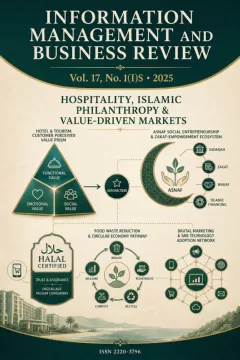 Vol. 17 No. 1(I)S (2025)
Hospitality, Islamic Philanthropy & Value-Driven Markets
View issue contents
Published
Submissions
Have research to publish? Information Management and Business Review welcomes submissions.
Make a Submission