Abstract
The increasing living costs have put a strain on people's ability to afford necessities like housing, transportation, education, and healthcare, which affects the quality of life in many countries. These factors have led to a rapidly growing trend of digital freelancing activities that utilize crowdsourcing technology to provide people with opportunities to earn additional income. However, a comprehensive understanding of the digital crowdsourcing landscape is hampered by the lack of studies examining it through a geographical lens, freelancer performance metrics, skillsets, and platform information. Therefore, this study addresses this issue by scraping data from various crowdsourcing platforms to analyze digital freelancing trends, particularly in Malaysia. Using descriptive analytics and visualization techniques, this study has revealed insights into the geographical distribution of Malaysian freelancers, freelancer skillsets in demand, platform preferences among freelancers, and factors influencing freelancer performance. The findings highlight the growing economic significance of digital freelancing and the role of crowdsourcing platforms in shaping the industry. Key information gaps were identified, including limited insights into freelancer demographics and performance metrics. These findings can empower individuals, inform stakeholders, and stimulate further research, ultimately contributing to the development of a more robust, inclusive, and thriving digital freelancing ecosystem in Malaysia.
Keywords
References
- Alauddin, F. D. A., Aman, A., Ghazali, M. F., & Daud, S. (2025). The influence of digital platforms on gig workers: A systematic literature review. Heliyon, 11(1), e41491. https://doi.org/10.1016/j.heliyon.2024.e41491
- Alvarez De La Vega, J. C., Cecchinato, M. E., Rooksby, J., & Newbold, J. (2023). Understanding Platform Mediated Work-Life: A Diary Study with Gig Economy Freelancers. Proceedings of the ACM on Human-Computer Interaction, 7(CSCW1), 1–32. https://doi.org/10.1145/3579539
- Blaising, A., & Dabbish, L. (2022). Managing the Transition to Online Freelance Platforms: Self-Directed Socialization. Proceedings of the ACM on Human-Computer Interaction, 6(November). https://doi.org/10.1145/3555201
- Fiers, F. (2024). Resilience in the gig economy: digital skills in online freelancing. Journal of Computer-Mediated Communication, 29(5). https://doi.org/10.1093/jcmc/zmae014
- Foong, E. (2020). Understanding and designing sociotechnical systems to support the impression management practices of online freelance workers. Proceedings of the International ACM SIGGROUP Conference on Supporting Group Work, 25–33. https://doi.org/10.1145/3323994.3371017
- Gussek, L., Grabbe, A., & Wiesche, M. (2023). Challenges of IT freelancers on digital labor platforms: A topic model approach. Electronic Markets, 33(1), 1–22. https://doi.org/10.1007/s12525-023-00675-y
- Hannák, A., Mislove, A., Wagner, C., Strohmaier, M., Garcia, D., & Wilson, C. (2017). Bias in Online Freelance Marketplaces: Evidence from TaskRabbit and Fiverr. Proceedings of the ACM Conference on Computer Supported Cooperative Work, CSCW, 1914–1933. https://doi.org/10.1145/2998181.2998327
- Harun, N., Ali, N. M., & Khan, N. L. M. A. (2020). An experimental measure of Malaysia’s gig workers using the labour force survey. Statistical Journal of the IAOS, 36(4), 969–977. https://doi.org/10.3233/SJI-200749
- Hulikal Muralidhar, S., Rintel, S., & Suri, S. (2022). Collaboration, Invisible Work, and the Costs of Macrotask Freelancing. Proceedings of the ACM on Human-Computer Interaction, 6(CSCW2). https://doi.org/10.1145/3555175
- Kim, P., Cheon, E. J., & Sawyer, S. (2023). Online Freelancing on Digital Labor Platforms: A Scoping Review. Proceedings of the ACM Conference on Computer Supported Cooperative Work, CSCW, 259–266. https://doi.org/10.1145/3584931.3607011
- Krishnamoorthy, R. A. L., Baharudin, A. S., & Karkonasasi, K. (2016). Intention to adopt and influence of online freelance portals among Malaysians. International Journal of Applied Engineering Research, 11(19), 10020–10026.
- Munoz, I., Dunn, M., Sawyer, S., & Michaels, E. (2022). Platform-mediated Markets, Online Freelance Workers and Deconstructed Identities. Proceedings of the ACM on Human-Computer Interaction, 6(November). https://doi.org/10.1145/3555092
- Munoz, I., Kim, P., O’Neil, C., Dunn, M., & Sawyer, S. (2024). Platformization of Inequality: Gender and Race in Digital Labor Platforms. Proceedings of the ACM on Human-Computer Interaction, 8(CSCW1), 1–22. https://doi.org/10.1145/3637385
- Musvosve, R., Turpin, M., & Van Belle, J. P. (2023). Platform Economy Employment Opportunities for Youth in the Global South. 2023 9th International Conference on E-Democracy and E-Government, ICEDEG 2023. https://doi.org/10.1109/ICEDEG58167.2023.10122096
- Olorundare, J. K., Olowe, A., & Olorundare, A. O. (2022). Digital transformation in Nigeria: The prospects and challenges of the gig economy. Proceedings of the 2022 IEEE Nigeria 4th International Conference on Disruptive Technologies for Sustainable Development, NIGERCON 2022, 1–5. https://doi.org/10.1109/NIGERCON54645.2022.9803148
- Pallam, B., & Gore, M. M. (2019). FAST: Freelancing avenues of state-of-the-art technologies. ACM International Conference Proceeding Series, 43–47. https://doi.org/10.1145/3317614.3317629
- Piyumidu, K. K. D., & Withaanarachchi, A. (2024). Subjective well-being of online freelancers in the digital gig economy: A study of Sri Lanka. Proceedings - International Research Conference on Smart Computing and Systems Engineering, SCSE 2024. https://doi.org/10.1109/SCSE61872.2024.10550901
- Pokhrel, S. (2024). Gig Economy in Malaysia: Current, Present and Future Nurul. ????, 15(1), 37–48.
- Prakasha, G. S., Shruti, J., Jestin, J., Mathai, S., & Thirumalesha, S. (2023). Effect of social influence on the saving behaviour of freelancing undergraduate students, mediated by financial literacy and self-control. Kontakt, 25(4), 298–306. https://doi.org/10.32725/kont.2023.042
- Rahim, A. F. A., Yaacob, N. A., Noor, R. M., Najid, N. A., & Zulkifli, N. (2021). Strengthening the Gig Economy: Future of Digital Labor Workforce Platform Post-COVID-19. GADING (Online) Journal for Social Sciences, 24(04), 17–26.
- Stephany, F., Kässi, O., Rani, U., & Lehdonvirta, V. (2021). Online Labour Index 2020: New ways to measure the world’s remote freelancing market. Big Data and Society, 8(2), 1–7. https://doi.org/10.1177/20539517211043240
- Syarfina Abu Bakar, A., & Hafizah Hassan, N. (2024). Awareness of the Gig Economy in Malaysia: A Study At International University of Malaya-Wales. KnE Engineering, 2024, 455–461. https://doi.org/10.18502/keg.v6i1.15416
Downloads
No downloads have been recorded for this article yet. Figures appear here once readers begin downloading the full text.
How to Cite
Share this article
License
Copyright (c) 2025 Asmahani Mahdi, Mohd Norhisham Razali, Rozita Hanapi, Khairul Imran Zulkefly, Angie Edward Daung (Author)

This work is licensed under a Creative Commons Attribution 4.0 International License.
Author (s) should affirm that the material has not been published previously. It has not been submitted and it is not under consideration by any other journal. At the same time author (s) need to execute a publication permission agreement to assume the responsibility of the submitted content and any omissions and errors therein. After submission of revised paper in the light of suggestions of the reviewers, the editorial team edits and formats manuscripts to bring uniformity and standardization in published material.
This work will be licensed under Creative Commons Attribution 4.0 International (CC BY 4.0) and under condition of the license, users are free to read, copy, remix, transform, redistribute, download, print, search or link to the full texts of articles and even build upon their work as long as they credit the author for the original work. Moreover, as per journal policy author (s) hold and retain copyrights without any restrictions.
Keywords
Section
Published in
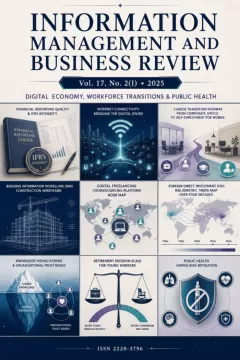 Vol. 17 No. 2(I) (2025)
Digital Economy, Workforce Transitions & Public Health
View issue contents
Published
Submissions
Have research to publish? Information Management and Business Review welcomes submissions.
Make a Submission