Abstract
This bibliometric analysis explored the research landscape of Foreign Direct Investment (FDI) in Malaysia from 1984 to 2024. By systematically reviewing 480 scholarly articles, this study identified the evolution of research themes, key contributors, and the significant impact of seminal works in the field. The findings highlight the strong focus on the economic impact of FDI, its role in environmental sustainability, and the influence of global economic changes on FDI flows into Malaysia. The analysis further elucidates the pivotal role of Malaysian institutions and scholars in shaping the FDI discourse. Emerging research trends indicate a growing interest in the interplay between FDI and Malaysia’s digital economy, labor markets, and regional economic integration within ASEAN. This study maps the historical and current academic focus on FDI in Malaysia. It outlines future research directions that could assist policymakers and practitioners in leveraging FDI for sustainable and inclusive economic development.
Keywords
- Foreign Direct Investment Search this journal for Foreign Direct Investment (opens in a new tab)
- Malaysia Search this journal for Malaysia (opens in a new tab)
- Bibliometric Analysis Search this journal for Bibliometric Analysis (opens in a new tab)
- Systematic Review Search this journal for Systematic Review (opens in a new tab)
- Harzing's Publish or Perish Search this journal for Harzing's Publish or Perish (opens in a new tab)
- VOSviewer Search this journal for VOSviewer (opens in a new tab)
References
- Ali, H., Er, A. C., Ahmad, A. R., Lyndon, N., & Ahmad, S. (2013). An analysis of the impact of foreign investment on regional disparities: A case of Malaysia. Asian Social Science, 9(14), 7-17.
- Chowdhury, A., & Mavrotas, G. (2006). FDI and growth: what causes what? The World Economy, 29(1), 9-19. https://doi.org/10.1111/j.1467-9701.2006.00755.x
- Contreras, O., Bendix, J., & Smith, B. (2022). Global Opportunity Index 2022: Focus on Emerging Southeast Asia. Milken Institute. https://milkeninstitute.org/sites/default/files/2022-01/global%20opp%20indexFINAL.pdf
- Hsiao, F. S., & Hsiao, M. W. (2006). FDI, exports, and GDP in East and Southeast Asia—Panel data versus time-series causality analyses. Journal of Asian Economics, 17(6), 1082-1106. https://doi.org/10.1016/j.asieco.2006.09.011
- Igweh, F. K., & Chukwuka, E. J. (2024). Strategic impact of knowledge entrepreneurship on foreign direct investment in Nigeria. World Journal of Advanced Research and Reviews, 21(1), 1699-1717. https://doi.org/10.30574/wjarr.2024.21.1.0239
- Kam, A. J. (2024). Navigating the US–China Decoupling: Malaysia's Response to the US–China Trade War. Asian Economic Papers, 23(2), 144-173. https://doi.org/10.1162/asep_a_00899
- Keita, K., Razak, A. B. A., & Abdullah, N. A. (2023). A Regulatory Framework on Foreign Direct Investment as a Factor in Determining the Economic Growth in Malaysia Post-COVID-19 Pandemic. International Journal of Law and Society, 2(3), 206-225. https://doi.org/10.59683/ijls.v2i3.60
- Lau, L., Choong, C., & Eng, Y. (2014). Investigation of the environmental Kuznets curve for carbon emissions in Malaysia: do foreign direct investment and trade matter? Energy Policy, 68, 490-497. https://doi.org/10.1016/j.enpol.2014.01.002
- Lim, G., & Kam, A. J. (2024). Chinese Investment in Malaysia:(De) Industrialization amidst Greater Financial and Trade Connectivity. The European Journal of Development Research, 36, 571-600. https://doi.org/10.1057/s41287-024-00645-w
- Pagavathi, K., & Rajkumar, P. (2019). K. The Progress and Achievement of Top Five Services Sectors through Foreign Direct Investments in India. International Journal of Recent Technology and Engineering, 8(2S10), 187-194. 10.35940/ijrte.B1032.0982S1019
- Perkins, D. H., Rasiah, R., & Woo, W. (2022). Explaining Malaysia’s past economic growth. In Malaysia’s Leap Into the Future. Dynamics of Asian Development. Springer, Singapore.
- Pham, M. H., Pham, A. D., & Dang, C. V. P. (2023). Determinants of FDI inflows: Aggregate versus country-specific evidence from ASEAN-6. The Economics and Finance Letters, 10(1), 111-121.
- Rasit, N., Singkong, F., & Aralas, S. I. (2019). Tourism and foreign direct investment: an analysis for ASEAN countries. Malaysian Journal of Business and Economics, 6(2), 283. https://doi.org/10.51200/mjbe.v0i0.2217
- Rogmans, T., & Ebbers, H. (2013). The determinants of foreign direct investment in the Middle East and North Africa region. International Journal of Emerging Markets, 8(3), 240-257. https://doi.org/10.1108/17468801311330310
- Sauvant, K. P., & Mallampally, P. (2015). Policy options for promoting foreign direct investment in the least developed countries. Transnational Corporations Review, 7(3), 237-268. https://doi.org/10.5148/tncr.2015.7301
- Solomon, C., Islam, M. A., & Bakar, R. (2015). Attracting foreign direct investment: The case of Malaysia. International Business Management, 9(4), 349-357.
- Tang, C. F., & Tan, B. W. (2014). The linkages among energy consumption, economic growth, relative price, foreign direct investment, and financial development in Malaysia. Quality & Quantity, 48, 781-797. https://doi.org/10.1007/s11135-012-9802-4
- Zhang, M., & Yang, R. (2022). FDI and spillovers: New evidence from Malaysia’s manufacturing sector. Review of Development Economics, 26(2), 847-877. https://doi.org/10.1111/rode.12857
- Zhu, H., Duan, L., Guo, Y., & Yu, K. (2016). The effects of FDI, economic growth and energy consumption on carbon emissions in ASEAN-5: evidence from panel quantile regression. Economic Modelling, 58, 237-248. https://doi.org/10.1016/j.econmod.2016.05.003
Downloads
No downloads have been recorded for this article yet. Figures appear here once readers begin downloading the full text.
How to Cite
Share this article
License
Copyright (c) 2025 Hafizah Hammad Ahmad Khan, Rosmaiza Abdul Ghani, Muhammad Hanif Othman, Handri Handri, Azib Azib (Author)

This work is licensed under a Creative Commons Attribution 4.0 International License.
Author (s) should affirm that the material has not been published previously. It has not been submitted and it is not under consideration by any other journal. At the same time author (s) need to execute a publication permission agreement to assume the responsibility of the submitted content and any omissions and errors therein. After submission of revised paper in the light of suggestions of the reviewers, the editorial team edits and formats manuscripts to bring uniformity and standardization in published material.
This work will be licensed under Creative Commons Attribution 4.0 International (CC BY 4.0) and under condition of the license, users are free to read, copy, remix, transform, redistribute, download, print, search or link to the full texts of articles and even build upon their work as long as they credit the author for the original work. Moreover, as per journal policy author (s) hold and retain copyrights without any restrictions.
Keywords
- Foreign Direct Investment Search this journal for Foreign Direct Investment (opens in a new tab)
- Malaysia Search this journal for Malaysia (opens in a new tab)
- Bibliometric Analysis Search this journal for Bibliometric Analysis (opens in a new tab)
- Systematic Review Search this journal for Systematic Review (opens in a new tab)
- Harzing's Publish or Perish Search this journal for Harzing's Publish or Perish (opens in a new tab)
- VOSviewer Search this journal for VOSviewer (opens in a new tab)
Section
Published in
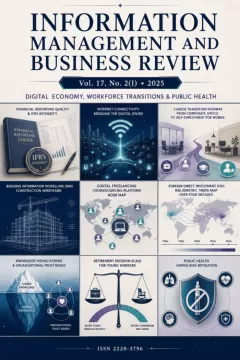 Vol. 17 No. 2(I) (2025)
Digital Economy, Workforce Transitions & Public Health
View issue contents
Published
Submissions
Have research to publish? Information Management and Business Review welcomes submissions.
Make a Submission