Abstract
Workforces are strengthened to share their knowledge to increase inspiration and improvement. However, people may hide their knowledge from view to pursue personal benefits. Knowledge hiding behavior has been identified as an important challenge in organizational settings, collaboration, innovation, and reducing performance. This paper contributes to a comprehensive review of the literature on hidden knowledge in the workplace, focusing on antecedents and consequences by conducting a comprehensive literature review. The study involves reviewing research articles gathered from the university's electronic databases of Scopus and Science Direct. By assessing findings from previous studies, the predictors and implications of knowledge-hiding behavior will be identified. A narrow focus on specific contexts, an overemphasis on individual factors, and a neglect of external influence. By indicating the antecedents, the importance of understanding the motivation behind knowledge hiding and its effect can be highlighted for future research direction.
Keywords
References
- Avença, I., Domingues, L., & Carvalho, H. (2024). Do the project manager's soft skills foster knowledge sharing? Project Leadership and Society, 5, Article 100139. https://doi.org/10.1016/j.plas.2024.100139
- Bashir, M., Naqshbandi, M.?M., & Pradhan, S. (2025). How ‘work from anywhere’ impacts knowledge hiding, distrust, and socialization: The role of knowledge infrastructure. Technological Forecasting and Social Change, 212, Article 123977. https://doi.org/10.1016/j.techfore.2025.123977 pmc.ncbi.nlm.nih.gov+9
- Bai, L. (2020). A Review of Knowledge Hiding Behavior [Review of A Review of Knowledge Hiding Behavior]. Proceedings of the 2021 6th International Conference on Social Sciences and Economic Development (ICSSED 2021). https://doi.org/10.2991/assehr.k.200331.085
- Chen, Z., & Tang, Z. (2024). The effect of caring ethical climate on employees’ knowledge-hiding behavior: evidence from Chinese construction firms. In Humanities and Social Sciences Communications (Vol. 11, Issue 1). Palgrave Macmillan. https://doi.org/10.1057/s41599-024-02796-x
- Chin, T., Shi, Y., Arrigo, E., & Palladino, R.. Paradoxical. (2024). Paradoxical behavior toward innovation: Knowledge sharing, knowledge hiding, and career sustainability interactions. European Management Journal. https://doi.org/10.1016/j.emj.2024.06.005
- Connelly, C. E., Zweig, D., Webster, J., & Trougakos, J. P. (2012). Knowledge Hiding in Organizations. Journal of Organizational Behavior, 33(1), 64-88.
- Das, A.K., Yi, L. and Uddin, M.A. (2018). Knowledge withholding in sharing knowledge within an organization: the shadowy impediment in spreading innovation. International Journal Knowledge Management Studies, 9(4), 381-402.
- El-Kassar, A.-N., Dagher, G. K., Lythreatis, S., & Azakir, M. (2021). Antecedents and consequences of knowledge hiding: The roles of HR practices, organizational support for creativity, creativity, innovative work behavior, and task performance. In Journal of Business Research (Vol. 140, p. 1). Elsevier BV. https://doi.org/10.1016/j.jbusres.2021.11.079
- Eni, L. N., Saha, S., Hossain, M. A., & Rahaman, M. M. (2025). Investigating the linkage between knowledge sharing attitude, self-efficacy, and behavior in the Bangladeshi information technology sector: Knowledge sharing intention as a mediator. Helion. https://doi.org/10.1016/j.heliyon.2024.e41399
- Guang, X., Huang, Y., & Huang, S. (2023). Informational justice and employee knowledge hiding behaviors: Mediation of organizational identification and moderation of justice sensitivity. In Heliyon (Vol. 9, Issue 4). Elsevier BV. https://doi.org/10.1016/j.heliyon.2023.e14697
- He, P., Wang, J., Zhou, H., Zhang, C., Liu, Q., & Xie, X. (2022). Workplace friendship, employee well-being and knowledge hiding: The moderating role of the perception of Chaxu climate. In Frontiers in Psychology (Vol. 13). Frontiers Media. https://doi.org/10.3389/fpsyg.2022.1036579
- Karim, D. N. (2022). Linking dark triad traits, psychological entitlement, and knowledge hiding behavior. Interactive Learning Environments, 31, 1344–1356. https://doi.org/10.1080/10494820.2022.2163522
- Kucharska, W., & Rebelo, T. (2022). Knowledge sharing and knowledge hiding in light of the mistakes acceptance component of learning culture-knowledge culture and human capital implications.
- Li, W.-Z., Chen, J.-F., Feng, X., & Yan, Q. (2022). Research on Influencing Factors of Knowledge Hiding Behavior in Socialized Q&A Communities: Taking Zhihu as an Example.
- Lin, M., Zhang, X., Ng, B. C. S., & Zhong, L. (2020). To Empower or Not to Empower? Multilevel Effects of Empowering Leadership on Knowledge Hiding. In International Journal of Hospitality Management (Vol. 89, p. 102540). Elsevier BV.
- Lu, L., Lin, X., & Leung, K. (2012). Goal orientation and innovative performance: The mediating roles of knowledge sharing and perceived autonomy. Journal of Applied Social Psychology, 42(1), E180–E197. doi: 10.1111/j.1559-1816.2012.01018.x
- Makhmoor, B., M., M.N & Sudeepta, P.(2025). How ‘work from anywhere’ impacts knowledge hiding, distrust, and socialization. Technological Forecasting and Social Change. Applied Materials and Mechanics, 1-14.
- Michalová, T., Maršíková, K., Falát, L., & Madzík, P. (2024). Altruistic leadership and its role in reducing knowledge hiding: the mediating effects of team learning and knowledge culture. In Journal of Innovation & Knowledge, 9(4), 100592. Elsevier BV. https://doi.org/10.1016/j.jik.2024.100592
- Posey, C., Shoss, M., 2024. Employees as a source of security issues in times of change and stress: a longitudinal examination of employees’ security violations during the COVID-19 pandemic. J. Bus. Psychol. 39(5), 1027–1048.
- Rezwan, R. B., & Takahashi, Y. (2021). The Psychology behind Knowledge Hiding in an Organization. Administrative Sciences, 11(2), 57. https://doi.org/10.3390/admsci11020057
- Shen, Y., Lythreatis, S., Singh, S. K., & Cooke, F. L. (2024). A meta-analysis of knowledge hiding behavior in organizations: Antecedents, consequences, and boundary conditions. Journal of Business Research, 186, 114963). Elsevier BV. https://doi.org/10.1016/j.jbusres.2024.114963
- Siachou, E., Trichina, E., Papasolomou, I., & Sakka, G. (2021). Why do employees hide their knowledge and what are the consequences? A systematic literature review. Journal of Business Research, 135, 195. Elsevier BV. https://doi.org/10.1016/j.jbusres.2021.06.031
- Singh, S. K. (2019). Territoriality, task performance, and workplace deviance: Empirical evidence on the role of knowledge hiding. Journal of Business Research, 97, 10–19.
- Skerlavaj, M., Cerne, M., & Batistic, S. (2023). Knowledge hiding in organizations: Metaanalysis 10 years later. Economic and Business Review, 25(2), 79–102. doi: 10.15458/2335-4216.1319
- Wang, Y., & Wang, C. (2023). The dark side of knowledge transfer: A visual analysis using VOSviewer. E+M Ekonomie A Management, 26(2), 122–139. doi: 10.15240/tul/ 001/2023-2-008
- Wu, J., & Lebreton, J. M. (2011). Reconsidering the dispositional basis of counterproductive work behavior: The role of aberrant personality. Personnel Psychology, 64(3), 593–626
- Xi, C., Qu, X., 2024. The effects of knowledge hiding on new product creativity in informational fault lines. J. Knowl. Manag. 29 (1), 72–91.
Downloads
No downloads have been recorded for this article yet. Figures appear here once readers begin downloading the full text.
How to Cite
Share this article
License
Copyright (c) 2025 Erratul Shela Eshak, Norlida Zakirai Zakaria, Munirah Mohd Jidi, Masliza Mohd Razali, Wan Nor Syazana Wan Hashim (Author)

This work is licensed under a Creative Commons Attribution 4.0 International License.
Author (s) should affirm that the material has not been published previously. It has not been submitted and it is not under consideration by any other journal. At the same time author (s) need to execute a publication permission agreement to assume the responsibility of the submitted content and any omissions and errors therein. After submission of revised paper in the light of suggestions of the reviewers, the editorial team edits and formats manuscripts to bring uniformity and standardization in published material.
This work will be licensed under Creative Commons Attribution 4.0 International (CC BY 4.0) and under condition of the license, users are free to read, copy, remix, transform, redistribute, download, print, search or link to the full texts of articles and even build upon their work as long as they credit the author for the original work. Moreover, as per journal policy author (s) hold and retain copyrights without any restrictions.
Keywords
Section
Published in
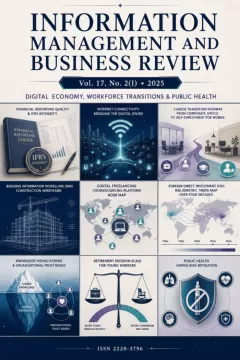 Vol. 17 No. 2(I) (2025)
Digital Economy, Workforce Transitions & Public Health
View issue contents
Published
Submissions
Have research to publish? Information Management and Business Review welcomes submissions.
Make a Submission