Abstract
When searching for quality childcare, the best childcare reviews can provide invaluable insights for parents in selecting childcare for their children. These reviews can highlight parents' experiences in using childcare and also shed light on the strengths and weaknesses of childcare centers. The study’s purpose was to determine the impact of customer reviews on perceived risk, with technology innovation as a mediator. The study used a quantitative approach in data collection and 385 questionnaires were distributed to working mothers across four zones in Peninsular Malaysia. The research instrument used was a questionnaire consisting of 15 questions for the variable CR (Customer Review), 5 questions for TI (Technology Innovation), and 6 questions for PR (Perceived Risk). The collected data were processed using Partial Least Squares Structural Equation Modelling (PLS-SEM). According to the analysis results, customer review was revealed to negatively and significantly affect perceived risk (β = -0.083, p = 0.030), but positively affect technology innovation (β = 0.419, p < 0.000). Also, technology innovation was revealed to have a significant mediating effect on customer review and perceived risk (β = -0.294, p = 0.000), which shows that customer review can be more effective in lowering perceived risk when integrated with technology innovation. Therefore, the contribution of technology innovation as a mediator can lower perceived risks in monitoring unregistered childcare centers. Future studies could explore other mediating and moderating variables, such as government regulation or parental experience with childcare centers.
Keywords
- Customer Review Search this journal for Customer Review (opens in a new tab)
- Technology Innovation Search this journal for Technology Innovation (opens in a new tab)
- Perceived Risk Search this journal for Perceived Risk (opens in a new tab)
- Childcare Services Search this journal for Childcare Services (opens in a new tab)
- PLS- SEM Search this journal for PLS- SEM (opens in a new tab)
References
- Ameen, N., Tarhini, A., Reppel, A., & Anand, A. (2021). Customer experiences in the age of artificial intelligence. Information & Management, 58(3), 103–138. https://doi.org/10.1016/j.im.2020.103414
- Almond, D., & Currie, J. (2011). Human capital development before age five. In D. Card & O. Ashenfelter (Eds.), Handbook of labor economics (Vol. 4, Part B, pp. 1315–1486). Elsevier.
- Asri, S., Mahmod, N. H., & Bahaudin, N. H. (2023, November 26). Lebih seorang didera setiap hari. Harian Metro. Retrieved from https://www.hmetro.com.my/utama/2023/11/1034179/lebih-seorang-didera-setiap-hari
- Carvalho, M., Rahim, R., & Tan, T. (2023, March 27). Over 300 child abuse cases at daycares, kindergartens in 2022, says Nancy Shukri. The Star. https://www.thestar.com.my/news/nation/2023/03/27/over-300-child-abuse-cases-at-daycares-kindergartens-in-2022-says-nancy-shukri
- Chatterjee, S., Chaudhuri, R., Vrontis, D., & Thrassou, A. (2020). The influence of online customer reviews on customers’ purchase intentions: A cross-cultural study from India and the UK. International Journal of Organizational Analysis. https://doi.org/10.1108/IJOA-02-2021-2627
- Cheung, C. M., Lee, M. K., & Rabjohn, N. (2008). The impact of electronic word-of-mouth: The adoption of online opinions in online customer communities. Internet Research, 18(3), 229–247. https://doi.org/10.1108/10662240810883290
- Chung, C., Moriuchi, E., Limbu, Y. B., & Ganesan, P. (2018). Attitudes toward star ratings: Generational differences among Indian consumers. Journal of Global Marketing, 31(2), 128–141. https://doi.org/10.1080/08911762.2017.1412553
- Dowling, G. R., & Staelin, R. (1994). A model of perceived risk and intended risk-handling activity. Journal of Consumer Research, 21(1), 119–134. Retrieved from http://www.jstor.org/stable/2489744
- Filieri, R. (2015). What makes online reviews helpful? A diagnosticity-adoption framework to explain informational and normative influences in e-WOM. Journal of Business Research, 68(6), 1261–1270. https://doi.org/10.1016/j.jbusres.2014.11.006
- Filieri, R., Acikgoz, F., Ndou, V., & Dwivedi, Y. (2020). Is TripAdvisor still relevant? The influence of review credibility, review usefulness, and ease of use on consumers’ continuance intention. International Journal of Contemporary Hospitality Management, 33(1), 199–223. https://doi.org/10.1108/ijchm-05-2020-0402
- Hair, J. F., Anderson, R., Tatham, R., & Black, W. (1998). Multivariate data analysis (5th ed.). Prentice Hall.
- Hair, J. F., Black, W. C., Babin, B. J., & Anderson, R. E. (2010). Multivariate data analysis (7th ed.). Prentice Hall.
- Hair, J. F., Hult, G. T. M., Ringle, C. M., & Sarstedt, M. (2017a). A primer on partial least squares structural equation modeling (PLS-SEM) (2nd ed.). Sage.
- Hair, J. F., Hult, G. T. M., Ringle, C. M., & Sarstedt, M. (2019). A primer on partial least squares structural equation modeling (PLS-SEM) (2nd ed.). Sage.
- Hair, J. F., Sarstedt, M., Ringle, C. M., & Mena, J. A. (2012). An assessment of the use of partial least squares structural equation modeling in marketing research. Journal of the Academy of Marketing Science, 40(3), 414–433. https://doi.org/10.1007/s11747-011-0261-6
- Henseler, J., Ringle, C. M., & Sinkovics, R. R. (2009). The use of partial least squares path modelling in international marketing. Advances in International Marketing, 20(May 2014), 277–319. https://doi.org/10.1108/S1474-7979 (2009)0000020014
- Herbst, C. M., Desouza, K. C., Al-Ashri, S., Kandala, S. S., Khullar, M., & Bajaj, V. (2020). What do parents value in a child care provider? Evidence from Yelp consumer reviews. Early Childhood Research Quarterly, 51, 288–306.
- Herbst, M., Fajkowska, M., & W?odarczyk, A. Z. (2018). Perceived risks and benefits in online shopping: A comparative study. Journal of Consumer Behavior, 17(4), 302–318. https://doi.org/10.1002/cb.1714
- Kline, R. B. (2011). Principles and practice of structural equation modeling (3rd ed.). Guilford Press.
- Lee, K. C., Chang, I. H., & Wu, T. J. (2022). The moderating role of perceived interactivity in the relationship between online customer experience and behavioral intentions to use parenting apps for Taiwanese preschool parents. SAGE Open. https://doi.org/10.1177/21582440221082136
- Mohd Iskandar, I. (2023, June 9). Jumlah TASKA tak berdaftar menjadi kebimbangan. Berita Harian. https://www.bharian.com.my/berita/nasional/2023/06/1112276/jumlah-taska-tak-berdaftar-amat-membimbangkan-nancy
- Mohd Shahidan, S. & Rozilawati, M. (2021, October 9). Child abuse in Malaysia is following an alarming trend. BebasNews. https://bebasnews.my/2021/09/10/child-abuse-in-malaysia-is-following-an-alarming-trend/
- Pee, L. G. (2016). Customer participation and perceived risk: A study of mobile applications. International Journal of Information Management, 36(6), 716–724. https://doi.org/10.1016/j.ijinfomgt.2016.04.010
- Reinartz, W. J., Haenlein, M., & Henseler, J. (2009). An empirical comparison of the efficacy of covariance-based and variance-based SEM. International Journal of Research in Marketing, 26(4), 332-344. https://doi.org/10.1016/j.ijresmar.2009.08.001
- Sarstedt, M., Ringle, C. M., & Hair, J. F. (2017). Partial least squares structural equation modeling. In C. Homburg, M. Klarmann, & A. Vomberg (Eds.), Handbook of Market Research. Springer.
- Singh, H. S. S. (2018, July 17). Unregistered childcare centres are a concern. Twentytwo13. https://twentytwo13.my/unregistered-childcare-centres-a-concern/
- Sohaib, O., & Kang, K. (2015). Individual level culture influence on online consumer iTrust aspects towards purchase intention across cultures: A S-O-R model. International Journal of Electronic Business, 12(2), 142. doi:10.1 504/ijeb.2015.069104
- Sulaiman, Z., & Hussain, Y. (2023). Parents’ satisfaction with the quality of the management of childcare centres. International Journal of Entrepreneurship Business and Technology (IJEBT), 1(2), 26-40.
- Xiao, L., & Li, Y. (2019). Examining the Effect of Positive Online Reviews on Consumers’ Decision Making. Journal of Global Information Management, 27(3), 159–181. doi: 10.4018/jgim.2019070109
- Yadav, M. S., De Valck, K., Hennig-Thurau, T., Hoffman, D. L., & Spann, M. (2020). Social commerce: A contingency framework for assessing marketing potential. Journal of Interactive Marketing, 47, 43–54. https://doi.org/10.1016/j.intmar.2018.04.001
- Yang, J., Sarathy, R., & Lee, J. (2016). The effect of product review balance and volume on online Shoppers’ risk perception and purchase intention. Decision Support Systems, 89, 66–76. doi: 10.1016/j.dss.2016.06.009
- Zaid, Z., Amin, S. M., & Noor, A. H. M. (2020). Positioning childcare matters among working mothers. Journal of Contemporary Social Science Research, 4(1).
- Zellman, G., & Perlman, M. (2008). Child care quality rating and improvement systems in five pioneer states: Implementation issues and lessons learned (Report No. MG-795-AECF/SPF/UWA). RAND Corporation. Retrieved from https://www.rand.org/pubs/monographs/MG795.html
Downloads
No downloads have been recorded for this article yet. Figures appear here once readers begin downloading the full text.
How to Cite
Share this article
License
Copyright (c) 2025 Nur Farah Ain Abd Shukor, Norlaile Salleh Hudin, Nur Shahira Ahmad, Wan Salmuni Wan Mustaffa (Author)

This work is licensed under a Creative Commons Attribution 4.0 International License.
Author (s) should affirm that the material has not been published previously. It has not been submitted and it is not under consideration by any other journal. At the same time author (s) need to execute a publication permission agreement to assume the responsibility of the submitted content and any omissions and errors therein. After submission of revised paper in the light of suggestions of the reviewers, the editorial team edits and formats manuscripts to bring uniformity and standardization in published material.
This work will be licensed under Creative Commons Attribution 4.0 International (CC BY 4.0) and under condition of the license, users are free to read, copy, remix, transform, redistribute, download, print, search or link to the full texts of articles and even build upon their work as long as they credit the author for the original work. Moreover, as per journal policy author (s) hold and retain copyrights without any restrictions.
Keywords
- Customer Review Search this journal for Customer Review (opens in a new tab)
- Technology Innovation Search this journal for Technology Innovation (opens in a new tab)
- Perceived Risk Search this journal for Perceived Risk (opens in a new tab)
- Childcare Services Search this journal for Childcare Services (opens in a new tab)
- PLS- SEM Search this journal for PLS- SEM (opens in a new tab)
Section
Published in
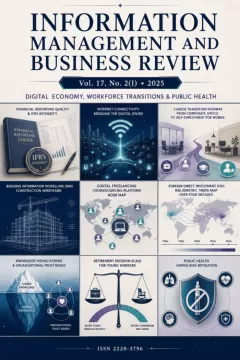 Vol. 17 No. 2(I) (2025)
Digital Economy, Workforce Transitions & Public Health
View issue contents
Published
Submissions
Have research to publish? Information Management and Business Review welcomes submissions.
Make a Submission