Abstract
Malaysia’s manufacturing sector faces mounting pressure to integrate sustainable practices amid rising environmental concerns, resource constraints, and regulatory demands. Despite government initiatives, many firms struggle to align profitability with environmental and social responsibility, hindered by limited resources, uneven managerial commitment, and varying levels of internal environmental orientation. This study examines the key drivers of sustainable manufacturing in this context, focusing on the influence of financial resources, managerial support, and internal environmental orientation on sustainability performance. Grounded in the Natural Resource-Based View (NRBV) theory, it investigates how these determinants shape environmental, social, and economic outcomes. A quantitative approach was adopted, using a cross-sectional survey of senior executives from medium and large manufacturing firms, yielding 330 valid responses. Partial Least Squares Structural Equation Modelling (PLS-SEM) was applied to test the proposed relationships. The findings reveal that financial resources and internal environmental orientation significantly enhance sustainability performance, whereas managerial support does not show a significant effect. This suggests that while resource allocation and a sustainability-oriented culture are critical enablers, the practical impact of managerial support may be constrained by organizational or cultural barriers. The study extends NRBV theory to the Malaysian manufacturing context, providing empirical evidence on strategic drivers of sustainability and highlighting the need for targeted investments and internal capability development.
Keywords
References
- Akhtar, F., Huo, B., & Wang, Q. (2023). Embracing green supply chain collaboration through technologies: the bridging role of advanced manufacturing technology. Journal of Business & Industrial Marketing, 38(12), 2626-2642. https://doi.10.1108/JBIM-01-2022-0051
- Aldaas, R., Mohamed, R., Ali, M. H., & Ismail, N. A. (2022). Green supply chain management and SMEs environmental performance: green HRM practices as antecedent from service sector of emerging economy. In International Journal of Emergency Services, 11, (3), 422. https://doi.org/10.1108/IJES-12-2021-0085
- Alkaf, A. R., Yusliza, M. Y., Ehido, A. J., Saputra, J., & Muhammad, Z. (2023). Top management support, green intellectual capital and green HRM: a proposed framework for sustainability. Journal of Environmental Management & Tourism, 14(5), 2308-2318. https://doi.org/10.14505/jemt.v14.5(69).12
- Andersén, J. (2021). A relational natural-resource-based view on product innovation: The influence of green product innovation and green suppliers on differentiation advantage in small manufacturing firms. In Technovation, 104, 102254. https://doi.org/10.1016/j.technovation.2021.102254
- Ardakani Andalib, D., Soltanmohammadi, A., & Seuring, S. [2023]. The impact of customer and supplier collaboration on green supply chain performance. Benchmarking: An International Journal, 30[7], 2248-2274. https://doi.org/10.1108/bij-12-2020-0655
- Asiedu, A., Frimpong, S. E., Opoku, R. K., & Agyapong, G. K. Q. [2023]. Sustainable procurement practices and sustainable performance: evidence from small and medium-sized manufacturing enterprises in an emerging economy. In International Journal of Procurement Management l [1], 1. https://doi.org/10.1504/IJPM.2024.137794
- Asif, M. S., Lau, H., Nakandala, D., Fan, Y., & Hurriyet, H. (2020). Adoption of green supply chain management practices through collaboration approach in developing countries–From literature review to conceptual framework. Journal of Cleaner Production, 276, 124191. https://doi.org/10.1016/j.jclepro.2020.124191
- Awan, U., & Khan, S. A. R. (2021). Mediating role of sustainable leadership in buyer-supplier relationships: an supply chain performance: an empirical study. LogForum, 17(1) https://doi.org/10.17270/J.LOG.2021.546
- Bouchmel, I., Ftiti, Z., Louhich, W., & Omri, A. [2024]. Financing sources, green investment, and environmental performance: Cross-country evidence. In Journal of Environmental Management, 353, 120230. https://doi.org/10.1016/j.jenvman.2024.120230
- Choudhary, K., & Sangwan, K. S. (2019). Adoption of green practices throughout the supply chain: an empirical investigation. Benchmarking: An International Journal. https://doi.org/10.1108/BIJ-09-2018-0293
- De Giovanni, P., & Vinzi, V. E. [(2012].). Covariance versus component-based estimations of performance in green supply chain management. International Journal of Production Economics, 135[2], 907-916. https://doi.org/10.1016/j.ijpe.2011.11.001
- Department of Statistics Malaysia (DOSM). (2024, July 3). Gross Domestic Product (GDP) by State, 2023 [Press release]. Putrajaya: DOSM. (Manufacturing sector accounted for ~24% of GDP) – retrieved from MIDA website: https://www.mida.gov.my/mida-news/services-manufacturing-made-up-82-6-per-cent-of-economy-in-2023/
- Department of Statistics Malaysia. (2025). Special Report on Impact of Floods in Malaysia, 2024. [ https://www.dosm.gov.my/uploads/release-content/file_20250319122430.pdf]
- Dubey, R., Gunasekaran, A. & Ali, S. (2015). Exploring the relationship between leadership, operational practices, institutional pressures, and environmental performance: a framework for green supply chain. International Journal of Production Economics, 160, 120-132. https://doi.org/10.1016/j.ijpe.2014.10.001
- Federation of Malaysian Manufacturers. (2018). FMM Directory of Malaysian Industries 2018.
- Gao, S., Lim, M. K., Qiao, R., Shen, C., Li, C., & Xia, L. (2021). Identifying critical failure factors of green supply chain management in China’s SMEs with a hierarchical cause–effect model. In Environment, Development and Sustainability, 24 (4), 5641. https://doi.org/10.1007/s10668-021-01675-8
- Gonçalves, H., Magalhães, V. S. M., Ferreira, L. M. D. F., & Arantes, A. (2024). Overcoming barriers to sustainable supply chain management in small and medium-sized enterprises: A multi-criteria decision-making approach. Sustainability, 16(2), 506. https://doi.org/10.3390/su16020506.
- Govindan, K., & Jha, P. C. (2024). Modelling of barriers in implementing sustainable manufacturer-supplier collaboration and coping strategies. Journal of Cleaner Production, 434, 139635. https://doi.org/10.3390/su16020506
- Goyal, A., Vaish, D. C., Agrawal, R., Choudhary, S., & Nayak, R. (2022). Sustainable manufacturing through systematic reduction in cycle time. Sustainability, 14(24), 16473. https://doi.org/10.3390/su142416473
- Hair Jr, J. F., Howard, M. C., & Nitzl, C. (2020). Assessing measurement model quality in PLS-SEM using confirmatory composite analysis. Journal of business research, 109, 101-110. https://doi.org/10.1016/j.jbusres.2019.11.069
- Hair, J., Hult, T., Ringle, C., & Sarstedt, M. (2014). A Primer on Partial Least Squares Structural Equation Modeling (PLS-SEM). Thousand Oaks, CA: Sage Publications, Inc. ISBN: 978-1-5443-9633-0
- Hall, J., & Sammons, P. (2013). Mediation, moderation & interaction. Handbook of quantitative methods for educational research, 267-286. ISBN: 978-94-6209-404-8
- Hanumsari, F. A., Liestyana, Y., & Utami, Y. (2021). The effect of green supply chain management practices on sustainability performance. Jurnal REKOMEN (Riset Ekonomi Manajemen), 5(1), 1-16. https://doi.org/ 10.37058/rekomen.v5i2.1481
- Hart, S. L. (1995). A natural-resource-based view of the firm. Academy of Management Review, 20(4), 986–1014. https://doi.org/10.5465/amr.1995.9512280033
- Harun, S., & Senawi, A. R. (2024). An Integrated Circular Supply Chain Framework to Enhance Malaysian Business Performance. Information Management and Business Review, 16(3), 130-136.
- Henseler, J., Ringle, C. M., & Sarstedt, M. (2015). A new criterion for assessing discriminant validity in variance-based structural equation modeling. Journal of the academy of marketing science, 43, 115-135. https://doi.org/ 10.1007/s11747-014-0460-y
- Henseler, J., Ringle, C. M., & Sinkovics, R. R. (2009). The use of partial least squares path modeling in international marketing. In New challenges to international marketing (Vol. 20, pp. 277-319). Emerald Group Publishing Limited. https://doi.org/ 10.1108/S1474-7979(2009)0000020016
- Huma, Sehrish, Waqar Ahmed, and Sohaib Uz Zaman. "The impact of supply chain quality integration on a firm’s sustainable performance." The TQM Journal 36.2 (2023): 385-404. https://doi.org/ 10.1108/TQM-10-2022-0310
- IFRC GO. (2023, October). Emergency - MYS: Other - 2023-10 - Haze # 1. Retrieved from https://go.ifrc.org/emergencies/6667/details
- Kannan, D., Gholipour, P., & Bai, C. (2023). Smart manufacturing as a strategic tool to mitigate sustainable manufacturing challenges: A case approach. Annals of Operations Research, 331(1), 543. https://doi.org/ 10.1007/s10479-023-05561-1
- Krejcie, R.V., & Morgan, D.W. (1970). Determining Sample Size for Research Activities. Educational and Psychological Measurement, 30, 607-610. https://doi.org/10.1177/001316447003000308
- Leppelt, Thomas, Kai Foerstl, Carsten Reuter, and Evi Hartmann. (2013). Sustainability management beyond organizational boundaries–sustainable supplier relationship management in the chemical industry." Journal of Cleaner Production 56. 94-102. https://doi.org/ 10.1016/j.jclepro.2012.03.013
- Li, Z., Rasool, S., Cavus, M. F., & Shahid, W. (2024). Sustaining the future: How green capabilities and digitalization drive sustainability in modern business. Heliyon, 10(1). https://doi.org/ 10.1016/j.heliyon.2023.e23030
- Lin, C. Y., Alam, S. S., Ho, Y. H., Al-Shaikh, M. E., & Sultan, P. (2020). Adoption of green supply chain management among SMEs in Malaysia. Sustainability, 12(16), 6454. https://doi.org/10.3390/su12166454
- Malimi, K. (2017). The Influence of Capital Adequacy, Profitability, and Loan Growth on Non-Performing Loans a Case of Tanzanian Banking Sector. International Journal of Economics, Business and Management Studies. 4(1), 38-49. https://doi.org/10.20448/807.4.1.38.49
- Ministry of Investment, Trade and Industry (MITI). (2023a). Circular Economy Policy Framework for the Manufacturing Sector in Malaysia. Putrajaya: MITI. Retrieved from https://www.miti.gov.my/miti/resources/CIRCULAR%20ECONOMY%20POLICY%20FRAMEWORK.pdf
- Ministry of Investment, Trade and Industry (MITI). (2023b, January 18). Trade Performance for Year 2022 and December 2022 [Media statement]. Retrieved from https://www.miti.gov.my/miti/resources/Trade_Performance_Press_Release_December_2022.pdf
- Nangpiire, C., Gyebi, F. O., & Nasse, T. (2024). Sustainable procurement practices and organisational performance of small and medium enterprises in Ghana. International Journal of Economics and Financial Issues, 14(1), 95-106. https://doi.org/10.32479/ijefi.15570
- Nath, S. D., Eweje, G., & Barua, S. [2023]. Drivers and barriers for implementing social sustainability in supply chains: A qualitative investigation of a developing country’s multi-tier suppliers. International Journal of Logistics Management, 35[4], 1332. https://doi.org/10.1108/IJLM-10-2022-0402
- Nazir, S., Zhaolei, L., Mehmood, S., & Nazir, Z. (2024). Impact of green supply chain management practices on the environmental performance of manufacturing firms considering institutional pressure as a moderator. Sustainability, 16(6), 2278. https://doi.org/10.3390/su16062278
- Rahman, N. A. A., & Rahim, Z. A. (2024). Exploring the Drivers, Challenges, and Opportunities of Supply Chain Technology Adoption for Small and Medium Enterprises (SMEs) in Malaysia. Information Management and Business Review, 16(3), 125-134. https://doi.org/10.22610/imbr.v16i3S(I)a.4126
- Ramli, E. M. M., Islam, R., Abdul Hadi, N., & Ismail, N. I. (2025). Greening the supply chain: Antecedents and ownership structure driving triple bottom line performance in Malaysian manufacturing firms. Logforum, 21(2), 11. https://doi.org/10.17270/J.LOG.2025.805
- Ramli, E., Zainudin, D., & Islam, R. (2022). Explore the research trends of green supply chain in the manufacturing industry: A bibliometric analysis. Operations and Supply Chain Management: An International Journal, 15(3), 345–358. https://doi.org/10.31387/oscm0500355
- Rao, P. & Holt, D., (2005). Do green supply chains lead to competitiveness and economic performance? International Journal of Operations and Production Management, 25 (9), 898–916. https://doi.org/ 10.1108/01443570510613904
- Rasit, Z. A., Zakaria, M., Hashim, M., Ramli, A., & Mohamed, M. (2019). Green Supply Chain Management (GSCM) practices for sustainability performance: An empirical evidence of Malaysian SMEs. International Journal of Financial Research, 10(3), 371-379. https://doi.org/10.5430/ijfr.v10n3p371
- Rizki, A. F., & Augustine, Y. [2022]. Green supply chain management practices: Direct effects on sustainability performance. Technium Social Sciences Journal, 28, 389. https://doi.org/10.47577/tssj.v28i1.6033
- Saad, M. N., & Manshor, M. (2024). The Effects of Sustainable Development on the Sustainable Performance of Small and Medium Enterprises in Emerging Economies: From the Perspective of VUCA Approach. Information Management and Business Review, 16(3), 295-308.
- Saher, K., & Siddique, Q. (2023). The Impact of Corporate Social Responsibility (CSR) and Green Investments on Sustainable Performance: The Mediating Role of Firm Financial Performance. J. Glob. Econ. Rev, 3, 59-73. https://doi.org/10.4103/0019-5154.182410
- Setia, M. S. (2016). Methodology series module 3: Cross-sectional studies. Indian Journal of Dermatology, 61(3), 261–264. | https://doi.org/10.4103/0019-5154.182410
- Shafie, N. I., Abd Rahman, N. H., Harun, R., Ismail, S., & Shafie, N. A. (2024). Consumer Green Products through the Lens of Bibliometrics: Trends analysis. Information Management and Business Review, 16(3), 514-524.
- Shaharudin, M. S., Ganesan, Y., Fernando, Y., & Haron, H. (2022). Green Technology Adoption in Malaysia: Where Are We Now? What Is Lacking? & What Should We Do Next. Journal of Information System and Technology Management, 7(27), 109-121. https://doi.org/ 10.35631/JISTM.727009
- Shahzad, M., Rehman, S. U., Zafar, A. U., & Masood, K. (2024). Sustainable sourcing for a sustainable future: the role of organizational motives and stakeholder pressure. Operations management research, 17(1), 75-90. https://doi.org/ 10.1007/s12063-023-00431-7
- Shmueli, G., Sarstedt, M., Hair, J. F., Cheah, J. H., Ting, H., Vaithilingam, S., & Ringle, C. M. (2019). Predictive model assessment in PLS-SEM: guidelines for using PLSpredict. European journal of marketing, 53(11), 2322-2347. https://doi.org/ 10.1108/EJM-10-2018-0754
- Silva, G. M., Gomes, P. J., Carvalho, H., & Geraldes, V. (2021). Sustainable development in small and medium enterprises: The role of entrepreneurial orientation in supply chain management. Business Strategy and the Environment, 30(8), 3804-3820. https://doi.org/ 10.1002/bse.2818
- Singh, S., Singh, G., Singh, S., & Misra, S. C. (2023). Understanding green procurement dynamics: An assessment framework for public sector organizations. Journal of Environmental Management, 351, 119756. https://doi.org/10.1016/j.jenvman.2023.119756
- Vijayvargy, L., Thakkar, J. & Agarwal, G. (2017). Green supply chain management practices and performance: The role of firm-size for emerging economies. Journal of Manufacturing Technology Management, 28 (3), 299-323. https://doi.org/10.1108/JMTM-05-2016-0062
- Wang, J., & Dai, J. (2018). Sustainable supply chain management practices and performance. Industrial Management & Data Systems, 118 (1), 2-21. https://doi.org/10.1108/IMDS-03-2017-0106
- Wijaya, S. V., Tarigan, Z., & Siagian, H. (2023). The role of top management commitment, employee empowerment and total quality management in production waste management and enhancing firm performance. Uncertain Supply Chain Management, 11(3), 1369-1382. https://doi.org/ 10.5267/j.uscm.2023.1.009
- Zhan, Y., Tan, K. H., Ji, G., & Tseng, M. L. (2018). Sustainable Chinese manufacturing competitiveness in the 21st century: green and lean practices, pressure, and performance. International Journal of Computer Integrated Manufacturing, 31(6), 523-536. https://doi.org/10.1080/0951192X.2018.1471372
- Zhou, Y., Zhou, Y., Zhang, L., Zhao, X., & Chen, W. (2022). Effects of top management team characteristics on patent strategic change and firm performance. Frontiers in Psychology, 12, 6286. https://doi.org/ 10.3389/fpsyg.2021.737194
- Zhu, Q., Sarkis, J., & Geng, Y. [2005].). Green supply chain management in China: Pressures, practices, and performance. International Journal of Operations and Production Management, 25[5],), 449 https://doi.org/0.1108/01443570510593149
Downloads
No downloads have been recorded for this article yet. Figures appear here once readers begin downloading the full text.
How to Cite
Share this article
License
Copyright (c) 2025 Erna Masfiza Mohamed Ramli, Mohamed Said Aly Amin, Nabawiyah Binti Abdul Hadi, Noor Idayu Ismail (Author)

This work is licensed under a Creative Commons Attribution 4.0 International License.
Author (s) should affirm that the material has not been published previously. It has not been submitted and it is not under consideration by any other journal. At the same time author (s) need to execute a publication permission agreement to assume the responsibility of the submitted content and any omissions and errors therein. After submission of revised paper in the light of suggestions of the reviewers, the editorial team edits and formats manuscripts to bring uniformity and standardization in published material.
This work will be licensed under Creative Commons Attribution 4.0 International (CC BY 4.0) and under condition of the license, users are free to read, copy, remix, transform, redistribute, download, print, search or link to the full texts of articles and even build upon their work as long as they credit the author for the original work. Moreover, as per journal policy author (s) hold and retain copyrights without any restrictions.
Keywords
Section
Published in
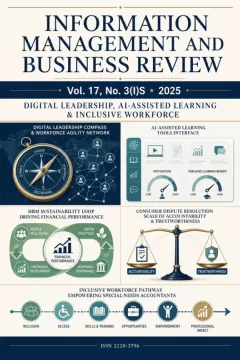 Vol. 17 No. 3(I)S (2025)
Digital Leadership, AI-Assisted Learning & Inclusive Workforce
View issue contents
Published
Submissions
Have research to publish? Information Management and Business Review welcomes submissions.
Make a Submission