Abstract
The underrepresentation of women on corporate boards remains a global concern. Malaysia has taken steps to address this issue through the Malaysian Code of Corporate Governance (MCCG 2021), which recommends a minimum of 30% female directors on boards. However, as of April 2025, the percentage of women directors in Bursa Malaysia stood at only 28% across all PLCs, indicating a gap between policy recommendations and actual implementation. This study examines the impact of board gender diversity and independence on corporate sustainability performance (CSP), proxied by the total ESG score. Using data from Refinitiv Eikon, the study covers 1,028 firms listed on Bursa Malaysia's main and ACE markets between 2019 and 2024, resulting in 6,168 firm-year observations. After excluding firms with insufficient ESG data, the final sample comprises 936 firm-year observations. A fixed-effects model was employed to analyse the unbalanced panel data. The results reveal that board gender diversity and board independence significantly enhance CSP. Additionally, board independence strengthens the positive relationship between board gender diversity and CSP, demonstrating its moderating effect. Robustness checks confirm that board gender diversity similarly influences both the environmental and social pillars. The findings provide empirical evidence supporting the role of board gender diversity and independence in promoting corporate sustainability. These insights have practical implications for investors and policymakers, emphasising the need to prioritise gender-diverse board compositions as Asian markets increasingly focus on corporate governance reforms.
Keywords
References
- Albitar, K., Hussainey, K., Kolade, N., & Gerged, A. M. (2020). ESG disclosure and firm performance before and after IR: The moderating role of governance mechanisms. International Journal of Accounting & Information Management, 28(3), 429-444. https://doi.org/10.1108/ijaim-09-2019-0108 DOI: https://doi.org/10.1108/IJAIM-09-2019-0108
- Amorelli, M. F., & García?Sánchez, I. M. (2021). Trends in the dynamic evolution of board gender diversity and corporate social responsibility. Corporate Social Responsibility and Environmental Management, 28(2), 537-554. https://doi.org/10.1002/csr.2079 DOI: https://doi.org/10.1002/csr.2079
- Arayssi, M., Dah, M., & Jizi, M. (2016). Women on boards, sustainability reporting and firm performance. Sustainability Accounting, Management and Policy Journal, 7(3), 376-401. DOI: https://doi.org/10.1108/SAMPJ-07-2015-0055
- Bannò, M., Filippi, E., & Trento, S. (2023). Women in top echelon positions and their effects on sustainability: a review, synthesis and future research agenda. Journal of management and governance, 27(1), 181-251. https://doi.org/10.1007/s10997-021-09604-7 DOI: https://doi.org/10.1007/s10997-021-09604-7
- Bear, S., Rahman, N., & Post, C. (2010). The impact of board diversity and gender composition on corporate social responsibility and firm reputation. Journal of Business Ethics, 97, 207–221. https://doi.org/10.1007/s10551-010-0505-2 DOI: https://doi.org/10.1007/s10551-010-0505-2
- Bennouri, M., Chtioui, T., Nagati, H., & Nekhili, M. (2018). Female board directorship and firm performance: What really matters? Journal of Banking & Finance, 88, 267–291. https://doi.org/10.1016/j.jbankfin.2017.12.010 DOI: https://doi.org/10.1016/j.jbankfin.2017.12.010
- Birindelli, G., Chiappini, H., & Savioli, M. (2020). When do women on the board of directors reduce bank risk? Corporate Governance: The International Journal of Business in Society, 20(7), 1307-1327. https://doi.org/10.1108/CG-03-2020-0089 DOI: https://doi.org/10.1108/CG-03-2020-0089
- Byron, K., & Post, C. (2016). Women on boards of directors and corporate social performance: A meta?analysis. Corporate Governance: An International Review, 24(4), 428–442. https://doi.org/10.1111/corg.12165 DOI: https://doi.org/10.1111/corg.12165
- Carnini Pulino, S., Ciaburri, M., Magnanelli, B. S., & Nasta, L. (2022). Does ESG disclosure influence firm performance?. Sustainability, 14(13), 7595. https://doi.org/10.3390/su14137595 DOI: https://doi.org/10.3390/su14137595
- Chatterjee, C., & Nag, T. (2023). Do women on boards enhance firm performance? Evidence from top Indian companies. International Journal of Disclosure and Governance, 20(2), 155–167. https://doi.org/10.1057/s41310-022-00153-5 DOI: https://doi.org/10.1057/s41310-022-00153-5
- Chen, Z., & Xie, G. (2022). ESG disclosure and financial performance: The moderating role of ESG investors. International Review of Financial Analysis, 83, 102291. https://doi.org/10.1016/j.irfa.2022.102291 DOI: https://doi.org/10.1016/j.irfa.2022.102291
- Chintrakarn, P., Jiraporn, P., Tong, S., Jiraporn, N., & Proctor, R. (2020). How do independent directors view corporate social responsibility (CSR)? Evidence from a quasi?natural experiment. Financial Review, 55(4), 697-716. https://doi.org/10.1111/fire.12244 DOI: https://doi.org/10.1111/fire.12244
- Dang, R., Houanti, L. H., Sahut, J. M., & Simioni, M. (2021). Do women on corporate boards influence corporate social performance? A control function approach. Finance Research Letters, 39, https://doi.org/101645. 10.1016/j.frl.2020.101645 DOI: https://doi.org/10.1016/j.frl.2020.101645
- Dhir, A., Khan, S. J., Islam, N., Ractham, P., & Meenakshi, N. (2023). Drivers of sustainable business model innovations. An upper echelon theory perspective. Technological Forecasting and Social Change, 191, 122409. https://doi.org/10.1016/j.techfore.2023.122409 DOI: https://doi.org/10.1016/j.techfore.2023.122409
- Dunn, P., & Sainty, B. (2009). The relationship among board of directors characteristics, corporate social performance and corporate financial performance. International Journal of Managerial Finance, 5(4), 407–423. https://doi.org/10.1108/17439130910987558 DOI: https://doi.org/10.1108/17439130910987558
- Eagly, A. H., & Karau, S. J. (2002). Role congruity theory of prejudice toward female leaders. Psychological Review, 109(3), 573-598. https://doi.org/10.1037//0033-295X.109.3.573 DOI: https://doi.org/10.1037/0033-295X.109.3.573
- Frankl, M., & Roberts, S. (2018). Female executives in healthcare management in the context of the upper echelon theory. Journal of Business Diversity, 18(2). 98-112. https://doi.org/10.33423/jbd.v18i2.529 DOI: https://doi.org/10.33423/jbd.v18i2.529
- Galbreath, J. (2018). Is board gender diversity linked to financial performance? The mediating mechanism of CSR. Business & Society, 57(5), 863–889. https://doi.org/10.1177/0007650316647967 DOI: https://doi.org/10.1177/0007650316647967
- García?Sánchez, I. M., Martínez?Ferrero, J., & García?Benau, M. A. (2019). Integrated reporting: The mediating role of the board of directors and investor protection on managerial discretion in munificence. Corporate Social Responsibility and Environmental Management, 26(1), 29-45. https://doi.org/10.1002/csr.1659 DOI: https://doi.org/10.1002/csr.1655
- Ginglinger, E., & Raskopf, C. (2023). Women directors and E&S performance: Evidence from board gender quotas. Journal of Corporate Finance, 83, 102496. https://doi.org/10.1016/j.jcorpfin.2023.102496 DOI: https://doi.org/10.1016/j.jcorpfin.2023.102496
- Gurol, B. and Lagasio, V. (2023), "Women board members’ impact on ESG disclosure with the environment and social dimensions: evidence from the European banking sector", Social Responsibility Journal, 19 (1), 211–228. https://doi.org/10.1108/SRJ-08-2020-0308 DOI: https://doi.org/10.1108/SRJ-08-2020-0308
- Hair, J. F., Black, W. C., Babin, B. J., & Anderson, R. E. (2010). Multivariate Data Analysis (7th ed.). New York: Pearson/Prentice Hall.
- Hambrick, D. C., & Mason, P. A. (1984). Upper echelons: The organization as a reflection of its top managers. Academy of Management Review, 9(2), 193-206. https://doi.org/10.2307/258434 DOI: https://doi.org/10.2307/258434
- Hillman, A. J., Cannella Jr, A. A., & Harris, I. C. (2002). Women and racial minorities in the boardroom: How do directors differ? Journal of Management, 28(6), 747-763. https://doi.org/10.1177/014920630202800 DOI: https://doi.org/10.1177/014920630202800603
- Hyun, E., Yang, D., Jung, H., & Hong, K. (2016). Women on boards and corporate social responsibility. Sustainability, 8(4), 300-326. https://doi.org/10.3390/su8040300 DOI: https://doi.org/10.3390/su8040300
- Isidro, H., & Sobral, M. (2015). The effects of women on corporate boards on firm value, financial performance, and ethical and social compliance. Journal of Business Ethics, 132, 1-19. https://doi.org/10.1007/s10551-014-2302-9 DOI: https://doi.org/10.1007/s10551-014-2302-9
- Jo, H., & Harjoto, M. A. (2012). The causal effect of corporate governance on corporate social responsibility. Journal of Business Ethics, 106, 53-72. https://doi.org/10.1007/s10551-011-1052-1 DOI: https://doi.org/10.1007/s10551-011-1052-1
- Jo, H., & Na, H. (2012). Does CSR reduce firm risk? Evidence from controversial industry sectors. Journal of Business Ethics, 110, 441-456. https://doi.org/10.1007/s10551-012-1492-2 DOI: https://doi.org/10.1007/s10551-012-1492-2
- Johanson, D., & Østergren, K. (2010). The movement toward independent directors on boards: A comparative analysis of Sweden and the UK. Corporate Governance: An International Review, 18(6), 527-539. https://doi.org/10.1111/j.1467-8683.2010.00813.x DOI: https://doi.org/10.1111/j.1467-8683.2010.00813.x
- Kallamu, B. S. (2016). Ownership structure, independent directors and firm performance. Journal of Social and Administrative Sciences, 3(1), 17-30. https://doi.org/10.1453/jsas.v3i1.625 DOI: https://doi.org/10.18685/EJBME(7)1_EJBME-15-012
- Kamaludin, K., Ibrahim, I., Sundarasen, S., & Faizal, O. V. A. (2022). ESG in the boardroom: Evidence from the Malaysian market. International Journal of Corporate Social Responsibility, 7(1), 4-19. https://doi.org/10.1186/s40991-022-00072-2 DOI: https://doi.org/10.1186/s40991-022-00072-2
- Khan, M. A. (2022). ESG disclosure and firm performance: A bibliometric and meta-analysis. Research in International Business and Finance, 61, 101668. https://doi.org/10.1016/j.ribaf.2022.101668 DOI: https://doi.org/10.1016/j.ribaf.2022.101668
- Khunkaew, R., Wichianrak, J., & Suttipun, M. (2023). Sustainability reporting, gender diversity, firm value and corporate performance in the ASEAN region. Cogent Business & Management, 10(1), 2200608. https://doi.org/10.1080/23311975.2023.2200608 DOI: https://doi.org/10.1080/23311975.2023.2200608
- Lückerath-Rovers, M. (2013). Women on boards and firm performance. Journal of Management & Governance, 17, 491-509. https://doi.org/10.1007/s10997-011-9186-1 DOI: https://doi.org/10.1007/s10997-011-9186-1
- Makhija, H. & Raghukumari, P.S. & Sethiya, A. (2024). Does board gender diversity moderate the impact of ESG on firms' economic value added? Evidence from an emerging economy. International Journal of Productivity and Performance Management. 74. 10.1108/IJPPM-12-2023-0664. DOI: https://doi.org/10.1108/IJPPM-12-2023-0664
- Mallin, C. A., & Michelon, G. (2011). Board reputation attributes and corporate social performance: An empirical investigation of the US best corporate citizens. Accounting and Business Research, 41(2), 119–144. https://doi.org/10.1080/00014788.2011.550740 DOI: https://doi.org/10.1080/00014788.2011.550740
- Maicsa. (2024). Women on boards in 2024. Maicsa.
- MCCG. (2021). Malaysian Code on Corporate Governance. Kuala Lumpur, Malaysia: Securities Commission Malaysia, Kuala Lumpur, Malaysia.
- Muhammad, H., & Migliori, S. (2023). Effects of board gender diversity and sustainability committees on environmental performance: A quantile regression approach. Journal of Management & Organization, 29(6), 1051-1076. https://doi.org/10.1017/jmo.2022.8 DOI: https://doi.org/10.1017/jmo.2022.8
- Nadeem, M., Zaman, R., & Saleem, I. (2020). Boardroom gender diversity and corporate sustainability practices: Evidence from Australian securities exchange-listed firms. Journal of Cleaner Production, 249, 119434. https://doi.org/10.1016/j.jclepro.2019.119434 DOI: https://doi.org/10.1016/j.jclepro.2019.119434
- Nashri, N. S., Ismail, R. F., Md Nor, H., & Aguilera-Caracual. J. (2023). Do Board Composition Attributes Lead to Better Environmental, Social and Governance Performance in Malaysia? Asian Journal of Accounting and Governance 20: 64–75. http://dx.doi.org/10.17576/AJAG-2023-20-05 DOI: https://doi.org/10.17576/AJAG-2023-20-05
- Naveed, M., Sohail, M. K., Abdin, S. Z., Awais, M., & Batool, N. (2020). Role of ESG disclosure in determining asset allocation decision: An individual investor perspective. Paradigms, 14(1), https://doi.org/157-165. 10.24312/193014024
- Nazir Gardazi, S. S., Sheikh Hassan, A. F., Saidin, S. F., & Johari, J. B. (2023). Dynamic Relationship Between Board of Directors and Corporate Sustainability Performance: Evidence from the Energy Sector. International Journal of Economics & Management, 17(1). 19–35. http://doi.org/10.47836/ijeam.17.1.02 DOI: https://doi.org/10.47836/ijeam.17.1.02
- Newman, C., Rand, J., Tarp, F., & Trifkovic, N. (2020). Corporate social responsibility in a competitive business environment. The Journal of Development Studies, 56(8), 1455–1472. https://doi.org/10.1080/00220388.2019.1694144 DOI: https://doi.org/10.1080/00220388.2019.1694144
- Nguyen, P., & Nguyen, A. (2015). The effect of corporate social responsibility on firm risk. Social Responsibility Journal, 11(2), 324–339. https://doi.org/10.1108/SRJ-08-2013-0093 DOI: https://doi.org/10.1108/SRJ-08-2013-0093
- Nielsen, S., & Huse, M. (2010). The contribution of women on boards of directors: Going beyond the surface. Corporate governance: An international review, 18(2), 136-148. https://doi.org/10.1111/j.1467-8683.2010.00784.x DOI: https://doi.org/10.1111/j.1467-8683.2010.00784.x
- Nielsen, V. L., & Madsen, M. B. (2017). Does gender diversity in the workplace affect job satisfaction and turnover intentions? International Public Management Review, 18(1), 77-115. http://journals.sfu.ca/ipmr/index.php/ipmr/article/view/318 DOI: https://doi.org/10.68807/ipmr.318
- Nishii, L. H., Gotte, A., & Raver, J. L. (2007). Upper echelon theory revisited: The relationship between upper echelon diversity, the adoption of diversity practices, and organizational performance. Working paper series. Working Paper 07 – 04, Cornell University. https://hdl.handle.net/1813/77344 DOI: https://doi.org/10.1037/e518532013-679
- Ntim, C. G., & Soobaroyen, T. (2013). Corporate governance and performance in socially responsible corporations: New empirical insights from a Neo?Institutional framework. Corporate Governance: An International Review, 21(5), 468-494. https://doi.org/10.1111/corg.12026 DOI: https://doi.org/10.1111/corg.12026
- Ortas, E., Álvarez, I., & Zubeltzu, E. (2017). Firms’ board independence and corporate social performance: A meta-analysis. Sustainability, 9(6), 1006-1032. https://doi.org/10.3390/su9061006 DOI: https://doi.org/10.3390/su9061006
- Paoloni, P., Lombardi, R., & Principale, S. (2023). The impact of gender diversity on corporate social responsibility knowledge: empirical analysis in the European context. Journal of Knowledge Management, 27(9), 2484-2498. https://doi.org/10.1108/JKM-07-2022-0512 DOI: https://doi.org/10.1108/JKM-07-2022-0512
- Pareek, R., Sahu, T. N., & Gupta, A. (2023). Gender diversity and corporate sustainability performance: empirical evidence from India. Vilakshan-XIMB Journal of Management, 20(1), 140–153. https://doi.org/10.1108/XJM-10-2020-0183 DOI: https://doi.org/10.1108/XJM-10-2020-0183
- Park, S. R., & Jang, J. Y. (2021). The impact of ESG management on investment decision: Institutional investors’ perceptions of country-specific ESG criteria. International Journal of Financial Studies, 9(3), 48-75. https://doi.org/10.3390/ijfs9030048 DOI: https://doi.org/10.3390/ijfs9030048
- Purbawangsa, I. B. A., Solimun, S., Fernandes, A. A. R., & Mangesti Rahayu, S. (2020). Corporate governance, corporate profitability, toward corporate social responsibility disclosure and corporate value (comparative study in Indonesia, China and India stock exchanges in 2013-2016). Social Responsibility Journal, 16(7), 983-999. https://doi.org/10.1108/SRJ-08-2017-0160 DOI: https://doi.org/10.1108/SRJ-08-2017-0160
- Sahin, K., Basfirinci, C. S., & Ozsalih, A. (2011). The impact of board composition on corporate financial and social responsibility performance: Evidence from public-listed companies in Turkey. African Journal of Business Management, 5(7), 2959. http://www.academicjournals.org/AJBM
- Securities Commission Malaysia. (2021). Malaysian Code on Corporate Governance (MCCG). Retrieved from https://www.sc.com.my/regulation/corporate-governance/malaysian-code-on-corporate-governance
- Shaikh, I. (2022). Environmental, social, and governance (ESG) practice and firm performance: An international evidence. Journal of Business Economics and Management, 23(1), 218–237. https://doi.org/10.3846/jbem.2022.16202 DOI: https://doi.org/10.3846/jbem.2022.16202
- Shakil, M. H., Munim, Z. H., Zamore, S., & Tasnia, M. (2024). Sustainability and financial performance of transport and logistics firms: Does board gender diversity matter? Journal of Sustainable Finance & Investment, 14(1), https://doi.org/100-115. 10.1080/20430795.2022.2039998 DOI: https://doi.org/10.1080/20430795.2022.2039998
- Velte, P. (2016). Women on the management board and ESG performance. Journal of Global Responsibility, 7(1), 98–109. https://doi.org/10.1108/JGR-01-2016-0001 DOI: https://doi.org/10.1108/JGR-01-2016-0001
- Velte, P. (2017). Do women on the board of directors have an impact on corporate governance quality and firm performance? A literature review. International Journal of Sustainable Strategic Management, 5(4), 302–346. https://doi.org/10.1504/IJSSM.2017.10010121 DOI: https://doi.org/10.1504/IJSSM.2017.089125
- Wan Mohammad, W. M., Zaini, R., & Md Kassim, A. A. (2023). Women on boards, firms’ competitive advantage and its effect on ESG disclosure in Malaysia. Social Responsibility Journal, 19(5), 930-948. https://doi.org/10.1108/SRJ-04-2021-0151 DOI: https://doi.org/10.1108/SRJ-04-2021-0151
- Wasiuzzaman, S., & Wan Mohammad, W. M. (2020). Board gender diversity and transparency of environmental, social and governance disclosure: Evidence from Malaysia. Managerial and Decision Economics, 41(1), 145-156. https://doi.org/10.1002/mde.3099 DOI: https://doi.org/10.1002/mde.3099
- Wong, S. L. (2024). The impact of female representation and ethnic diversity in committees on environmental, social and governance performance in Malaysia. Society and Business Review, 19(2), 207-229. https://doi.org/10.1108/SBR-02-2023-0052 DOI: https://doi.org/10.1108/SBR-02-2023-0052
- Yadav, P., & Jain, A. (2023). Sustainability disclosures and corporate boards: a stakeholder approach to decision-making. Journal of Applied Accounting Research, 24(5), 1027–1047. https://doi.org/10.1108/JAAR-10-2022-0279 DOI: https://doi.org/10.1108/JAAR-10-2022-0279
- Younas, N., Uddin, S., Awan, T., & Khan, M. Y. (2021). Corporate governance and financial distress: Asian emerging market perspective. Corporate Governance: The International Journal of Business in Society, 21(4), 702-715. https://doi.org/10.1108/CG-04-2020-0119 DOI: https://doi.org/10.1108/CG-04-2020-0119
- Zaman, R., Jain, T., Samara, G., & Jamali, D. (2022). Corporate governance meets corporate social responsibility: Mapping the interface. Business & Society, 61(3), 690-752. https://doi.org/10.1177/0007650320973415 DOI: https://doi.org/10.1177/0007650320973415
- Zawawi, M. M., Ismail, M., & Kamarudin, S. N. (2023). Gender Diversity and Environmental, Social and Governance (ESG) of Malaysian Listed Companies. International Journal of Academic Research in Business & Social Sciences, 13 (1), 933 – 941. http://dx.doi.org/10.6007/IJARBSS/v13-i1/15251 DOI: https://doi.org/10.6007/IJARBSS/v13-i1/15251
- Zhang, Y., Khan, H. U. R., Lee, C. C., & Salik, M. (2022). Female directors and corporate sustainability performance: The moderating role of political connection. International Journal of Finance & Economics, 27(3), 3307–3325. https://doi.org/10.1002/ijfe.2327 DOI: https://doi.org/10.1002/ijfe.2327
Downloads
Full-text downloads recorded for this article, by month.
No downloads have been recorded for this article yet. Figures appear here once readers begin downloading the full text.
How to Cite
Share this article
License
Copyright (c) 2025 Raja Adzrin Raja Ahmad, Nurul Azlin Azmi, Nor Balkish Zakaria (Author)

This work is licensed under a Creative Commons Attribution 4.0 International License.
Author (s) should affirm that the material has not been published previously. It has not been submitted and it is not under consideration by any other journal. At the same time author (s) need to execute a publication permission agreement to assume the responsibility of the submitted content and any omissions and errors therein. After submission of revised paper in the light of suggestions of the reviewers, the editorial team edits and formats manuscripts to bring uniformity and standardization in published material.
This work will be licensed under Creative Commons Attribution 4.0 International (CC BY 4.0) and under condition of the license, users are free to read, copy, remix, transform, redistribute, download, print, search or link to the full texts of articles and even build upon their work as long as they credit the author for the original work. Moreover, as per journal policy author (s) hold and retain copyrights without any restrictions.
Keywords
Section
Published in
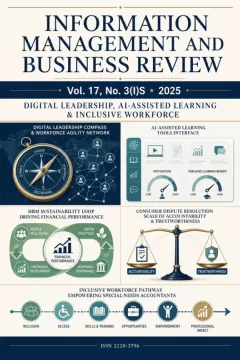 Vol. 17 No. 3(I)S (2025)
Digital Leadership, AI-Assisted Learning & Inclusive Workforce
View issue contents
Published
Submissions
Have research to publish? Information Management and Business Review welcomes submissions.
Make a Submission