Abstract
Normalizing in adoption of digital payment will contribute to a digital economy environment. This conceptual paper describes the literature review on a proposal for a study of the parents’ behavior towards the use of digital payment by their primary school children. The proposed factors derived from the TAM and UTAUT model that would explain the adoption and non-adoption factors. The main objective of the study is to investigate the relationship between parents’ readiness and the factors influencing their acceptance of technology, especially the use of digital payment systems by their primary school children. The proposed research method uses convenience sampling. The questionnaire will be disseminated to parents who have primary school children aged 6 to 12 years old. The response of 200 questionnaires was assumed as suitable for drawing a conclusion for the study. The findings aim to provide insight into the various factors, including digital literacy, financial awareness, and accessibility of technology, that influence parents’ readiness to adopt digital payments. The result of this study will assist the banking industry in improving its facilities and strategies in its digital payment. The result would also help government agencies (such as schools and the education ministry) in improving their policy and management.
Keywords
References
- Arvian Firmansyah, E., Masri, M. & Anshari, M. & Besar, A. (2023). Factors Affecting Fintech Adoption: A Systematic Literature Review. FinTech. 2. 21-33. 10.3390/fintech2010002.
- Bhoopathy, G., & Kanagaraj, P. (2023). The Impact of Digital Payments on Consumer Spending Habits. https://doi.org/10.52783/tjjpt.v44.i4.1896
- Bhuiyan, M. R. I., Akter, M. S., & Islam, S. (2024). How does digital payment transform society into a cashless society? An empirical study in a developing economy. Journal of Science and Technology Policy Management. https://doi.org/10.1108/JSTPM-10-2023-0170
- Buenestado-Fernández, M., Ramírez Montoya, M. S., Ibarra-Vazquez, G., & Patiño, A. (2023). Digital competency as a key to the financial inclusion of young people in complex scenarios: A focus group study. Citizenship, Social and Economics Education, 22, 48–62. https://doi.org/10.1177/14788047231170083
- Chawla, D. & Joshi, H. (2019). Consumer attitude and intention to adopt mobile wallet in India – An empirical study. International Journal of Bank Marketing, 37(7), 1590-1617. https://doi.org/10.1108/IJBM-09-2018-0259.
- Colline, F., Furinto, A. & Kartono, R. (2022). Digital Payment Adoption: Review of Literature. https://doi.org/10.46254/in02.20220496
- Davis, F. (1989). Perceived Usefulness, Perceived Ease of Use and User Acceptance of Information Technology. MIS Quarterly 13 (3), 319-339. http://dx.doi.org/10.2307/249008
- Dimitrova, I. (2024). Barrier-breakers’ influence on full adoption of digital payment methods. Internet Research, 34(7), 139–159. https://doi.org/10.1108/INTR-11-2022-0886
- Ghouse, S. M., Shekhar, R. and Chaudhary, M. (2025). Driving financial inclusion: exploring mobile wallet adoption among rural Omani millennials, Journal of Islamic Marketing, 16(4), 1229-1257. https://doi.org/10.1108/JIMA-02-2024-0073
- Handoko, B. L., Siswono, G. N., & Azani, J. M. (2022). Analysis of Perceived Risk, Perceived Trust, and Perceived Security Factors on Consumer Intention using E-Payment. https://doi.org/10.1145/3543106.3543109
- Kabir, M. A., Saidin, S. Z., & Ahmi, A. (2017). Analysis of factors that influence electronic payment adoption. Journal of Engineering and Applied Sciences, 12(3), 6560-6568.
- Kartika, A., Nurbaiti, N., & Aslami, N. (2023). Pengaruh Gerakan Nasional Non Tunai, Social Influence, Dan Persepsi Kemudahan Penggunaan Terhadap Minat Menggunakan Digital Payment Dalam Konsep Maslahah (Studi Kasus: Kota Kisaran). https://doi.org/10.36987/jumsi.v3i1.3974
- Krishna, B., Krishnan, S., & Sebastian, M. P. (2023). Understanding the process of building institutional trust among digital payment users through national cybersecurity commitment trustworthiness cues: a critical realist perspective. Information Technology and People. https://doi.org/10.1108/ITP-05-2023-0434
- Lakhaiyar, S., & Mani, M. (2022). Factors Influencing the Adoption of Digital Payment Systems During COVID-19. International Journal of Sociotechnology and Knowledge Development, 14(1), 1–21. https://doi.org/10.4018/ijskd.315292
- Linh, T. T., Huyen, N. T. T., Thang, D. N., & Phuong, N. M. (2024). How neighbor influence negatively affects digital payment adoption in Vietnam. Cogent Business and Management, 11(1). https://doi.org/10.1080/23311975.2024.2431654
- Mat Shafie, I.S., Mohd Yusof, Y. L., Mahmood, A. N., & Abu Kasim, N. H. A. (2020). Factors Influencing the Adoption of e-Payment: An Empirical Study in Malaysia. Advances in Business Research International Journal, 4(2), 53-62. DOI: 10.24191/abrij.v4i2.10009
- Mun, Y. P., Khalid, H., & Nadarajah, D. (2017). Millennials’ perception of mobile payment services in Malaysia. Procedia Computer Science, 124, 397-404.
- Nasution, N., Arrahmi, A., Wahyuni, B., & Nugraha, V. P. (2022). Fenomena digitalisasi pembayaran iuran sekolah dan implikasinya terhadap akuntabilitas keuangan sekolah (Studi Interpretif Pada Sekolah Saga Lifeschool). Jurnal Akuntansi Dan Bisnis Krisnadwipayana, 9(2), 723. https://doi.org/10.35137/jabk.v9i2.682
- Nurabiah, Pusparini, H., & Fitriyah, N. (2024). Risks of Using Digital Payment Methods Using the Perceived Risk (PR) Theory Approach. Journal of Accounting and Finance in Emerging Economies. https://doi.org/10.26710/jafee.v10i3.3038
- Pratama, A., & Anas, E. P. (2024). Financial Technology Adoption on Payment Systems and Financial Transactions Among Millennials in Indonesia. Syntax Literate: Jurnal Ilmiah Indonesia. https://doi.org/10.36418/syntax-literate.v9i3.14104
- Purwanto, H., Sasmito Adi, H. I., Astuty, H. S., & Suwarno, S. (2024). Influence Of Perceived Ease Of Use On The Intention To Use Digital Payment Applications In Transactions. Jurnal Ilmiah Ekonomi Global Masa Kini, 15(2), 111–116. https://doi.org/10.36982/jiegmk.v15i2.4813
- Ramdhani, A., Syafitri, S., Amalia, D. R., Lanfadilan, K., & Ahmad, A. P. (2024). The influence of perceived ease of use and perceived usefulness on the decision to use of qris as a digital payment in Generation Z in the city of Bandung. Jurnal Bisnis Dan Ekonomi, 2(3), 371–389. https://doi.org/10.61597/jbe-ogzrp.v2i3.44
- Rezza, A. M., Widyana, S. F., & Anggraeni, A. D. (2024). Digital Payment Adoption: The Antecedent of Habit and Behavioral Intention. JPPI (Jurnal Penelitian Pendidikan Indonesia), 10(4). https://doi.org/10.29210/020243563
- Ritthitraiphop, C., & Hamra, W. (2019). Organization and Parental Perceptions of Electronic Payments by Selected Seventh-day Adventist (SDA) International Schools in Thailand. 7(1), 1143–1161. https://doi.org/10.35974/ISC.V7I1.1017
- Rodiah & Melati (2020). Pengarauh Kemudahan Penggunaan, Kemanfatan Risiko dan Kepercayaan terhadapay Minat Menggunakan E-Wallet pada Generasi Milenial Kota Semarang Fakultas Ekonomi, Universitas Negeri Semarang, Indonesia. 1(2), 66-80.
- Oktafian, H. S. (2022). Financial literacy, social influence and the use of digital payments: a literature review. 1(2), 206–220. https://doi.org/10.55606/iceb.v1i2.124
- Saragih, M. H., & Mulyadi, M. C. (2025). Influence of perceived usefulness, trust, perceived ease of use and social Sinfluence on e-wallet adoption in Generation Z. Pedagogic Research - Applied Literacy Journal, 2(1), 8–15. https://doi.org/10.70574/stfrsq53
- Shafie, I. S. M., Yusof, Y. L. M., Mahmood, A. N., Ishar, N. I. M., Jamal, H. Z., & Kasim, N. H. A. A. (2020). Factors influencing the adoption of e-payment: an empirical study in Malaysia. Advances in Business Research International Journal, 4(2), 53-62.
- Shehadeh, M., Dawood, H. M., & Hussainey, K. (2024). Digital financial literacy and usage of cashless payments in Jordan: the moderating role of gender. International Journal of Accounting and Information Management. https://doi.org/10.1108/IJAIM-03-2024-0115
- Shen, Y., Hu, W., & Hueng, C. J. (2021). Digital Financial Inclusion and Economic Growth: A Cross-country Study. Procedia Computer Science, 187, 218–223. https://doi.org/10.1016/j.procs.2021.04.054
- Srivastava, S., Mohta, A., & Shunmugasundaram, V. (2024). Adoption of digital payment FinTech service by Gen Y and Gen Z users: evidence from India. Digital Policy, Regulation and Governance, 26(1), 95–117. https://doi.org/10.1108/DPRG-07-2023-0110
- Sundararaj, J., & Meera, R. (2024). Adoption and User Behaviour Towards Digital Payments by Millennials. South Eastern European Journal of Public Health, 822–828. https://doi.org/10.70135/seejph.vi.2126
- Susanto, E. H., Solikin, I., & Purnomo, B. (2022). A review of digital payment adoption in Asia. Advanced International Journal Of Business, Entrepreneurship And SME’s, 4(11), 01–15. https://doi.org/10.35631/aijbes.411001
- Syafaastuti, S., Delfina, Y., & Syahchari, D. (2024). The Use of the Technology Acceptance Model (TAM) to Analyze the Effects of Social Influence on the Interest in Implementing Cashless Payment (QRIS). 1–6. https://doi.org/10.1109/ic2ie63342.2024.10748219
- Talwar, M., Corazza, L., Bodhi, R., & Malibari, A. (2023). Why do consumers resist digital innovations? An innovation resistance theory perspective. International Journal of Emerging Markets. https://doi.org/10.1108/IJOEM-03-2022-0529
- Teo, S. C., Law, P. L., & Koo, A. C. (2020). Factors Affecting the Adoption of E-Wallets among Youths in Malaysia. Journal of Information Systems and Technology Management, 5(19), 39-50. DOI: 10.35631/JISTM.519004.
- The Edge Malaysia. (n.d.). Bringing children into the digital payments universe. Retrieved from https://theedgemalaysia.com/article/bringing-children-digital-payments-universe
- Tomi?, N., Kalini?, Z. & Todorovi?, V. (2023). Using the UTAUT model to analyze user intention to accept electronic payment systems in Serbia. Port Econ J, 22, 251–270. https://doi.org/10.1007/s10258-022-00210-5
- van der Cruijsen, C. A. B., & Knoben, J. (2021). Ctrl+C Ctrl+Pay: Do People Mirror Electronic Payment Behavior of their Peers? Journal of Financial Services Research, 59(1), 69–96. https://doi.org/10.1007/S10693-020-00345-6
- Venkatesh, Morris, Davis, & Davis (2003). User Acceptance and Use of Information Technology: Towards a Unified View. MIS Quarterly, 27 (3), 425. DOI: 10.2307/30036540
- Viony, R., & Widodo, A. (2024). Mobile Payment Service Adoption: Understanding OVO E-Wallet Customers among GEN Y and GEN Z in Bandung, West Java. https://doi.org/10.69477/ima.v2i2.30
- Hanafi, W. N., & Toolib, S. N. (2020). Influences of Perceived Usefulness, Perceived Ease of Use, and Perceived Security on Intention to Use Digital Payment: A Comparative Study Among Malaysian Younger and Older Adults. 3(1), 15–24.
- Wang, Q., Niu, G., Zhou, Y. & Gan, X. (2024). Education and FinTech adoption: evidence from China. China Finance Review International. https://doi.org/10.1108/cfri-06-2023-0141
- Weiner, B.J. (2009). A theory of organizational readiness for change. Implementation Sci 4, 67, https://doi.org/10.1186/1748-5908-4-67
- Xia Loh, Y., Aziati Abdul Hamid, N., Sen Seah, C., Jie Yo, J., Chung Law, Y., Yin Tan, S., Loo Chung, H., Leong Liew, Y., & Chong, C. (2021). The Factors and Challenges affecting Digital Economy in Malaysia, 1(1). https://journal.uib.ac.id/index.php/combines
- Zhang, Y., Sun, J., Yang, Z., & Wang, Y. (2018). What Makes People Actually Embrace or Shun Mobile Payment: A Cross-Culture Study. Mobile Information Systems, 1–13. https://doi.org/10.1155/2018/7497545
- Zhao, P., Bazarova, N. N., & Valle, N. (2023). Digital parenting divides: the role of parental capital and digital parenting readiness in parental digital mediation. Journal of Computer-Mediated Communication, 28(5). https://doi.org/10.1093/jcmc/zmad032
Downloads
No downloads have been recorded for this article yet. Figures appear here once readers begin downloading the full text.
How to Cite
Share this article
License
Copyright (c) 2025 Masita Hassan, Norlinda Tendot Binti Abu Bakar (Author)

This work is licensed under a Creative Commons Attribution 4.0 International License.
Author (s) should affirm that the material has not been published previously. It has not been submitted and it is not under consideration by any other journal. At the same time author (s) need to execute a publication permission agreement to assume the responsibility of the submitted content and any omissions and errors therein. After submission of revised paper in the light of suggestions of the reviewers, the editorial team edits and formats manuscripts to bring uniformity and standardization in published material.
This work will be licensed under Creative Commons Attribution 4.0 International (CC BY 4.0) and under condition of the license, users are free to read, copy, remix, transform, redistribute, download, print, search or link to the full texts of articles and even build upon their work as long as they credit the author for the original work. Moreover, as per journal policy author (s) hold and retain copyrights without any restrictions.
Keywords
Section
Published in
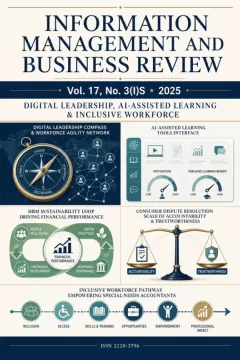 Vol. 17 No. 3(I)S (2025)
Digital Leadership, AI-Assisted Learning & Inclusive Workforce
View issue contents
Published
Submissions
Have research to publish? Information Management and Business Review welcomes submissions.
Make a Submission