Abstract
The integration of digital leadership and workforce agility has become increasingly vital for managing digital transformation in educational systems. This conceptual paper explores how school leaders in Malaysian public schools can navigate technological change while cultivating a teaching workforce that is adaptive, self-regulating, and resilient. Grounded in transformational and distributed leadership theories, and informed by frameworks on learning agility and professional development, the study presents a contextsensitive conceptual model. Drawing on a synthesis of literature and practitioner experience, the paper articulates five key theoretical propositions linking digital leadership competencies such as emotional intelligence, strategic vision, and inclusive governance to workforce agility outcomes. It further examines organizational enablers including professional development, collaborative culture, and infrastructure support. The end product is a framework that provides a comprehensive picture of how the practices of educational leaders can contribute to institutional resilience, innovation, and inclusive capacity-building in the case of Malaysia's public schooling. This study adds to leadership theory and application by situating Western models within Southeast Asian environments and provides a basis for further empirical testing and policy development.
Keywords
- Digital Leadership Search this journal for Digital Leadership (opens in a new tab)
- Workforce Agility Search this journal for Workforce Agility (opens in a new tab)
- Educational Transformation Search this journal for Educational Transformation (opens in a new tab)
- Malaysian Public Schools Search this journal for Malaysian Public Schools (opens in a new tab)
- Teacher Agency Search this journal for Teacher Agency (opens in a new tab)
References
- Adams, D., & Velarde, J. M. (2021). Leadership in a culturally diverse environment: perspectives from international school leaders in Malaysia. Asia Pacific Journal of Education, 41(2), 323-335. https://doi.org/10.1080/02188791.2020.1732295
- Adams, D., Thien, L. M., Chuin, E. C. Y., & Semaadderi, P. (2021). The elusive Malayan tiger ‘captured': A systematic review of research on educational leadership and management in Malaysia. Educational Management Administration & Leadership, 51(3), 673-692. https://doi.org/10.1177/1741143221998697
- Al-Ganemi, S. S. W., & Chalab, I. D. (2021). Reflection of the effect of empowering leadership behaviors on the workforce agility (An analytical study of the opinions of teachers in the private schools of the Diwaniyah governorate center). Turkish Journal of Computer and Mathematics Education, 12(14), 2120-2149. https://search.proquest.com/openview/7f6d7a377da2a67e653021f467ff130c/1?pq-origsite=gscholar&cbl=2045096
- Alviani, D., Hilmiana, Widianto, S., & Muizu, W. O. Z. (2024). Workforce agility: a systematic literature review and research agenda. Frontiers in Psychology, 15, 1376399. https://doi.org/10.3389/fpsyg.2024.1376399
- Anis, M. (2024). Teacher professional development in the digital age: Addressing the evolving needs post-COVID. International Journal for Multidisciplinary Research (IJFMR), 6(1), 1-14. https://www.ijfmr.com/papers/2024/1/12386.pdf
- Avolio, B. J., Kahai, S. S., & Dodge, G. E. (2014). E-leadership: Implications for theory, research, and practice. The Leadership Quarterly, 15(4), 615–668. https://doi.org/10.1016/j.leaqua.2004.09.004
- Azmi, F. R., Musaa, H., Chew, B. C., & Jagiripu, I. P. (2021). Supply risk management: A case study of the halal food industry in Malaysia. Uncertain Supply Chain Management, 9(2), 501-512. https://www.growingscience.com/uscm/Vol9/uscm_2021_1.pdf
- Bailey, J. A. (2021). Building learning capacity in an age of uncertainty (1st ed.). Routledge. https://doi.org/10.4324/9781003144847
- Baroudi, S. (2022). Leading in times of crisis: evidence of digital transformational leadership among Arab female educational leaders. International Journal of Leadership in Education, 27(4), 1051–1058. https://doi.org/10.1080/13603124.2022.2108506
- Dam?a, C., Langford, M., Uehara, D., & Scherer, R. (2021). Teachers’ agency and online education in times of crisis. Computers in Human Behavior, 121, 106793. https://doi.org/10.1016/j.chb.2021.106793
- Fuad, M., & Musa, H. (2021). Critical factors that affect logistics performance in the UAE ADNOC Oil and Gas Industry. Proceedings of the 11th Annual International Conference on Industrial Engineering and Operations Management, 6521-6528. https://ieomsociety.org/singapore2021/papers/1120.pdf
- Ghamrawi, N., & Tamim, R. M. (2023). A typology for digital leadership in higher education: the case of a large-scale mobile technology initiative (using tablets). Education and Information Technologies, 28(28), 7089–7110. https://doi.org/10.1007/s10639-022-11483-w
- Jameson, J., Rumyantseva, N., Cai, M., Markowski, M., Essex, R., & McNay, I. (2022). A systematic review and framework for digital leadership research maturity in higher education. Computers and Education Open, 3, 100115. https://doi.org/10.1016/j.caeo.2022.100115
- Kamran, A. (2023). Digital leadership in Pakistan’s public education system: A post-pandemic analysis. South Asian Journal of Educational Development, 11(2), 88–102. https://doi.org/10.1080/09720000.2023.11.2.88
- Karakose, T., Polat, H., & Papadakis, S. (2021). Examining teachers’ perspectives on school principals’ digital leadership roles and technology capabilities during the COVID-19 pandemic. Sustainability, 13(23), 13448. https://doi.org/10.3390/su132313448
- Lim, Y. S., Halim, H. A., & Ramayah, T. (2022). Should teachers be agile? Postulating the self-determination theory. International Journal of Management in Education, 16(6), 636–663. https://doi.org/10.1504/IJMIE.2022.126587
- Lyons, P., & Bandura, R. P. (2023). Coaching to build commitment for generating performance improvement. Journal of Work-Applied Management, 15(2). https://doi.org/10.1108/JWAM-05-2022-0025
- Mahmuto?lu, C., Celep, C., & Kaya, A. (2024). The effect of teachers' learning agility on organizational commitment attitudes. TOJET: The Turkish Online Journal of Educational Technology, 23(4), 192-200. https://files.eric.ed.gov/fulltext/EJ1444576.pdf
- Manaf, S. (2024). Educational management in the digital age: Integrating technology for student success. Al-Ishlah: Jurnal Pendidikan, 16(2), 1451–1461. https://doi.org/10.35445/alishlah.v16i2.4919
- Mozaffari, K., Ghahramani, M., & Abolghasemi, M. (2021). The relationship between learning climate and organizational agility in managers of the education department. Journal of School Administration, 9(3), 164–177. https://jsa.uok.ac.ir/article_61917_e4b9f552a099089c533dac298a418218.pdf
- Msila, V. (2022). Higher education leadership in a time of digital technologies: A South African case study. International Journal of Information and Education Technology, 12(10), 1110–1117. https://doi.org/10.18178/ijiet.2022.12.10.1728
- Mutil, R., Zahari, M., & Saad, N. (2024). Leadership for digital schools: Emotional agility, crisis readiness, and distributed governance. Malaysian Journal of Educational Leadership, 12(1), 44–59.
- Nadeem, M. (2024). Distributed leadership in educational contexts: A catalyst for school improvement. Social Sciences & Humanities Open, 9, 100835. https://doi.org/10.1016/j.ssaho.2024.100835
- Northouse, P. G. (2019). Leadership: Theory and practice (8th ed.). SAGE Publications.
- Oktaysoy, O., Topcuoglu, E., & Kaygin, E. (2022). A study on digital leadership scale adaptation. International Journal of Organizational Leadership, 11(4), 407-425. https://doi.org/10.33844/ijol.2022.60342
- Özdemir, G. (2023). The relationship between school administrators' agile leadership and their innovation management competencies. International Journal of Education & Literacy Studies, 11(1), 175-184. http://dx.doi.org/10.7575/aiac.ijels.v.11n.1p.175
- Pal, R. K. (2022). Digital leadership in 21st-century education. International Journal for Research Trends and Innovation, 7(7), 1652-1655. https://ijrti.org/papers/IJRTi2207285.pdf
- Phakamach, P., Panjarattanakorn, D., & Onsampant, S. (2023). Conceptualization and development of digital leadership to drive corporate digital transformation for sustainable success. International Journal of Educational Communications and Technology (IJECT), 3(2), 30-42. https://ph01.tci-thaijo.org/index.php/IJECT/article/download/252269/170911
- Ramadan, M., Bou Zakhem, N., Baydoun, H., Daouk, A., Youssef, S., El Fawal, A., Elia, J., & Ashaal, A. (2023). Toward digital transformation and business model innovation: The nexus between leadership, organizational agility, and knowledge transfer. Administrative Sciences, 13(8), 185. https://doi.org/10.3390/admsci13080185
- Ramalingam, S., Saforrudin, N. B., Harun, N. B., Salamat, Z. B., & Yunus, R. (2024). Enhancing educational leadership through digital transformation: A school-based digital leadership project in a Malaysian school. International Conference on Business Studies and Education (ICBE), 358-365. https://www.icbe.my/wp-content/uploads/2024/04/44-1.pdf
- Rumeli, M. S., & Rami, A. A. M. (2023). Developing education leaders in managing adaptation of technology: Focus group analysis. Faculty of Educational Studies, Universiti Putra Malaysia. http://eprints.iab.edu.my/v2/1371/1/DevelopingEducationLeadersInManagingAdaptationOfTechnology.pdf
- Sa?ba?, M., & Erdo?an, F. A. (2022). Digital leadership: A systematic literature review. ?stanbul Kent Üniversitesi ?nsan ve Toplum Bilimleri Dergisi, 3(1), 17-36. https://dergipark.org.tr/en/download/article-file/2083776
- Schmitz, M. L., Antonietti, C., Consoli, T., Cattaneo, A., Gonon, P., & Petko, D. (2023). Transformational leadership for technology integration in schools: Empowering teachers to use technology in a more demanding way. Computers & Education, 204, 104880. https://doi.org/10.1016/j.compedu.2023.104880
- Shamsudin, S. (2023). Malaysian Principals Leadership Model: The Quest in Developing Future-Ready School Leaders. Global Journal of Educational Research and Management (GERMANE), 3(3), 55-63. http://eprints.iab.edu.my/v2/1477/1/55_63_Shuhaida_Leadership%2BModel.pdf
- Soliman, M., Alshamrani, M., & Saleh, A. (2023). Emotional intelligence and digital stress in educational leadership. Journal of Educational Psychology and Technology, 15(2), 112–129. https://doi.org/10.1016/j.jept.2023.01.004
- Wahjunianto, H. (2022). Workforce agility: Improving employee performance from the perspective of a competitive work environment. Enrichment: Journal of Management, 12(5), 3556–3563. https://enrichment.iocspublisher.org/index.php/enrichment/article/download/815/680/
Downloads
No downloads have been recorded for this article yet. Figures appear here once readers begin downloading the full text.
How to Cite
Share this article
License
Copyright (c) 2025 Azmi Bin Ahmad Sapian, Fauzi Bin Kamarudin (Author)

This work is licensed under a Creative Commons Attribution 4.0 International License.
Author (s) should affirm that the material has not been published previously. It has not been submitted and it is not under consideration by any other journal. At the same time author (s) need to execute a publication permission agreement to assume the responsibility of the submitted content and any omissions and errors therein. After submission of revised paper in the light of suggestions of the reviewers, the editorial team edits and formats manuscripts to bring uniformity and standardization in published material.
This work will be licensed under Creative Commons Attribution 4.0 International (CC BY 4.0) and under condition of the license, users are free to read, copy, remix, transform, redistribute, download, print, search or link to the full texts of articles and even build upon their work as long as they credit the author for the original work. Moreover, as per journal policy author (s) hold and retain copyrights without any restrictions.
Keywords
- Digital Leadership Search this journal for Digital Leadership (opens in a new tab)
- Workforce Agility Search this journal for Workforce Agility (opens in a new tab)
- Educational Transformation Search this journal for Educational Transformation (opens in a new tab)
- Malaysian Public Schools Search this journal for Malaysian Public Schools (opens in a new tab)
- Teacher Agency Search this journal for Teacher Agency (opens in a new tab)
Section
Published in
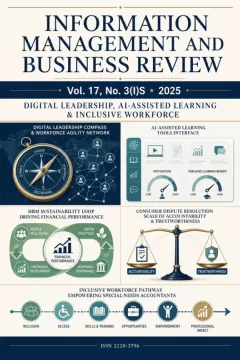 Vol. 17 No. 3(I)S (2025)
Digital Leadership, AI-Assisted Learning & Inclusive Workforce
View issue contents
Published
Submissions
Have research to publish? Information Management and Business Review welcomes submissions.
Make a Submission