Abstract
Accountants with disabilities face persistent barriers in the profession, such as limited educational access, inadequate workplace accommodations, inaccessible technologies, and prevailing social and institutional biases. These limitations restrict their participation and deprive the profession of diverse talents and perspectives. Thus, this study explores how artificial intelligence (AI) and assistive technologies can empower accountants with disabilities in Malaysia by reducing obstacles, fostering inclusivity, and promoting workforce diversity. Using content analysis of existing literature, the study identifies the challenges encountered by workers with disabilities, examines current technological applications, and reviews international practices to highlight lessons that may be adapted to the Malaysian and regional context. The findings indicate that AI-driven solutions and assistive tools such as screen readers, real-time captioning, smart prosthetics, and cognitive support systems can improve accessibility, communication, productivity, and independence for these professionals. Consequently, such empowerment fosters greater workforce inclusion, enhanced productivity, strengthened equity and independence, and expanded opportunities for lifelong learning. Although specific evidence in Malaysia is limited, increasing institutional support and local innovations demonstrate strong potential for integration. The study contributes to the literature on diversity and inclusion in accounting. Practically, it calls for firms, educators, and stakeholders to adopt inclusive technologies, and from a policy perspective, it highlights the importance of government support in promoting equal opportunities. The study addresses this issue in Malaysia, offering fresh insights for a more inclusive accounting profession. It addresses the research gap in inclusivity and highlights how technology can foster a more equitable professional environment.
Keywords
- Orang Kurang Upaya (OKU) Search this journal for Orang Kurang Upaya (OKU) (opens in a new tab)
- Malaysia Search this journal for Malaysia (opens in a new tab)
- Accountants Search this journal for Accountants (opens in a new tab)
- Artificial Intelligence Search this journal for Artificial Intelligence (opens in a new tab)
- Assistive Technologies Search this journal for Assistive Technologies (opens in a new tab)
References
- Ahmad Rofe, N. A., & Syed Marzuki, S. Z. (2022). Person with disabilities and business sustainability factors in Malaysia: A review of literature. ASEAN Entrepreneurship Journal (AEJ), 8(2), 1-9.
- Ali, W. A. R. W., Kassim, A. A., & Rashid, S. M. M. (2024). Assistive technology for persons with physical disabilities: A literature review. International Journal in Business and Social Science, 14(2), 544-560.
- Azam, N. S. M., Shafii, N. S., Khudzari, A. Z. M., Osman, K., Shafi, A. A., & Kori, M. I. (2024). Development and Functional Assessment of a Wearable Assistive Device with Vibration Motor for Blind and Vision Impaired Persons (BVIP). Journal of Medical Device Technology, 3(2), 90-95.
- Chen, H., Wang, J., Guo, Z., Li, J., Zhou, D., Wu, B., Guan, C., Chen, G., & Heng, P.A. (2024). SignVTCL: Multi-Modal Continuous Sign Language Recognition Enhanced by Visual-Textual Contrastive Learning. arXiv. https://doi.org/10.48550/arXiv.2401.11847
- Faiella, F., Carpinelli, L., Navarra, M., Marsico, G., & Mollo, M. (2023). An Inclusive Workplace Approach to Disability through Assistive Technologies: A Systematic Review and Thematic Analysis of the Literature. Societies, 13(11), 231. https://doi.org/10.3390/soc13110231
- Hussin, N. A. K. M., Bukhari, N. A. N. M., Nor Hashim, N. H. A., Shaipul Bahari, S. N. A., & Ali, M. M. (2024). The impact of artificial intelligence on the accounting profession: A concept paper. Business, Management and Strategy, 15(1), 34. https://doi.org/10.5296/bms.v15i1.21620
- Kamaludin, M. H., Mahmood, N. H., Omar, C., & Yusof, M. A. M. (2015). Sonar assistive device for visually impaired people. Jurnal Teknologi (Sciences & Engineering), 73(6).
- Kokina, J., & Davenport, T. H. (2017). The emergence of artificial intelligence: How automation is changing auditing. Journal of Emerging Technologies in Accounting, 14(1), 115-122.
- MataOCR. (n.d.). MataOCR: AI-powered OCR for Malaysian documents. https://www.mataocr.com/
- Meena, Y. K., & Salvi, M. (2025). Multimodal Appearance-based Gaze-Controlled Virtual Keyboard with Synchronous Asynchronous Interaction for Low-Resource Settings. arXiv preprint arXiv:2508.16606.
- MetaBot Sdn. Bhd. (n.d.). AI OCR services Malaysia-Document Automation. https://metabot.com.my/
- Mitra, S. (2017). Disability, health, and human development. Springer Nature.
- Mustapha, R., & Abdullah, M. (2021). Disability policy in Malaysia: Implementation gaps and future directions. International Journal of Disability, Development and Education, 68(5), 651–666.
- Naayini, P., Myakala, P. K., Bura, C., Jonnalagadda, A. K., & Kamatala, S. (2025). AI-powered assistive technologies for visual impairment. arXiv preprint. https://arxiv.org/abs/2503.15494
- Nasir, S. N. C. M., Ahmad, N. N. Z., Aziz, S., Mohamad, J., & Razali, N. H. M. (2024). Design guideline: education building for handicapped people towards a healthy environment. Planning Malaysia, 22.
- National Council for the Blind, Malaysia (NCBM). (n.d.). Assistive Tech (Malaysia). https://ncbm.org.my/index/assistive-tech-malaysia/
- Notion. (n.d.). What is Notion AI? Everything we know about the AI note-taking assistant. TechRadar Pro. https://www.techradar.com/pro/what-is-notion-ai-everything-we-know-about-the-ai-note-taking-assistant
- OKU Rights Matter (2025). https://okurightsmatter.com/access-to-employment/
- Otter.ai. (2023). Live transcription for meetings. https://otter.ai
- Ottobock. (2023). Bebionic Hand: 14 different grips and hand positions [Product information]. https://www.ottobock.com/en-sc/prosthetics/upper-limb-prosthetics/bebionic
- Qi, F. (2025). A Critical Evaluation of Otter as an Educational AI Tool: Insights from the UNESCO AI Competency Framework. International Journal of Education and Social Development, 3(3), 74-78. https://doi.org/10.54097/0s907b11
- QNE Optimum Sdn. Bhd. (n.d.). QNE QuickScan: AI OCR module for accounting entries. https://qne.com.my/whatsapp-quickscan
- Rahman, A., & Wahab, N. (2022). Supporting students with dyslexia in accounting education: A Malaysian case study. International Journal of Inclusive Education, 26(12), 1392–1408. https://doi.org/10.1080/13603116.2020.1831624
- Rusdi, S., Othman, N. A. F., & Omar, M. K. (2021). Modelling employers’ adoption of assistive technology in advancing employment for persons with disabilities. Journal of Contemporary Issues in Business and Government, 27(3), 2375–2381.
- Shahbudin, N. S., & Jamil, R. (2024). Technology empowerment in disability employment: a bibliometric and systematic review. Journal of Education and Training.
- Sin, T. R., Ming, E. S. L., Fai, Y. C., Fu, O. J., & Shane, S. Y. (2015). Mobile text reader for people with low vision. Jurnal Teknologi (Sciences & Engineering), 74(6).
- Smith, A. B., & Jones, C. D. (2024). Assistive technologies in accounting: promoting autonomy and inclusivity for professionals with disabilities. Journal of Disability and Work Studies, 12(3), 145- 162.
- Tan, Kock Lim & Lee, Wei Seng. (2024). Determinants of Artificial Intelligence Adoption in Accounting Among Malaysian Small and Medium-Sized Enterprises. Journal of Accounting, Business and Management, 32(1), 244 259.
- TM One (n.d.). TM One Voice AI. https://www.tmone.com.my/business-services/technology-enabler/voice-ai/.
- Universiti Putra Malaysia [UPM] News. (2025). Dyslexia is no barrier to attaining a Bachelor of Accounting. https://www.upm.edu.my/news/dyslexia_is_no_barrier_to_attaining_bachelor_of_accounting-64854
- Violeta, L. P., & Toda, T. (2023). An analysis of personalized speech recognition system development for the deaf and hard-of-hearing. arXiv preprint. https://arxiv.org/abs/2306.13953
- Waterfield, J., & West, B. (Eds.). (2005). Inclusive assessment in higher education: A resource for change. University of Plymouth.
- Wentz, B., Jaeger, P. T., & Lazar, J. (2011). Retrofitting accessibility: The legal inequality of after-the-fact online access for persons with disabilities in the United States. First Monday, 16(11).
- Yaacob, A., & Hasan, S. (2019). Disability rights in Malaysia: Time to strengthen the Persons with Disabilities Act 2008. Journal of Social Policy and Society, 18(3), 445–460.
- Yunos, N., Hamzah, S. A., Romli, M. H., Makhdzir, N., & Aris, A. (2022). Satisfaction with the use of mobility aids among lower limb amputees and impact on activities of daily living in Selangor, Malaysia. International Journal of Care Scholars, 5(1), 21–28.
Downloads
No downloads have been recorded for this article yet. Figures appear here once readers begin downloading the full text.
How to Cite
Share this article
License
Copyright (c) 2025 Nur Nariza Mod Arifin, Anita Che Hassan, Musliha Musman, Nor Jaslina Nik Wil (Author)

This work is licensed under a Creative Commons Attribution 4.0 International License.
Author (s) should affirm that the material has not been published previously. It has not been submitted and it is not under consideration by any other journal. At the same time author (s) need to execute a publication permission agreement to assume the responsibility of the submitted content and any omissions and errors therein. After submission of revised paper in the light of suggestions of the reviewers, the editorial team edits and formats manuscripts to bring uniformity and standardization in published material.
This work will be licensed under Creative Commons Attribution 4.0 International (CC BY 4.0) and under condition of the license, users are free to read, copy, remix, transform, redistribute, download, print, search or link to the full texts of articles and even build upon their work as long as they credit the author for the original work. Moreover, as per journal policy author (s) hold and retain copyrights without any restrictions.
Keywords
- Orang Kurang Upaya (OKU) Search this journal for Orang Kurang Upaya (OKU) (opens in a new tab)
- Malaysia Search this journal for Malaysia (opens in a new tab)
- Accountants Search this journal for Accountants (opens in a new tab)
- Artificial Intelligence Search this journal for Artificial Intelligence (opens in a new tab)
- Assistive Technologies Search this journal for Assistive Technologies (opens in a new tab)
Section
Published in
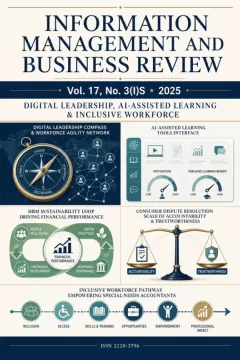 Vol. 17 No. 3(I)S (2025)
Digital Leadership, AI-Assisted Learning & Inclusive Workforce
View issue contents
Published
Submissions
Have research to publish? Information Management and Business Review welcomes submissions.
Make a Submission