Abstract
Taxation remains a vital and dependable source of revenue for governments, playing a key role in promoting social and economic development. In Libya, despite ongoing efforts to strengthen tax collection mechanisms, compliance among self-employed individuals remains persistently low, leading to substantial revenue shortfalls. The impact of public expenditure and perceived corruption on tax evasion, particularly within the context of Libya’s ongoing political instability, remains insufficiently explored in the existing literature. These factors may be important in molding the compliance of the taxpayer. This research sought to explore the effect of perceived corruption and public spending on tax evasion, while political instability was considered as a moderating variable. Questionnaires were distributed to 369 self-employed taxpayers in Libya which were analyzed by Smart-PLS version 4. Findings show that there is a positive and statistically significant relationship between perceived corruption and tax evasion while the relationship between public spending and tax evasion is negative and statistically significant. Though political instability does not significantly moderate the relationship between corruption and tax evasion, it does moderate the relationship between public spending and tax evasion. The results provide important policy implications that would benefit tax authorities aimed at increasing revenue collection and minimizing evasion in Libya's independent sector.
Keywords
- Perceived Corruption Search this journal for Perceived Corruption (opens in a new tab)
- Public Spending Search this journal for Public Spending (opens in a new tab)
- Political Instability Search this journal for Political Instability (opens in a new tab)
- Tax Evasion Search this journal for Tax Evasion (opens in a new tab)
- Libya Search this journal for Libya (opens in a new tab)
References
- Abodher, F. M., Ariffin, Z. Z., & Saad, N. (2020). Religious factors on tax non-compliance: Evidence from Libyan self-employed. Problems and Perspectives in Management, 18(1), 278–288. https://doi.org/10.21511/ppm.18(1).2020.24 DOI: https://doi.org/10.21511/ppm.18(1).2020.24
- Aca, E., & Dick, N. (2018). An Empirical Review of the Determinants of Tax Evasion in Nigeria: Emphasis on the Informal Sector Operators in Port Harcourt Metropolis. Journal of Accounting and Financial Management, 4(3). www.iiardpub.org
- Akdede, S. H. (2006). Corruption and Tax Evasion. Do?u? Üniversitesi Dergisi, 2(7), 141–149. https://doi.org/10.31671/dogus.2019.247 DOI: https://doi.org/10.31671/dogus.2019.247
- Al-Asfour, F., & McGee, R. W. (2024). Tax Evasion and Tax Compliance: What Have We Learned from the 100 Most Cited Studies? DOI: https://doi.org/10.2139/ssrn.4709193
- Alkhatib, A. A., Abdul-Jabbar, H., Abuamria, F., & Rahhal, A. (2019). The Effects of Social Influence Factors on Income Tax Evasion among the Palestinian SMEs. International Journal of Advanced Science and Technology, 28(17), 690–700.
- Alloza, M., Brunet, J., Forte-Campos, V., Moral-Benito, E., & Pérez, J. J. (2019). Government spending in Spain from a European perspective. Documentos Ocasionales No. 2217.
- Al-Rahamneh, N. M., Al Zobi, M. K., & Bidin, Z. (2023). The influence of tax transparency on sales tax evasion among Jordanian SMEs: The moderating role of moral obligation. Cogent Business & Management, 10(2). https://doi.org/10.1080/23311975.2023.2220478 DOI: https://doi.org/10.1080/23311975.2023.2220478
- Al-Rahamneh, N. M., & Bidin, Z. (2022). The Effect of Tax Fairness, Peer Influence, and Moral Obligation on Sales Tax Evasion among Jordanian SMEs. Journal of Risk and Financial Management, 15(9). https://doi.org/10.3390/jrfm15090407 DOI: https://doi.org/10.3390/jrfm15090407
- Amoh, J. K., Ofori-Boateng, K., Nsor-Ambala, R., & Anarfo, E. B. (2023). Revisiting the tax evasion and corruption–economic development nexus in Ghana: fresh evidence from a SEM approach. Journal of Economic and Administrative Sciences. https://doi.org/10.1108/JEAS-01-2023-0020 DOI: https://doi.org/10.1108/JEAS-01-2023-0020
- Anggareni, I. N., & Mujiyati, M. (2024). The Effect of Understanding Taxation, Justice, Discrimination, Tax Rates, Taxation Systems, Tax Sanctions on Student Perceptions of Tax Evasion. International Journal of Economics and Management Research, 3(2). https://doi.org/10.55606/ijemr.v3i2.203 DOI: https://doi.org/10.55606/ijemr.v3i2.203
- Azmi, A. C., Azmi, A. A. C., & Perumal, K. A. (2008). Tax Fairness Dimensions In An Asian Context: The Malaysian Perspective. In International Review of Business Research Papers, 4(5). https://www.researchgate.net/publication/242288892
- Bani-Khalid, T., Alshira’h, A. F., & Alshirah, M. H. (2022). Determinants of Tax Compliance Intention among Jordanian SMEs: A Focus on the Theory of Planned Behavior. Economies, 10(2). https://doi.org/10.3390/economies10020030 DOI: https://doi.org/10.3390/economies10020030
- Baron, R. M., & Kenny, D. A. (1986a). The Moderator-Mediator Variable Distinction in Social Psychological Research: Conceptual, Strategic, and Statistical Considerations. In Journal of Personality and Social Psychology, 51(6). DOI: https://doi.org/10.1037/0022-3514.51.6.1173
- Baron, R. M., & Kenny, D. A. (1986b). The Moderator-Mediator Variable Distinction in Social Psychological Research: Conceptual, Strategic, and Statistical Considerations. Journal of Personality and Social Psychology, 51(6). DOI: https://doi.org/10.1037/0022-3514.51.6.1173
- Ben Othman, H., Hussainey, K., & Moumen, N. (2023). The influence of cultural tightness–looseness, religiosity, and the institutional environment on tax evasion behaviour: A cross-country study. European Financial Management. https://doi.org/10.1111/eufm.12420 DOI: https://doi.org/10.1111/eufm.12420
- Carmelo Castellanos Polo, O., Alexander Velasquez Ochoa, J., Felipe Sanmartin Sanmartin, A., & Alberto García Arango, D. (2023). Tax evasion, corruption and tax administrative management. In the Russian Law Journal, 11(2). DOI: https://doi.org/10.52783/rlj.v11i2.509
- Fagbadebo, O. (2007). Corruption, Governance and Political Instability in Nigeria. African Journal of Political Science and International Relations, 1(2), 28–037. http://www.academicjournals.org/AJPSIR
- Gebrihet, H. G., Gebresilassie, Y. H., & Woldu, G. T. (2024). Trust, Corruption, and Tax Compliance in Fragile States: On a Quest for Transforming Africa into a Future Global Powerhouse. Social Sciences, 13(1). https://doi.org/10.3390/socsci13010003 DOI: https://doi.org/10.3390/socsci13010003
- Hair, J., & Alamer, A. (2022). Partial Least Squares Structural Equation Modeling (PLS-SEM) in second language and education research: Guidelines using an applied example. Research Methods in Applied Linguistics, 1(3), 100027. https://doi.org/10.1016/j.rmal.2022.100027 DOI: https://doi.org/10.1016/j.rmal.2022.100027
- Hair, J. F., Sharma, P. N., Sarstedt, M., Ringle, C. M., & Liengaard, B. D. (2024). The shortcomings of equal weights estimation and the composite equivalence index in PLS-SEM. European Journal of Marketing, 58(13), 30–55. https://doi.org/10.1108/EJM-04-2023-0307 DOI: https://doi.org/10.1108/EJM-04-2023-0307
- Haji-Othman, Y., & Yusuff, M. S. S. (2022). Assessing Reliability and Validity of Attitude Construct Using Partial Least Squares Structural Equation Modeling (PLS-SEM). International Journal of Academic Research in Business and Social Sciences, 12(5). https://doi.org/10.6007/ijarbss/v12-i5/13289 DOI: https://doi.org/10.6007/IJARBSS/v12-i5/13289
- Hope, K. R. (2022). Reducing corruption and bribery in Africa as a target of the Sustainable Development Goals: applying indicators for assessing performance. Journal of Money Laundering Control, 25(2), 313–329. https://doi.org/10.1108/JMLC-03-2021-0018 DOI: https://doi.org/10.1108/JMLC-03-2021-0018
- Iraman, E., Ono, Y., & Kakinaka, M. (2021). When do people become more willing to pay taxes? The effects of government spending information on the public’s willingness to pay taxes. The Social Science Journal, 1–12. https://doi.org/10.1080/03623319.2021.1969511 DOI: https://doi.org/10.1080/03623319.2021.1969511
- Irawan, F., & Utama, A. S. (2021). The impact of tax audit and corruption perception on tax evasion. International Journal of Business and Society, 22(3), 1158–1173. https://doi.org/10.33736/ijbs.4290.2021 DOI: https://doi.org/10.33736/ijbs.4290.2021
- Jeyapalan, K., & Abdul-Jabbar, H. (2014). Gender and Ethnicity Differences in Tax Compliance. https://www.researchgate.net/publication/43655798
- Khaltar, O. (2024). Tax evasion and governance quality: The moderating role of adopting open government. International Review of Administrative Sciences, 90(1), 276–294. https://doi.org/10.1177/00208523231197317 DOI: https://doi.org/10.1177/00208523231197317
- Kousar, S., Ahmed, F., Afzal, M., & Segovia, J. E. T. (2023). Is government spending in the education and health sectors necessary for human capital development? Humanities and Social Sciences Communications, 10(1). https://doi.org/10.1057/s41599-023-01514-3 DOI: https://doi.org/10.1057/s41599-023-01514-3
- Legate, A. E., Hair, J. F., Chretien, J. L., & Risher, J. J. (2023). PLS-SEM: Prediction-oriented solutions for HRD researchers. Human Resource Development Quarterly, 34(1), 91–109. https://doi.org/10.1002/hrdq.21466 DOI: https://doi.org/10.1002/hrdq.21466
- Litina, A., & Palivos, T. (2014). Corruption, Tax Evasion and Social Values.
- McGee, R., Aljaaidi, K. S., & Musaibah, A. S. (2012). The Ethics of Tax Evasion: A Survey of Administrative Sciences’ Students in Yemen. International Journal of Business and Management, 7(16). https://doi.org/10.5539/ijbm.v7n16p1 DOI: https://doi.org/10.5539/ijbm.v7n16p1
- Mishi, S., & Tshabalala, N. (2023). Public finance in South Africa: Tax compliance and behavioral responses to tax increases. Africa’s Public Service Delivery and Performance Review, 11(1). https://doi.org/10.4102/apsdpr.v11i1.662 DOI: https://doi.org/10.4102/apsdpr.v11i1.662
- Mugarura, A., Kaberuka, W., Tweheyo, G., & Muramuzi, B. (2021). Tax Understanding, Tax Awareness and Tax Compliance in Nakawa Division, Kampala District, Uganda: The Moderating Role of Public Trust, International Journal of Social Science and Economic Research. https://doi.org/10.46609/IJSSER.2021.v06i11.005
- Novita, S., Lasmana, M. S., Yusof, N. A. M., Safeei, R., & Chuen, L. C. (2024). Trust in Government and Tax Compliance in Indonesia and Malaysia: Do Ethics and Tax Amnesty Matter? International Journal of Economics and Financial Issues, 14(6), 10–22. https://doi.org/10.32479/ijefi.16925 DOI: https://doi.org/10.32479/ijefi.16925
- Obaid, M. M. A., Ibrahim, I., & Udin, N. M. (2020). An investigation of the determinants of tax compliance among Yemeni manufacturing SMEs using the Fisher model. International Journal of Psychosocial Rehabilitation, 24(4), 1809–1824. https://doi.org/10.37200/IJPR/V24I4/PR201289 DOI: https://doi.org/10.37200/IJPR/V24I4/PR201289
- Obaid, M. M., & Udin, N. M. (2020). Corruption and tax noncompliance variables: An empirical investigation from Yemen. International Journal of Financial Research, 11(4), 52–63. https://doi.org/10.5430/ijfr.v11n4p52 DOI: https://doi.org/10.5430/ijfr.v11n4p52
- Ogungbade, O. I., Enitan, A., & Adekoya, A. C. (2021). Tax Awareness, Taxpayers’ Perceptions and Attitudes and Tax Evasion in the Informal Sector of Ekiti State, Nigeria. International Journal of Financial Research, 12(5), 24. https://doi.org/10.5430/ijfr.v12n5p24 DOI: https://doi.org/10.5430/ijfr.v12n5p24
- Posadnieva, O., & Sidelnykova, L. (2024). Fiscal and Psychological Factors of Tax Evasion. Socio-Economic Relations in the Digital Society, 1(51), 97–107. https://doi.org/10.55643/ser.1.51.2024.549 DOI: https://doi.org/10.55643/ser.1.51.2024.549
- Rashid, M. H. U., Buhayan, M. S. A., Masud, M. A. K., & Sawyer, A. (2021). Impact of governance quality and religiosity on tax evasion: Evidence from OECD countries. Advances in Taxation, 29, 89–110. Emerald Group Holdings Ltd. https://doi.org/10.1108/S1058-749720210000029007 DOI: https://doi.org/10.1108/S1058-749720210000029007
- Rashid, M. H. U., Uddin, N., Haque, M. S., & Hossain, S. Z. (2022). Good governance and tax evasion: mediating effect of socioeconomic conditions. Asia-Pacific Journal of Regional Science, 6(2), 759–776. https://doi.org/10.1007/s41685-022-00242-x DOI: https://doi.org/10.1007/s41685-022-00242-x
- Saddaf, N., Mehmood, M. T., Pitafi, A., & Husain, S. (2022). Government Trust as a Significant Determinant of Tax Compliance: A Study of Pakistan. Journal of Applied Economics and Business Studies, 6(2), 95–104. https://doi.org/10.34260/jaebs.626 DOI: https://doi.org/10.34260/jaebs.626
- Senan, N. A. M. (2024). The Moderating Role of Corporate Governance on the Associations of Internal Audit and Its Quality with the Financial Reporting Quality: The Case of Yemeni Banks. Journal of Risk and Financial Management, 17(3). https://doi.org/10.3390/jrfm17030124 DOI: https://doi.org/10.3390/jrfm17030124
- Sidik, M. H. J., Zandi, G. R., & Ruhoma, A. S. A. (2019). Examining the influence of fairness perception on tax compliance behavior of the Libya individual taxpayers: The moderating effect of tax awareness and tax complexity. Humanities and Social Sciences Reviews, 7(2), 519–525. https://doi.org/10.18510/hssr.2019.7261 DOI: https://doi.org/10.18510/hssr.2019.7261
- Tawiah, P. A., Appiah-Brempong, E., Okyere, P., Adu-Fosu, G., & Ashinyo, M. E. (2025). Prevalence, predisposing factors, and turnover intention related to low back pain among health workers in Accra, Ghana. PloS One, 20(1), e0317582. https://doi.org/10.1371/journal.pone.0317582 DOI: https://doi.org/10.1371/journal.pone.0317582
- Torgler, B. (2011). Tax Morale and Compliance Review of Evidence and Case Studies for Europe. http://econ.worldbank.org. DOI: https://doi.org/10.1596/1813-9450-5922
Downloads
Full-text downloads recorded for this article, by month.
No downloads have been recorded for this article yet. Figures appear here once readers begin downloading the full text.
How to Cite
Share this article
License
Copyright (c) 2026 Salh Agrerah Ali Mohamed, Morni Hayati Jaafar Sidik, Haslina Hassan (Author)

This work is licensed under a Creative Commons Attribution 4.0 International License.
Author (s) should affirm that the material has not been published previously. It has not been submitted and it is not under consideration by any other journal. At the same time author (s) need to execute a publication permission agreement to assume the responsibility of the submitted content and any omissions and errors therein. After submission of revised paper in the light of suggestions of the reviewers, the editorial team edits and formats manuscripts to bring uniformity and standardization in published material.
This work will be licensed under Creative Commons Attribution 4.0 International (CC BY 4.0) and under condition of the license, users are free to read, copy, remix, transform, redistribute, download, print, search or link to the full texts of articles and even build upon their work as long as they credit the author for the original work. Moreover, as per journal policy author (s) hold and retain copyrights without any restrictions.
Keywords
- Perceived Corruption Search this journal for Perceived Corruption (opens in a new tab)
- Public Spending Search this journal for Public Spending (opens in a new tab)
- Political Instability Search this journal for Political Instability (opens in a new tab)
- Tax Evasion Search this journal for Tax Evasion (opens in a new tab)
- Libya Search this journal for Libya (opens in a new tab)
Section
Published in
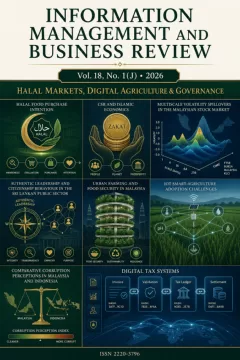 Vol. 18 No. 1(I) (2026)
Halal Markets, Digital Agriculture & Governance
View issue contents
Published
Submissions
Have research to publish? Information Management and Business Review welcomes submissions.
Make a Submission