Abstract
Corruption remains a major challenge to governance, public trust, and institutional legitimacy in Southeast Asia. This study compares trends in the Corruption Perceptions Index (CPI) in Malaysia and Indonesia from 2012 to 2024 using annual data published by Transparency International. It examines how changes in CPI scores and rankings corresponded with major political transitions, institutional reforms, and anti-corruption developments in both countries. Through a qualitative approach, this study interprets CPI trends alongside key political and governance events identified through content analysis. The findings show that Malaysia recorded higher CPI scores than Indonesia throughout the period, although its performance remained unstable post 2020 amid political turnover and governance uncertainty. In Indonesia, CPI data observed pre-2020 were not sustained, with subsequent declines coinciding with reforms widely seen as weakening the autonomy of the Corruption Eradication Commission (KPK). These patterns imply that improvements in corruption perception are difficult to sustain without institutional continuity, credible enforcement, and political commitment to reform. By comparing two neighboring democracies with different reform paths, this study contributes to the broader debate on corruption, governance, and political accountability and offers policy-relevant insights to strengthen anti-corruption institutions in both countries.
Keywords
- Corruption Perception Index Search this journal for Corruption Perception Index (opens in a new tab)
- Governance Search this journal for Governance (opens in a new tab)
- Political Transition Search this journal for Political Transition (opens in a new tab)
- Malaysia Search this journal for Malaysia (opens in a new tab)
- Indonesia Search this journal for Indonesia (opens in a new tab)
References
- Butt, S. (2019). Anti-corruption reform in Indonesia: An obituary? Bulletin of Indonesian Economic Studies, 55(1), 25–44.
- Cahyawati, D., Chandranegara, I., Burhanuddin, N., & Yani, A. (2023). Comparative presidential’s role, systems and constitutional practice between Indonesia and South Korea. Jurnal Dinamika Hukum, 23(1), 142. https://doi.org/10.20884/1.jdh.2023.23.1.3521
- Hamilton-Hart, N. (2001). Corruption and economic policy in Southeast Asia. Asian Survey, 41(5), 741–756. https://doi.org/10.1525/as.2001.41.5.741
- Heywood, P. M. (2016). Rethinking Corruption: Hocus-Pocus, Locus and Focus. Slavonic and East European Review, 95(1), 1–19.
- Hussein, A., Khamis, K. A., Omar, R., & Razak, M. A. A. (2024). Factors Influencing Foreign Direct Investment (Fdi) Inflows from West Asia/Middle East to Malaysia Between 2018 And 2023: A Qualitative Analysis from a Political Economic Perspective. International Journal of Religion, 5(11), 4664–4676. https://doi.org/10.61707/dhyhga80
- International Monetary Fund (IMF). (2025). World Economic Outlook (WEO) data mapper: Labor productivity. https://www.imf.org/external/datamapper/LP@WEO/VNM/IDN/ PHL/MMR/MYS/KHM/LAO/THA/SGP/BRN.
- Johnston, M. (2014). Corruption, contention, and reform: The power of deep democratization. Cambridge University Press.
- Jones, D. S. (2020). 1MDB corruption scandal in Malaysia: a study of failings in control and accountability. Public Administration and Policy, 23(1), 59–72. https://doi.org/10.1108/PAP-11-2019-0032
- Jones, D. S. (2022). Challenges in combating corruption in Malaysia: issues of leadership, culture and money politics. Public Administration and Policy, 25(2), 136–149. https://doi.org/10.1108/PAP-01-2022-0002
- Kaufman, D., Kraay, A., & Zoido-Lobaton, P. (2011). Governance matters From Measurement to Action. Leading and Managing Schools, 37(2), 10–13. https://doi.org/10.4135/9781446288870.n3
- Khan, M. H. (2018). Political settlements and the analysis of institutions. African Affairs, 117(469), 636–655. https://doi.org/10.1093/afraf/adx044
- Malaysia Anti-Corruption Commission. (2019). National Anti-Corruption Plan 2019-2023. / https://www.pmo.gov.my/wp-content/uploads/2019/07/National-Anti-Corruption-Plan-2019-2023_.pdf
- Mallow, M. S. (2018). Corruption: The law and challenges in Malaysia. Proceedings of ADVED 2018 - 4th International Conference on Advances in Education and Social Sciences, 59–61.
- Mohamed Noor, M. N. (2021). Pakatan Harapan’s First Year in Putrajaya: Reform and Resistance. Journal of Strategic Studies & International Affairs, 1(1), 7–29. https://doi.org/10.17576/sinergi.0101.2021.02
- Mungiu-Pippidi, A. (2015). The Quest for Good Governance. The Quest for Good Governance. https://doi.org/10.1017/cbo9781316286937
- Najih, M., & Wiryani, F. (2020). Learning the social impact of corruption: A study of legal policy and corruption prevention in indonesia and malaysia. Journal of Social Studies Education Research, 11(4), 175–189.
- Public Procurement Service (PPS) Korea. (n.d.). KONEPS (Korea ON-line E-Procurement System). Retrieved April 4, 2025, from https://pps.go.kr/eng/content.do?key=00777
- Putriyana, A., & Rochaeti, N. (2021). The Impact of Enforcement of Corruption Law by the Corruption Eradication Commission after the Ratification of the Latest KPK Law. Jurnal Penelitian Hukum De Jure, 21(3), 299. https://doi.org/10.30641/dejure.2021.v21.299-310
- Ramli, R. M. (2001). E-Government Implementation Challenges in Malaysia and South Korea: A Comparative Study. Electronic Journal of Information Systems in Developing Countries, 4(1), 1–2. https://doi.org/10.1002/j.1681-4835.2001.tb00023.x
- Rose-Ackerman, S. (1999). Corruption and government: Causes, consequences, and reform. Cambridge University Press.
- Siddiquee, Noore Alam, H. Z. (2022). Absolute power, absolute venality: The politics of corruption and anti-corruption in Malaysia. Public Integrity, 24(1), 1–17.
- Transparency International. (2025). Corruption Perception Index. https://www.transparency.org
- United Nations. (2025). E-Government Knowledge Database: Data Center. https://publicadministration.un.org/egovkb/en-us/Data-Center
- Warganegara, A., Makhya, S., & Drajat, D. K. (2019). Globalization, Democratization and Political Change in Malaysia (New Media And 2018 Elections). Journal of Governance, 4(2). https://doi.org/10.31506/jog.v4i2.6870
- Wibisana, A. G., & Marbun, A. N. (2018). Corporate criminal liability in Indonesia anti-corruption law:Does it work properly? Asian Journal of Law and Economics, 9(1).
- World Bank. (1992). Governance and Development.
Downloads
No downloads have been recorded for this article yet. Figures appear here once readers begin downloading the full text.
How to Cite
Share this article
License
Copyright (c) 2026 Nor Aishah Mohd Ali, Rozaiha Ab Majid, Siti Aisyah Basri, Bayu Tri Cahya, Mohd Waliuddin Mohd Razali (Author)

This work is licensed under a Creative Commons Attribution 4.0 International License.
Author (s) should affirm that the material has not been published previously. It has not been submitted and it is not under consideration by any other journal. At the same time author (s) need to execute a publication permission agreement to assume the responsibility of the submitted content and any omissions and errors therein. After submission of revised paper in the light of suggestions of the reviewers, the editorial team edits and formats manuscripts to bring uniformity and standardization in published material.
This work will be licensed under Creative Commons Attribution 4.0 International (CC BY 4.0) and under condition of the license, users are free to read, copy, remix, transform, redistribute, download, print, search or link to the full texts of articles and even build upon their work as long as they credit the author for the original work. Moreover, as per journal policy author (s) hold and retain copyrights without any restrictions.
Keywords
- Corruption Perception Index Search this journal for Corruption Perception Index (opens in a new tab)
- Governance Search this journal for Governance (opens in a new tab)
- Political Transition Search this journal for Political Transition (opens in a new tab)
- Malaysia Search this journal for Malaysia (opens in a new tab)
- Indonesia Search this journal for Indonesia (opens in a new tab)
Section
Published in
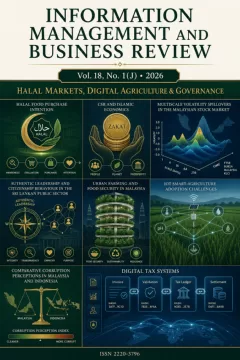 Vol. 18 No. 1(J) (2026)
Halal Markets, Digital Agriculture & Governance
View issue contents
Published
Submissions
Have research to publish? Information Management and Business Review welcomes submissions.
Make a Submission