Abstract
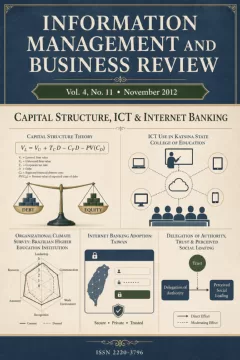
The paper analyze the frequency of academic staff and students use of information and communication technology {Ict} in Katsina State College of Education, it explore the ability of staff and students in computer application 114 academic staff and 1995 students were engaged in the study. A survey research design was used; the data collected was analyzed using percentage to present the responses. 4 point Likert-scale was used, while a mean of 2.50 was adopted to determine the higher and lower participation in the use of ICT and ability in computer application. The finding show that the use of ICT in the College is high [m=2.78 higher than m=2.50]. The study also indicated that the academic staff are more competent in the use of wide range of computer applications than students are [m=3.08and 2.56 respectively] the study reveals that the staff and students actually engaged in the use of ICT almost on a daily basis for both school learning and individual use. The researchers therefore recommend that this study should be carried out in all the tertiary institutions in Nigeria to clarify the uncertainty of the frequency of ICT use in Nigeria schools.
Keywords
- Information Search this journal for Information (opens in a new tab)
- Communication Search this journal for Communication (opens in a new tab)
- Technology Search this journal for Technology (opens in a new tab)
- Frequency Search this journal for Frequency (opens in a new tab)
- Competency Search this journal for Competency (opens in a new tab)
References
- Babalola, J. B., Akpa, G. O. & Imam, H. (2008). Managing Education for Sustainable Development in Developing Countries. NAEAP, Mokola Ibadan.
- Badamasi, J. (2010). Re Invigorating Information and Communication Technology (ICT) for a visionary Nigeria. Isa Kaita Multidisciplinary Journal of Education , 4(1).
- Farell, G. & wachol, Z. (2003). Meta survey on the use of Technologies in Education in Asia and the pacific in: visiada C. Zembulas M; & Legaspi, J.M.B empower ICT: e-learning for in Service Teacher Education and Supports.
- Keengwe, J. (2007). Faculty Integration of Technology in to Instruction and students perceptions of Computer Technology to improve students’ learning. Journal of information technology education , 6, 169-180.
- Marwan, A. (2008). An analysis of Australian student’s use of information and communication technology (ICT) available at www.itdl.org/article05.ltm
- National centre of educational statistics. (2000). Teachers tools for the 21st century. Reports on teacher’s use of technology in Usida; c. Zembulas. M & legasp PMB empower ICT; e-learning for In–service teachers’ education and support. International journal of computer the internet and management , 12, 281-86.
- Nwikina, L. (2010). University of Lagos communities level of satisfactions with the self-reliance measure at the institutions. Nigerian Journal of Curriculum Theories & Educational Technologist , 1(1).
- Nworgu, B. G. (1995). Educational Research: basic issues and Methodology, Ibadan: wisdom publishers limited.
- UNESCO. (2003). Mapping Globalization: Selected Cross-cutting issues: role of ICT in bridging the digital divide in selected area. Economic and Social Commission for Asia and the pacific.
Downloads
No downloads have been recorded for this article yet. Figures appear here once readers begin downloading the full text.
How to Cite
Share this article
License
Copyright (c) 2012 Mbaba, A. E., Shema, I. M. (Author)

This work is licensed under a Creative Commons Attribution 4.0 International License.
Author (s) should affirm that the material has not been published previously. It has not been submitted and it is not under consideration by any other journal. At the same time author (s) need to execute a publication permission agreement to assume the responsibility of the submitted content and any omissions and errors therein. After submission of revised paper in the light of suggestions of the reviewers, the editorial team edits and formats manuscripts to bring uniformity and standardization in published material.
This work will be licensed under Creative Commons Attribution 4.0 International (CC BY 4.0) and under condition of the license, users are free to read, copy, remix, transform, redistribute, download, print, search or link to the full texts of articles and even build upon their work as long as they credit the author for the original work. Moreover, as per journal policy author (s) hold and retain copyrights without any restrictions.
Keywords
- Information Search this journal for Information (opens in a new tab)
- Communication Search this journal for Communication (opens in a new tab)
- Technology Search this journal for Technology (opens in a new tab)
- Frequency Search this journal for Frequency (opens in a new tab)
- Competency Search this journal for Competency (opens in a new tab)
Section
Published
Submissions
Have research to publish? Information Management and Business Review welcomes submissions.
Make a Submission