Abstract
The constantly intensifying demand for mobility has generated enormous market opportunities for telecom companies. The Internet has transformed lives of the Homo sapiens over the last decade in manners beyond the horizons of imaginations. 4G; the new kid on the block is the abbreviation for fourth-generation wireless; the phase of mobile communications providing high quality connections for transportable devices. By drawing on the attributes of the Technology Acceptance Model (TAM) which is an established methodology in technology based product acceptance researches; this paper contemplates the factors that influence the intentions of Malaysian college and university students to adopt 4G broadband for academic and for pleasure purposes. A theoretical framework has been proposed for this study which consisting of four independent variables, namely Perceived Ease of Use, Perceived Usefulness, Subjective Normand Perceived Enjoyment. The dependent variable of this study is Intention to Use.
Keywords
- Customer Attitude Search this journal for Customer Attitude (opens in a new tab)
- Internet Search this journal for Internet (opens in a new tab)
- Product Diffusion Search this journal for Product Diffusion (opens in a new tab)
- TAM Search this journal for TAM (opens in a new tab)
- Technology Search this journal for Technology (opens in a new tab)
References
- Adams, D. A., Nelson, R. R. & Todd, P. A. (1992). Perceived usefulness, ease of use, and usage of information technology: a replication. MIS Quarterly, 16(2), 227-47.
- Ajzen, I. (1991). The theory of planned behavior. Organizational Behaviour and Human Decision Processes 50(2), 179-211.
- Ajzen, I., Fishbein, M. (1980). Understanding attitudes and predicting social behavior. Englewood Cliffs, NJ; Prentice-Hall.
- Bagozzi, R. P. & Yi, Y. (1988). On the evaluation of structural equation models. Journal of the Academy of Marketing Science, 16(1), 74-94.
- Chen, L. G. (2008). The presence and usage of computer technology and the internet in the classroom: An examination of secondary school students’ and teachers' attitudes. The Claremont Graduate University, 2008. 3294590. ProQuest Dissertations and Theses.
- Childers, T. L., Carr, C. L., Peck, J. & Carson, S. (2001). Hedonic and utilitarian motivations for online retail shopping behavior. Journal of Retailing, 77(4), 511-35.
- Clarke, R. (2001). Person-location and person-tracking: Technologies, risks and policy implications. Information Technology and People Summer , 3, 206-231.
- Conner, M. & Armitage, C. J. (1998).Extending the theory of planned behavior: a review and avenues for future research. Journal of Applied Social Psychology, 28(15), 1429-64.
- Dabholdar, P. A. (1996). Consumer Evaluations of New Technology-based Self-service Options: An Investigation of Alternative Models of Service Quality. International Journal of Research in Marketing, 13(1), 29-51.
- Davis, F. D. (1989). Perceived usefulness, perceived ease of use, and user acceptance of information technology. MIS Quarterly, 13(3), 319-40.
- Davis, F. D. (1993). User acceptance of information technology: system characteristics, user perceptions and behavioral impacts. International Journal of Man-Machine Studies, 38(3), 475-87.
- Davis, F. D., Bogazzi, R. P. & Warshaw, P. R. (1989). User acceptance of computer technology: a comparison of two theoretical models. Management Science, 35(8), 982-1003.
- Davis, F. D., Bagozzi, R. P. & Warshaw, P. R. (1992). Extrinsic and intrinsic motivation to use computers in the workplace. Journal of Applied Social Psychology , 22 , 1111–1132.
- Drennan, J., Kennedy, J. & Pisarski, A. (2005). Factors affecting student attitudes toward flexible online learning in management education. The Journal of Educational Research, 98(6), 331-8.
- Fishbein, M. & Ajzen, I. (1975). Belief, Attitude, Intention and Behavior: An Introduction to Theory and Research, Addison-Wesley, Reading, MA.
- Gary, D. M. (2005). Student use of the Internet. Journal of Educational. Technology Systems, 33(1), 53-66.
- George, S. F. & Thomas, M. K. (2005.). Broadband and Economic Development: A Municipal Case Study from Florida.
- Gianluigi, G., Alberto, M. & Alessandro, M. P. (2011). Nature and antecedents of a marketing approach according to Italian SME entrepreneurs: A structural equation modeling approach. International Journal of Entrepreneurial Behaviour & Research, 17(4), 342 – 360.
- Hans-van-der, H. (2004). User Acceptance of Hedonic Information Systems. MIS Quarterly, 28(4), 695-704.
- Hong, S. J., Thong, J. Y. L., Moon, J. Y. & Tam, K. Y. (2008). Understanding the behavior of mobile data services consumers, 431-445.
- Hsu, C. L. & Lin, J. C. C. (2008). Acceptance of blog usage: the roles of technology acceptance, social influence and knowledge-sharing motivation. Information and Management, 45(1), 65-74.
- Hsu, C. L. & Lu, H. P. (2004). Why do people play online games? An extended TAM with social influences and flow experience. Information and Management, 41, 853-68.
- Huang, J. H., Lin, Y. R. & Chuang, S. T. (2007). Elucidating user behavior of mobile learning: A perspective of the extended Technology Acceptance Model. Electronic Library, 45(6), 387-393.
- Hu, L. & Bentler, P. M. (1999). Cutoff criteria for fit indexes in covariance structure analysis: conventional criteria versus new alternatives. Structural Equation Modeling, 6(1), 1-55.
- June, L., James, E. Y. & Chun-Sheng, Y. (2005). Personal innovativeness, social influences and adoption of wireless Internet services via mobile technology. The Journal of Strategic Information Systems, 14(3), 245-268.
- Legris, P., Ingham, J. & Collerette, P. (2003). Why do people use information technology? A critical review of the technology acceptance model. Information & Management , 40(2), 191-204.
- Liao, Z. & Cheung, M. T. (2001). Internet-based e-Shopping and Consumer Attitudes: An Empirical Study. Information and Management, 38(5), 299-306.
- Liao, Z. & Lichtensteiny, S. (2006). Consumer Acceptance of Third Generation Mobile Value-added Services: A Survey of Hong Kong Consumer Perceptions.
- Li, X., Hess, T. J. & Valacich, J. S. (2008). Why do we trust new technology? A study of initial trust formation with organizational information systems. The Journal of Strategic Information Systems, 17(1), 39-71.
- Lopez-Nicolas, C., Molina-Castillo, F. J. & Bouwman, H. (2008). An assessment of advanced mobile services acceptance: contributions from TAM and diffusion theory models. Information and Management, 45(6), 359-64.
- Lubans, J. (1998). How first-year university students use and regard Internet resources. Available from Duke University Libraries Web site: www.lib.duke.edu/staff/orgnztn/lubans/docs/1styear/firstyear.htm
- Lubans, J. (1999). Students and the Internet. Available from Duke University Libraries Web site: www.lib.duke.edu/staff/orgnztn/lubans/docs/study3.htm.
- Lucy, F. & David, M. (2005). B roadband: benefits and problems. Telecommunications Policy , 29(2–3), 223-236.
- Lu, W. W. & Lu, P. D. P. W. (2006). Open Wireless Architecture (OWA) Open Wireless Architecture (OWA)– Defining China’s Fourth Defining China’s Fourth Defining China’s Fourth Generation Mobile Communications Generation Mobile Communications.
- Marcelline, F. & Subhash, D. (2005). An exploration of student internet use in India: the technology acceptance model and the theory of planned behavior. Campus-Wide Information Systems, 22(4), 233 – 246.
- Mathieson, K. (1991). Predicting user intentions: comparing the technology acceptance model with the theory of planned behavior. Information Systems Research, 2(3), 173-91.
- Metzgera, M. J., Flanagina, A. J. & Zwarunb, L. (2003). College student Web use, perceptions of information credibility, and verification behavior. Computers & Education, 41, 271-290.
- Mohamed, S. & Chtourou, N. S. (2010). Rethinking the TAM model: time to consider fun. Journal of Consumer Marketing, 27(4), 336 – 344.
- Noureddine, B., Mohammad, S. & Obaidat, F. Z . (2008). Intelligent network functionalities in wireless 4G networks: Integration scheme and simulation analysis. Computer Communications, 31(16), 37523759.
- Ong, C. H. & Lai, J. Y. (2006). Gender differences in perceptions and relationships among dominants of e- learning acceptance. Computers in Human Behavior, 22(5), 816-29.
- Oscar, P. (2008). A Social Cognitive Perspective on Mobile Communication Technology Use and Adoption. Social Science Computer Review, 27(1), 76-95.
- Pagani, M. & Fine, C. H. (2008). Value network dynamics in 3G-4G wireless communications: A systems thinking approach to strategic value assessment. Journal of Business Research, 61, 1102-1112.
- Pavlou, P. A. & Fygenson, M. (2006). Understanding and predicting electronic commerce adoption: an extension of the theory of planned behavior. MIS Quarterly, 30(1), 115-43.
- Pew Research Center. (15 September, 2002).The Internet goes to college: how students are living in the future with today’s technology. Available: www.pewinternet.org/reports/pdfs/PIP_College_Report.pdf
- Prensky, M. (2001). Digital Natives Digital Immigrants. 9 .
- Ramayah, T., Chin, Y. L., Norazah, M. S. & Amlus, I. (2005). Determinants of Intention to Use an Online Bill Payment System among MBA Students. E-Business, 9, 80-91.
- Sabri, M. F., MacDonald, M., Masud, J., Paim, L., Hira, T. K. & Othman, M. A. (2008). Financial Behavior and Problems among College Students in Malaysia: Research and Education Implication. Consumer Interests Annual, 54(2).
- Samuel, Y. (2012). Mobile applications and 4G wireless networks: a framework for analysis. Campus-Wide Information Systems, 29(2) .
- Shackleford, J., Thompson, D. S. & James, M. B. (1999). Teaching strategy and assignment design: assessing the quality and validity of information via the Web. Social Science Computer Review , 17(2), 196–208.
- Szajna, B. (1996) Empirical Evaluation of the Revised Technology Acceptance Model , Management Science, 42, 85-92.
- Timothy, T. (2011). Modeling the determinants of pre-service teachers' perceived usefulness of e-learning. Campus-Wide Information Systems, 28(2), 124 – 140.
- Ulun, A. & Nuray, T. (2012). Marketing Intelligence & Planning, 30(4), 444-459.
- Venkatesh, V. & Davis, F. D. (1996). A model of the antecedents of perceived ease of use: development and test. Decision Sciences , 27(3), 451-81.
- Venkatesh, V. & Davis, F. D. (2000). A theoretical extension of the technology acceptance model: four longitudinal field studies. Management Science, 46(2), 184-204.
Downloads
No downloads have been recorded for this article yet. Figures appear here once readers begin downloading the full text.
How to Cite
Share this article
License
Copyright (c) 2013 Wong Lai Soon, Neerjang Lama, Bobby Chai Boon Hui, Wong Kee Luen (Author)

This work is licensed under a Creative Commons Attribution 4.0 International License.
Author (s) should affirm that the material has not been published previously. It has not been submitted and it is not under consideration by any other journal. At the same time author (s) need to execute a publication permission agreement to assume the responsibility of the submitted content and any omissions and errors therein. After submission of revised paper in the light of suggestions of the reviewers, the editorial team edits and formats manuscripts to bring uniformity and standardization in published material.
This work will be licensed under Creative Commons Attribution 4.0 International (CC BY 4.0) and under condition of the license, users are free to read, copy, remix, transform, redistribute, download, print, search or link to the full texts of articles and even build upon their work as long as they credit the author for the original work. Moreover, as per journal policy author (s) hold and retain copyrights without any restrictions.
Keywords
- Customer Attitude Search this journal for Customer Attitude (opens in a new tab)
- Internet Search this journal for Internet (opens in a new tab)
- Product Diffusion Search this journal for Product Diffusion (opens in a new tab)
- TAM Search this journal for TAM (opens in a new tab)
- Technology Search this journal for Technology (opens in a new tab)
Section
Published in
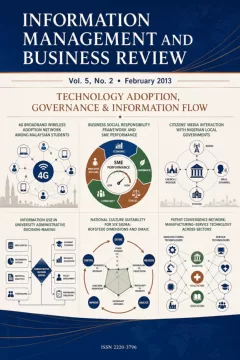 Vol. 5 No. 2 (2013)
Technology Adoption, Governance & Information Flow
View issue contents
Published
Submissions
Have research to publish? Information Management and Business Review welcomes submissions.
Make a Submission