Abstract
Business social responsibility (BSR) is receiving an increasingly significant issue for economic agents all over the world, due to a new attention to all the aspects of firm’s activities and their relationships with stakeholders. However few studies have considered the influence of BSR and organizational performances. Even if any the finding reveals inconsistencies’. Hence a mediating mechanism is suggested. This paper aims to provide a propose framework that examine the relationship between BSR and SMEs performance with mediating effect of organizational culture. Based on literature review, this paper proposes four constructs which can be used to identify the implementation at firm level. The constructs are commitment, passiveness, organizational culture, and SMEs performance.
Keywords
- BSR Commitment Search this journal for BSR Commitment (opens in a new tab)
- BSR Passiveness Search this journal for BSR Passiveness (opens in a new tab)
- Organisational Culture Search this journal for Organisational Culture (opens in a new tab)
- Organisational Performance Search this journal for Organisational Performance (opens in a new tab)
References
- Allen, N. J. & Meyer, J. P. (1990).The Measurement and Antecedents of Affective, Commitment and Normative Commitment to the Organization. Journal of Occupational Psychology , 18(1).
- Amaeshi, K., Adi, B., Ogbechie, C. & Amao, O. (2006). Corporate Social Responsibility in Nigeria: Western Mimicry or Indigenous influence? No 39-2006, ICCSR Research paper series-ISSN 1479-5124, The University Nottingham.
- Ambrose, M. L., Arnaud, A. & Schminke, M. (2008). Individual Moral Development and Ethical Climate: The influence of Person-Organization Fit on Job Attitudes. Journal of Business Ethics , 77, 323-333.
- Argenti, P. A. & Thea, S. H. (2006). Get Your Act Together. Harvard Business Review , 84(10), 26.
- Baron, R. M. & Kenny, D. A. (1986). Moderator-mediator variable distinction in social psychological research: conceptual, strategic and statistical considerations. Journal of Personality and Social Psycholog y, 6, 1173-1182.
- Beneke, J., Wanke, E., Pelteret, T. & Gordon, D. (2012). Don’t bank on it: Delineating the relationship between corporate social responsibility and retail banking affinity. South Africa Journal of Business Management, 43(1).
- Berrone, P., Surroca, J. & Tribo, J. A. (2007). Corporate Ethical Identity as Determinant of Firm Performances: A Test of the Mediating Role of Stakeholder Satisfaction. Journal of Business Ethics, 76, 35-53.
- Bowen, H. P. (1953). Social Responsibilities of the Businessman (Harper, New York). Business for social responsibility (BSR), (2005), Introduction (Online) available at www.bsr.org. (Accessed March 2005).
- Cameron, K. S. & Freeman, S. J. (1991). Cultural congruence, strength, and type: relationships to effectiveness. Research in Organizational Change and Development, 5, 23-58.
- Carroll, A. B. (1979). A Three-dimensional conceptual model of corporate social performance. Research in corporate social performance and policy, 4.
- Carroll, A. B. (1989). The Pyramid of corporate social responsibility: Toward the moral management of organizational stakeholders. Business horizon , 34(4), 39-48.
- Carroll, A. B. (1999). Corporate social responsibility: evolution of a definitional construct. Business and society, 38(3), 268-295.
- Carroll, A. B. & Shabana, K. M. (2010). The business case for corporate social responsibility: a review of concepts, research and practice. International Journal of Management Reviews, 12(1), 85-105.
- Carton, R. B. & Hofer, C. W. (2006). Measuring organizational performance: metrics for entrepreneurship and strategic management research. Cheltenham, UK; Northampton, MA: Edward Elgar.
- Carneiro, J. M. T., Silva, J. F., Rocha, A. & Dib, L. A. R. (2007). Building a better measure of business performance. RAC-Eletrônica, 1 (2), 114-135.
- Combs, J. G., Crook, T. R. & Shook, C. L. (2005). The dimension of organizational performance and its implications for strategic management research. In D. J. Ketchen & D. D. Bergh (Eds.), Research methodology in strategy and management (259-286). San Diego: Elsevier.
- Connolly, T., Conlon, E. J. & Deutsch, S. J. (1980). Organizational effectiveness: a multiple constituencies approach. Academy of Management Review, 5(2), 211-217.
- Cooke, R. A. & Rousseau, D. M. (1998). Behavioural norms and expectations: A quantitative approach to the assessment of organizational culture. Group and Organizational Studies , 13(3), 245-273.
- Chew, J. & Chan, C. C. A. (2006). Human resource practices, organizational commitment and intention to stay. International Journal of Manpower , 29(6), 503-522.
- Daft, R. L. (2005). The Leadership Experience , 3rd ed. Thomson-South western: Canada.
- Davis, K. (1960). Can Business Afford to Ignore Social Responsibilities? California Management Review , 3, 70-76.
- Dewan, M. H. (2009). Social responsibility of business organizations: Bangladesh Perspective. Research papers series. SSRN.
- Drucker, P. F. (1993). Post capitalist society, Butter worth Heinemann, Oxford.
- Fang, S., Huang, C. & Stephanie, W. (2010). Corporate social responsibility strategies, dynamic capability and organizational performance: Cases of top Taiwan- selected benchmark enterprises. African journal of Business Management , 4(1), 120-132.
- Fombrun, C. J. & Shanley, M. (1990). What’s in a Name? Reputation building and corporate strategy, Academy of management journal , 33(2).
- Freeman, E. R. (1984). Strategic Management: A Stakeholder Approach (Pitman, Boston, MA).
- Friedman, M. (1962). Capitalism and Freedom. University of Chicago press
- Frooman, J. (1997). Socially Irresponsible and Illegal Behaviour and Shareholder Wealth: A Meta-Analysis of Event Studies. Business & Society , 36(3), 221–249.
- Glautier, H. & Underdown, C. (2000). Accounting Theory and Practice. Pitman Publishing, London.
- Galbreath, J. (2010). Drivers of corporate social responsibility: The role of formal strategic planning and firm culture. British Journal of Management , 21, 511-525.
- Goffee, R. & Jones, G. (1998).The Character of a Corporation: How Your Company’s Culture Can Make or Break Your Business. Harper Business: London.
- Gorondutse, A. H. & Hilman, H. A. (2012). A conceptual relationship between business social responsibility (BSR) and firms performances in Nigeria. International Journal of arts and commerce , 1(4), 45-53.
- Gronum, S., Verreynne, M. & Kastelle, T. (2012). The role of networks in small and medium size enterprises innovation and firm performances. Journal of Small Business Management, 50, 257282.
- Hamel, G. & Prahalad, C. K. (1994). Competing for the future. Boston, MA: HBS Press.
- Hassan, A. (2007). Determinants of Corporate Social Performance disclosure in the Nigerian Food and Beverages Industry. Unpublished M. Sc Theses, Bayero University, Kano Nigeria.
- Hilman, H. A. (2009). The Relationship of Competitive Strategy, Strategic Flexibility and Sourcing Strategy on Organizational Performances. PhD Thesis.
- Hung, M. P., Cheng, B. S. & Chou, L. F. (2005). Fitting in organizational values. The mediating role of person-organization fit between CEO charismatic leadership and employee outcomes. International Journal of Manpower , 26(1), 35-110.
- Jones, T. M. (1980). Corporate Social Responsibility Revisited, Redefined. California Management Review, 22(3), 59-67.
- Kaplan, R. & Norton, D. (2000). Strategy-Focused Organization, Harvard Business Press.
- Kotler, P. & Lee, N. (2005). Corporate Social Responsibility. Doing the Most Good for Your Company and Your Cause (John Wiley & Sons, Hoboken, NJ).
- Lee, M. P. (2008). A review of the theories of corporate social responsibility: its evolutionary path and the road ahead. International journal of management reviews, 10(1), 53-73.
- Lok, P. & Crawford, J. (2001). Antecedents of Organizational Commitment and the Mediating Role of Job Satisfaction. Journal of Managerial Psychology, 16(8), 594–613.
- MacDoughall, S. L. & Pike, R. H. (2003). Consider Your Options: Changes to Strategic Value During Implementation of Advanced Manufacturing Technology. Omega , 31(1).
- McConnell, C. J. (2006). An examination of the relationships among person-organization fit, individual and organizational value structures, and affective, normative and continuance components of organizational commitment. PhD thesis, Nova South eastern University, Florida, 115 pages, AAT 3211695.
- Mohr, L. A., Webb D. J. & Harris. E. (2001). Do Consumers Expect Companies to be Socially Responsible? The Impact of Corporate Social Responsibility on Buying Behavior. Journal of Consumer Affairs , 35(1), 45–72.
- Murphy, P. E. (1995). Corporate ethics statement: Current states and future statements. Journal of business ethics, 14, 727-740.
- National Planning Commission (NPC). (2004). Meeting Everyone’s Needs. National Economic Empowerment and Development Strategy. NPC Abuja Nigeria.
- Peloza, J. & Papania, L. (2008). The Missing link Between Corporate Social Responsibility and Financial Performances: Stakeholder Salience and Identification. Corporate Reputation Review , 11(20), 169-181.
- Pivato, S., Misani, N. & Tencati, A. (2008). The Impact of Corporate Social Responsibility on Consumer Trust: The Case of Organic Food. Business Ethics: A European Review , 17(1), 3–12.
- Porter, L. W., Steers, R. M., Mowday, R. T. & Boulian, P. V. (1974). Organizational Commitment, Job Satisfaction, and Turnover among Psychiatric Technicians. Journal of Applied Psychology, 59, 603-609.
- Quinn, R. E. & Cameron, K. (1983). Organizational life cycles and sifting criteria of effectiveness: Some preliminary evidence. Management Science , 29, 33-51.
- Quinn, R. E. & Rohrbaugh, J. (1983). A spatial model of effectiveness criteria: Towards a competing values approach to organizational analysis. Management Science , 29, 363-84
- Rashid, M. Z. A., Sambasivan, M. & Johari, J. (2003). The influence of corporate culture and organizational commitment on performance. Journal of Management Development , 22(8), 708-28.
- Richard, P. J., Devinney, T. M., Yip, G. S. & Johnson, G. (2009). Measuring organizational performance: towards methodological best practice. Journal of Management, 35(3), 718-804.
- Russo, A. & Perrini, F. (2010). Investigating stakeholder theory and social capital: CSR in large firms and SMEs. Journal of Business Ethics , 44(2/3), 133-148.
- Sen, S. & Bhattacharya, C. B. (2001). Does Doing Good Always Lead to Doing Better? Consumer Reactions to Corporate Social Responsibility. Journal of Marketing Research , 38(2), 225–243.
- Shallini, T. S., Kumar, T. P. & Gupta, K. R. (2011). Researches in Corporate Social Responsibility: A Review of Shifting Focus, paradigms, and Methodologies. Journal of Business Ethics , 101, 343-364.
- Sethi, S. P. (1975). Dimensions of corporate social performance: an analytic framework. California Management Review , 2, 58–64.
- Singhapakdi, A., Kraft, K. L., Vitell, S. J. & Rallapalli, K. C. (1995). The Perceived Importance of Ethics and Social Responsibility on Organizational Effectiveness: A Survey of Marketers. Journal of the Academy of Marketing Science , 23, 49–56.
- Sterk, A. (1993). What’s the matter with business ethics? Harvard Business Review, 3, 39-45.
- Venkatraman, N. & Ramanujam, V. (1986). Measurement of business performance in strategy research: a comparison of approaches. Academy of Management Review, 1(4), 801-814.
- Warhust, A. (2000). Corporate Citizenship as corporate Social Investment. Journal of corporate citizenship , 1, 57-73.
- White, M. A. (1996). Investor Response to the Exxon values oil Spill. (Online), London available at www.nottingham.ac.uk/business/ICCSR.
- Wood, D. J. (1991). Corporate social performance Revisited. Academy of management Review, 16(1).
- World business council for sustainable development (WBSSD). (1998). Corporate Social responsibility: The WBCSD’S Journey. Greneva.
- Zammuto, R. F. (1984). A comparison of multiple constituency models of organizational effectiveness. Academy of Management Review, 9(4), 606-616.
Downloads
No downloads have been recorded for this article yet. Figures appear here once readers begin downloading the full text.
How to Cite
Share this article
License
Copyright (c) 2013 Abdullahi Hassan Gorondutse, Haim Hilman (Author)

This work is licensed under a Creative Commons Attribution 4.0 International License.
Author (s) should affirm that the material has not been published previously. It has not been submitted and it is not under consideration by any other journal. At the same time author (s) need to execute a publication permission agreement to assume the responsibility of the submitted content and any omissions and errors therein. After submission of revised paper in the light of suggestions of the reviewers, the editorial team edits and formats manuscripts to bring uniformity and standardization in published material.
This work will be licensed under Creative Commons Attribution 4.0 International (CC BY 4.0) and under condition of the license, users are free to read, copy, remix, transform, redistribute, download, print, search or link to the full texts of articles and even build upon their work as long as they credit the author for the original work. Moreover, as per journal policy author (s) hold and retain copyrights without any restrictions.
Keywords
- BSR Commitment Search this journal for BSR Commitment (opens in a new tab)
- BSR Passiveness Search this journal for BSR Passiveness (opens in a new tab)
- Organisational Culture Search this journal for Organisational Culture (opens in a new tab)
- Organisational Performance Search this journal for Organisational Performance (opens in a new tab)
Section
Published in
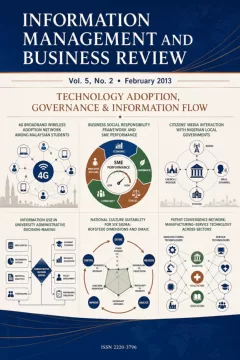 Vol. 5 No. 2 (2013)
Technology Adoption, Governance & Information Flow
View issue contents
Published
Submissions
Have research to publish? Information Management and Business Review welcomes submissions.
Make a Submission