Abstract
The concept and methodology of Six Sigma was developed by the American companies within the local culture of America. Therefore it is grounded on the standards, ethics and behaviours represented by America. The present study proposes that implementing Six Sigma in other countries with different cultures, norms and behaviours may have adjustment problems, as the required culture, values and behaviours for Six Sigma do not match with the local cultures of countries. A conceptual model is proposed which would utilize the Hofstede’s cultural dimensions to determine the effect of national culture at each phase of Six Sigma process.
Keywords
References
- Adler, N. J. (2002). International dimensions of organizational behavior (4th Ed.). Cincinnati, OH: SouthWestern Thomson Learning.
- Anthony, J. & Banuelas, R. (2002). Key Ingredients for the Effective Implementation of Six Sigma Program. Measuring Business Excellence, 6(4), 20-27.
- Bertels, T. (2000). But we don’t have processes! Six Sigma goes beyond manufacturing. Leadership Report , 3, 1–5.
- Bigio, D., Edgeman, R. & Ferlemen, T. (2004). Six Sigma availability management of information technology in the office of the chief technology officer of Washington, DC. Total Quality Management & Business Excellence , 15(5), 679–688.
- Binder, R. & Lawrence, S. (1997). Can a manufacturing quality model work for software? IEEE Software , 14(5), 101–103.
- Brun, A. (2010). Critical success factors of Six Sigma implementations in Italian companies. International Journal of Production Economics, 131, 158-164.
- Coronado, R. & Antony, J. (2002). Critical success factors for the successful implementation of Six Sigma projects in organizations. The TQM Magazine , 14(2), 92–99.
- Crom, S. (2005). Using Six Sigma in Europe: A cross-cultural perspective. iSixSigma Europe , 2(2).
- Dale, B. (2000). Marginalization of quality: Is there a case to answer? The TQM Magazine , 12, 266–274.
- Dasgupta, T. (2003). Using the Six-Sigma metric to measure and improve performance of a supply chain. Total Quality Management & Business Excellence , 14(3), 355–366.
- De Brantes, R. & Galvin, R. (2001). Creating, connecting and supporting active consumers. International Journal of Medical Marketing , 2(1), 73–81.
- Does, R., Van Den Heuvel, E., De Mast, J. & Bisgaard, S. (2002). Comparing nonmanufacturing with traditional applications of Six Sigma. Quality Engineering , 15(1), 177–183.
- Eckes, G. (2000). The Six Sigma revolution. New York: John Wiley & Sons.
- Frank, S. (2003). Applying Six Sigma to revenue and pricing management. Journal of Revenue & Pricing Management , 2(3), 245–254.
- Gnibus, R. (2000). Six Sigma’s missing link. Quality Progress , 33(11), 77–81.
- Gupta, P. (2005). The Six Sigma performance handbook. New York: McGraw-Hill.
- Hall, E.T. & Hall, M. R. (1990). Understanding cultural differences: Germans, French and Americans. Yarmouth, ME: Intercultural Press, Inc.
- Harry, M. (2000). A new definition aims to connect quality with financial performance. Quality Progress , 33(1), 48–53.
- Harry, M. & Schroeder, R. (2000). Six Sigma: The breakthrough management strategy revolutionizing the world’s top corporations. New York, US: Currency Publishers.
- Henderson, K. & Evans, J. (2000). Successful implementation of Six Sigma: Benchmarking General Electric Company. Benchmarking , 7(4), 260–282.
- Hendricks, C. & Kelbaugh, R. (1998). Implementation of Six Sigma at GE. Journal for Quality and Participation , 21(4), 48–53.
- Hendry, L. & Nonthaleerak, P. (2005). Six Sigma: Literature review and key future research areas. Working Paper. Department of Management Science, Lancaster University, UK. Retrieved September 23, 2005, from http://www.lums.lancs.ac.uk/publications/viewpdf/002475/
- Hofstede, G. (1980). Culture’s consequences: International differences in work-related values. Beverly Hills, CA: Sage.
- Hofstede, G. (1993). Cultural constraints in management theories. Academy of Management Executive , 7(1), 81–94.
- Hofstede, G. (1994). Management scientists are human. Management Science , 40(1), 4–13.
- Hofstede, G. (1997). Cultures and organizations: Software of the mind. New York: McGraw-Hill.
- Hofstede, G. & Hofstede, G. J. (2005). Cultures and organizations: Software of the mind (revised and expanded 2nd ed.). New York: McGraw-Hill.
- Hong, G. & Goh, T. (2003). Six Sigma in software quality. The TQM Magazine , 15(6), 364–373.
- Hutchins, G. (2000). The branding of Six Sigma. Quality Progress , 33(9), 120–122.
- Kaufmann, U. H. (2000). Six Sigma is in the bloodstream when Leadership Report, Spring, 3–4.
- Kilbey, G. (2003). Six Sigma. BþFS , 117(4), 18–20.
- Lanyon, S. (2003). At Ratheon Six Sigma works, too, to improve HR management processes. Journal of Organizational Excellence , 22(4), 29–42.
- Lipscomb, B. & Lewis, A. (2004). The principles of Six Sigma: Building a quality claims management program. Risk Management , 51, 30–34.
- Lee, T., Wong, W., & Yeung, K. (2011). Developing a readiness self-assessment model (RSM) for Six Sigma for China enterprises. International Journal of Quality & Reliability Management , 28 (2), 169–194.
- McAdam, R. & Lafferty, B. (2004). A multilevel case study critique of Six Sigma: Statistical control or strategic change? International Journal of Operations & Production Management , 24(5), 530–549.
- McCarty, T., Daniels, L., Bremer, M. & Gupta, P. (2005). The Six Sigma black belt handbook. New York: McGraw-Hill.
- Newman, K. L. & Nollen, S. D. (1996). Culture and congruence: The fit between managerial practices and national culture. Journal of International Business Studies , 27(4), 753–779.
- Niemes, J. (1999). Taking sales success to new heights with Six Sigma. National Productivity Review , 18, 37–42.
- Pande, P., Neuman, R. & Cavanagh, R. (2000). The Six Sigma way: How GE, Motorola and other top companies are honing their performance. New York: McGraw-Hill.
- Pisani, M. J. (2000). An American management training model in a Latin American context: Some implications for international business consultants. Journal of Teaching in International Business , 12(1), 23–39.
- Pylipow, R. (2001). Can it be this easy? Quality Progress , 34(7), 139–141.
- Revelle, J. (2004). Six Sigma. Professional Safety , 49(10), 38–47.
- Rucker, R. (2000). Citibank increases customer loyalty with defect-free processes. Journal of Quality & Participation , 23(4), 32–37.
- Snee, R. (2001). Make the view worth the climb. Quality Progress , 34(11), 58–61.
- Sodhi, M. S. & Sodhi, N. S. (2005). Six Sigma pricing. Harvard Business Review , 83(5), 135–142.
- Watson, G. (2000). Toward central tendency on Six Sigma. Quality Progress , 33(7), 16–17.
- White, E. (2005). Rethinking quality improvement. Wall Street Journal , 2, 19, B3.
Downloads
No downloads have been recorded for this article yet. Figures appear here once readers begin downloading the full text.
How to Cite
Share this article
License
Copyright (c) 2013 Ahsan Qamar, Saqib Muneer, Ahmad Jusoh, Halimah Idris (Author)

This work is licensed under a Creative Commons Attribution 4.0 International License.
Author (s) should affirm that the material has not been published previously. It has not been submitted and it is not under consideration by any other journal. At the same time author (s) need to execute a publication permission agreement to assume the responsibility of the submitted content and any omissions and errors therein. After submission of revised paper in the light of suggestions of the reviewers, the editorial team edits and formats manuscripts to bring uniformity and standardization in published material.
This work will be licensed under Creative Commons Attribution 4.0 International (CC BY 4.0) and under condition of the license, users are free to read, copy, remix, transform, redistribute, download, print, search or link to the full texts of articles and even build upon their work as long as they credit the author for the original work. Moreover, as per journal policy author (s) hold and retain copyrights without any restrictions.
Keywords
Section
Published in
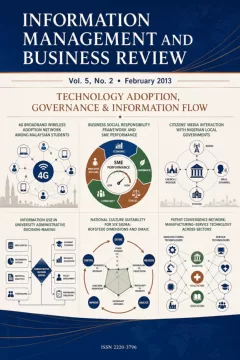 Vol. 5 No. 2 (2013)
Technology Adoption, Governance & Information Flow
View issue contents
Published
Submissions
Have research to publish? Information Management and Business Review welcomes submissions.
Make a Submission