Abstract
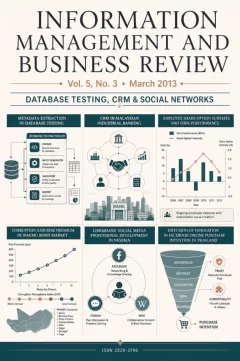
We study the relationship between corruption and risk premium in West African Economic Monetary Union (WAEMU) market bond. Our sample consists of bonds through a public offering and private placement. For this research data was collected from the stock exchange (Bourse Régionale des Valeurs Mobilières). Number of bonds, average corruption and average spread analysis was used to analyze the data. Most country in WAEMU states has a corruption index below 3.5. The results show that corruption score has negative effects on economic performance indicators and there was a predominance of private placement debt relative to debt through a public offering.
Keywords
References
- Asiedu, E. & Freeman, J. (2009). The Effect of Corruption on Investment Growth: Evidence from Firms in Latin America, Sub-Saharan Africa and Transition Countries . Review of Development Economics , 13(2), 200- 214.
- Azfar, O. & Murrell, P. (2005). Identifying Reticent Respondents: Assessing the quality of Survey Data on Corruption and Values. Economic development and cultural change EDCC
- Boehmer, E. & Megginson, W. L. (1990). Determinants of Secondary Market Prices for Developing Country Syndicated Loans. Journal of Finance , 45(5), 1517– 40 .
- Butler, W. A., Fauver, L. & Sandra, M. (2009). Corruption, Political Connections, and Municipal Finance. The review of financial studies , 3, 22-47.
- Cameron, L., Chaudhuri, A., Erkal, N. & Gangadharan, L. (2005). Do Attitudes Towards Corruption Differ Across Cultures? Experimental Evidence from Australia, India, Indonesia and Singapore? Working Paper No. 943. University of Melbourne
- Ciocchini, F., Durbin, E. & Ng, D. (2003). Does corruption Increase Emerging Market Bond Spread. Journal of Economics & Business , 1(2).
- David, N. (2006). The impact of corruption on financial markets. Managerial Finance , 32(10).
- Edwards, S. (1984). LDC foreign borrowing and default risk: An empirical investigation, 1976–80. American Economic Review , 74(4), 726–734.
- Eichengreen, B. & Mody, A. (1998a). Interest rates in the north and capital flows to the south: Is there a missing link? International Finance , 1(1), 35–57.
- Eichengreen, B. & Mody, A. (1998b). What explains changing spreads on emerging-market debt: Fundamentals or market sentiment? NBER Working Paper, 6408
- Eichengreen, B. & Mody, A. (2001). Flight to quality: Investor risk tolerance and the spread of emerging markets crises. In S. Claessens & K. Forbes (Eds.). International financial contagion (pp. 129–156). Kluwer Academic Publishers.
- Ferri, G. (2004). More Analysis, Better Ratings: Do Rating Agencies Invest Enough in Less Developed Countries. Journal of Applied Economics, 7(1), 77-98.
- Fisman, R. (1991). Estimating the value of political connections. American Economic Review, 94(4), 1095102.
- Gelos, R. G. & Wei, S. J. (2006). Transparency and international investor Behaviour. IMF Working Paper 02/174.
- Haque, N. & Sahay, R. (1996). Do Government Wage Cuts Close Budget Deficits? Costs of Corruption . International Monetary Fund Staff Papers, 43(4), 754–78.
- Johnson, S., Kaufmann, D. & Zoido-Lobaton, P. (1999). Corruption, Public Finances, and the Unofficial Economy, World Bank Policy Research Paper, 2169.
- Kaufman, D., Kraay, A. & Mastruzzi, M. (2005). Measuring Governance Using Cross- Country Perceptions Data. World Bank Working Paper. Washington, DC: World Bank.
- Lee, C. & Ng, D. (2002). Corruption and International Valuation: Does Virtue Pay, Mimeo, Cornell University.
- Mauro, P. (1995). Corruption and Growth. Quarterly Journal of Economics , 110, 681-712.
- Ng, D. & Qian, L. (2004) Corruption and corporate governance, mimeo, Cornell University, Ithaca, NY. Tanzi, V., Tanzi, V. & Davoodi, H. (1997). Corruption, public investment and growth. IMF Working Paper, WP/137/39.
Downloads
No downloads have been recorded for this article yet. Figures appear here once readers begin downloading the full text.
How to Cite
Share this article
License
Copyright (c) 2013 Mohamed Lamine MBENGUE (Author)

This work is licensed under a Creative Commons Attribution 4.0 International License.
Author (s) should affirm that the material has not been published previously. It has not been submitted and it is not under consideration by any other journal. At the same time author (s) need to execute a publication permission agreement to assume the responsibility of the submitted content and any omissions and errors therein. After submission of revised paper in the light of suggestions of the reviewers, the editorial team edits and formats manuscripts to bring uniformity and standardization in published material.
This work will be licensed under Creative Commons Attribution 4.0 International (CC BY 4.0) and under condition of the license, users are free to read, copy, remix, transform, redistribute, download, print, search or link to the full texts of articles and even build upon their work as long as they credit the author for the original work. Moreover, as per journal policy author (s) hold and retain copyrights without any restrictions.
Keywords
Section
Published
Submissions
Have research to publish? Information Management and Business Review welcomes submissions.
Make a Submission