Abstract
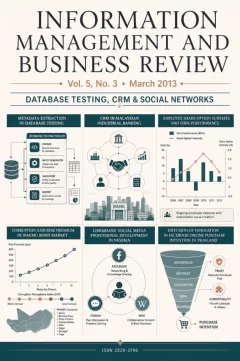
Although there are several studies on factors affecting online purchase intention in social media website using the Technology Acceptance Model (TAM), little research exists with respect to the study using different theories. This research is one of the studies that using an alternative theory, Diffusion of Innovation Model. This paper reports the findings of recent focus group research among working adult (ages 25 to 34), which examined the factors that influence their online purchase decision through online social network, particularly Facebook. The findings are presented and discussed in order to refine the preliminary research model that was developed from an extensive review of literature. Methods: Two focus groups involving 15 participants were recruited in Trang, Thailand. Researchers analyzed and coded the data according to research model and hypotheses. Results: Focus group respondents ranked in order of importance relative advantage, trust, perceived risk, compatibility as the factors that encouraged or discouraged them from purchasing product through Facebook. The findings of factors and their attributes from this study are in line with the findings in the literature with slight variation. Conclusions: This research makes a contribution to the development of a theoretical understanding of online purchase intention through social network.
Keywords
- Social Network Search this journal for Social Network (opens in a new tab)
- Facebook Search this journal for Facebook (opens in a new tab)
- Trust Search this journal for Trust (opens in a new tab)
- Risk Search this journal for Risk (opens in a new tab)
- Subjective Norm Search this journal for Subjective Norm (opens in a new tab)
- Diffusion of Innovation Search this journal for Diffusion of Innovation (opens in a new tab)
References
- Antony, S., Lin Z., Xu, B. (2006). Determinants of escrow service adoption in consumer-to-consumer online auction market: An experimental study. Decision Support Systems , 42(3), 1889-1900.
- Barber, H. (1983). The Logic and Limits of Trust , Rogers University Press.
- Bauer, R. A. (1960). Consumer Behavior as Risk Taking in Dynamic Marketing in a Changing World, R. S. Hancock, R.S. (ed.), Chicago: American Marketing Association, 389-398.
- Bhattacherjee, A. (2002). Individual trust in online firms: scale development and initial test. Journal of Management Information Systems , 19(1) 211–242.
- Bhatnagar, A., Misra, S. & Rao, H. R. (2000). On risk, convenience, and internet shopping behavior—why some consumers are online shoppers while others are not. Communications of the ACM , 43(11), 98– 105.
- Bhimani, A. (1996). Securing the Commercial Internet. Communications of the ACM , 39(6), 29-35.
- Burroughs, R. E. & Sabherwal, R. (2001). Determinants of retail electronic purchasing: a multi-period investigation. Journal of Information System Operation Research , 40(1), 35–56.
- Casaló L., Flavián C., Guinalíu M. (2007). The impact of participation in virtual brand communities on consumer trust and loyalty: The case of free software. Online Information Review , 31(6), 775 – 792.
- Cho, J. (2004). Likelihood to Abort an Online Transaction: Influences from Cognitive Evaluations, Attitudes, and Behavioral Variables. Information & Management , 41, 827-838.
- Cooper, R. B. & Zmud, R. W. (1990). Information Technology Implementation Research: A Technological Diffusion Approach. Management Science, 36(2), 123-139.
- Crespo, Á. H. & Rodríguez del Bosque, I. (2008). The effect of innovativeness on the adoption of B2C e- commerce: A model based on the Theory of Planned Behaviour. Computers in Human Behavior , 24(6), 2830-2847.
- Darley, W. M. & Smith, R. E. (1995). Gender differences in information processing strategies: an empirical test of the selectivity model in advertising response. Journal of Advertising , 24(1), 41-56.
- Deutsch, M. (1960). The effect of motivational orientation upon trust and suspicion. Human Relations , 13, 123–139.
- Fishbein, M. & Ajzen, I. (1975). Belief, Attitude, Intention, and Behavior: An Introduction to Theory and Research., Reading, MA: Addison-Wesley.
- Franzoi, S. L. (2003). Social Psychology, New York, McGraw-Hill, 2003.
- Fukuyama, F. (1995). Trust: The Social Virtues and the Creation of Prosperity, New York: Free Press.
- Gefen, D. (2002) Customer Loyalty in E-Commerce. Journal of the Association of Information Systems , 3, 27-51.
- Gefen, D. (2002). Reflections on the dimensions of trust and trustworthiness among online consumers. ACM SIGMIS Database , 33(3), 38–53.
- Gefen, D., Karahanna, E. & Straub, D. (2003). Trust and TAM in online shopping: an integrated model. MIS Quarterly , 27, 51–90.
- Gefen, D. & Straub, D. W. (2004). Consumer trust in B2C e-commerce and the importance of social presence: experiments in e-products and e-services. Omega , 32(6), 407-24.
- Hwang, Y. & Kim, D. J. (2007). Customer self-service systems: the effects of perceived web quality with service contents on enjoyment, anxiety, and e-trust. Decision Support Systems , 43(3), 746-60.
- Jahankhani, H. (2009). The Behaviour and Perceptions of On-Line Consumers: Risk, RiskPerception and Trust. International Journal of Information Science and Management , 7(1).
- Keen, P. G. W. (1999). Electronic Commerce Relationships: Trust by Design, NJ, Englewood Cliffs: PrenticeHall.
- Kendall, J., Tung, L. L., Chua, K. H., Ng, C. H. D. & Tan, S. M. (2001). Electronic commerce adoption by SMEs in Singapore, Proceedings of the 34th Hawaii International Conference on System Sciences, Kauai, Hawaii.
- Laudon K. C. & Traver C. G. (2010). E-commerce: business, technology, society., 6th ed. Prentice Hall: Upper Saddle River, NJ.
- Liang, T. P. & Huang, J. S. (1998). An empirical study on consumer acceptance of products in electronic markets: a transaction cost model. Decision Support Systems , 24, 29–43.
- Luhmann, N. (1988). Familiarity, confidence, trust: problems and alternatives, in: D. Gambetta (Ed.), Trust: Making and Breaking Cooperative Relations, Basil Blackwell, Oxford, 94–107.
- Martins, C. B. M. J., Steil, A. V., Todesco, J. L. (2004). Factors influencing the adoption of the internet as a teaching tool at foreign language schools. Computers and Education , 42, 353-74.
- Mayer, R. C., Davis, J. H. & Schoorman, F. D. (1995). An integrative model of organizational trust. Academy of Management Review , 20(3),709–734.
- McKnight, D. H., Choudhury, V., Kacmar, C. (2002). Developing and Validating Trust Measures for e- Commerce: An Integrative Typology. Information Systems Research , 13(3), 334-359.
- Miyazaki, A. D. & Fernandez, A. (2001). Consumer perceptions of privacy and security risks for online shopping. The Journal of Consumer Affairs , 35(1), 27–44.
- Moore, G. C. & Benbasat, I. (1991) Development of an instrument to measure the perceptions of adopting an information technology innovation. Information Systems Research , 2(3), 192-222.
- Moore, G. C. & Benbasat, I. (1995) Integrating diffusion of innovations and theory of reasoned action models to predict utilisation of information technology by end adopters, in Diffusion and Adoption of Information Technology, proceedings of the first IFIP WG 8.6 working conference on the diffusion and adoption of information technology, Oslo, Norway, October 1995, Chapman and Hall: United Kingdom.
- Ostlund, L. E. (1974). Perceived Innovation Attributes as Predictors of Innovativeness. Journal of Consumer Research , 1, 23-29.
- Pallis, G., Zeinalipour-Yazti, D., Dikaiakos, M. (2011). Online Social Networks: Status and Trends, In New Directions in Web Data Management, edited by A. Vakali, Jain, L.C., 213 - 234. Berlin: SpringerVerlag.
- Park, C. & Jun, J. K. (2003). A Cross-Cultural Comparison of Internet Buying Behavior. International Marketing Review , 20(5), 534-554.
- Pavlou, P. A. & Gefen, D. (2004). Building Effective Online Marketplaces with Institution-Based Trust. Information Systems Research , 15(1), 37-59.
- Quelch, J. A. & Klein, L. R. (1996). The Internet and International Marketing. Sloan Management Review , 1, 60-75.
- Ranganathan, C. & Ganapathy, S. (2002). Key dimensions of business to- consumer websites. Information and Management , 39, 457–465.
- Ranganathan, C. & Jha, S. (2007) Examining Online Purchase Intentions in B2C E-Commerce: Testing an Integrated Model. Information Resources Management Journal (IRMJ) , 20(4), 48-64.
- Ratnasingam, P. (1998). The importance of trust in electronic commerce. Internet Research: Electronic Networking Applications and Policy , 8(4), 313–321.
- Rogers, E. M. (1983). Diffusion of Innovations , New York: Free Press.
- Rogers, E. M. (1995). Diffusion of Innovations, fourth ed. New York: The Free Press.
- Rousseau, D. M., Sitkin, S. B., Burt, R. S. & Camerer, C. (1998). Not so different after all: a cross discipline view of trust, The Academy of Management Review , 23(3), 395–404.
- Schifter, D. B. & Ajzen, I. (1985). Intention, perceived control, and weight loss: An application of the theory of planned behaviour. Journal of Personality and Social Psychology , 49(3), 842–851.
- Seckler, V. (2000). Survey says Web apparel buys doubled, Women Wear Daily, 12, July, 2.
- Shim, S. & Drake, M. F. (1990). Consumer intention to utilize electronic shopping. Journal of Direct Marketing , 4(2), 22-33.
- Shim, S., Eastlick, M. A., Lotz, S. L. & Warrington, P. (2001). An online prepurchase intentions model: the role of intention to search. Journal of Retailing , 77(3), 397-416.
- Sin, L. & Tse, A. (2002) Profiling internet shoppers in Hong Kong: demographic, psychographic, attitudinal and experiential factors. Journal of Interactive Marketing , 15(1), 7–29.
- Slyke, C. V., Bélanger, F. & Hightower, R. (2005). Understanding Gender-Based Differences in Consumer E- Commerce Adoption . SAIS 2005 Proceedings. Paper 5. http://aisel.aisnet.org/sais2005/5
- Slyke, C. V., Comunale, C. L. & Belanger, F. (2002). Gender Differences in Perceptions of Web-Based Shopping. Communications of the ACM , 45(7), 82-86.
- Swanson, E. B. (1994). Information systems innovation among organization. Management Science , 40(9), 1069-92.
- Tornatzky, L. G. & Klein, K. J. (1982). Innovation Characteristics and Innovation AdoptionImplementation: A Meta-Analysis of Findings. IEEE Transactions on Engineering Management , 29(1), 28-45.
- Urban, G. (2001). Placing trust at the center of your Internet strategy, in: Strategies for E-Business Success, Jossey-Bass, 155–159.
- Van der Heijden, H. (2003). Factors influencing the usage of websites: The case of a generic portal in the Netherlands. Information & Management , 40, 541–549.
- Van der Heijden, H., Verhagen, T. & Creemers, M. (2003). Understanding online purchase intentions: contributions from technology and trust perspectives. European Journal of Information Systems, 12, 41-48.
- Venkatesh V. & Morris, M. G. (2000). Why don't men ever stop to ask for directions? Gender, social influence, and their role in technology acceptance and usage behavior. MIS Quarterly , 24(1), 11539.
- Yang, B. & Lester, D. (2004). Attitudes toward Buying Online. Cyber psychology & Behavior , 7(1), 85-92
Downloads
No downloads have been recorded for this article yet. Figures appear here once readers begin downloading the full text.
How to Cite
Share this article
License
Copyright (c) 2013 Atchara Leerapong, Anny Mardjo (Author)

This work is licensed under a Creative Commons Attribution 4.0 International License.
Author (s) should affirm that the material has not been published previously. It has not been submitted and it is not under consideration by any other journal. At the same time author (s) need to execute a publication permission agreement to assume the responsibility of the submitted content and any omissions and errors therein. After submission of revised paper in the light of suggestions of the reviewers, the editorial team edits and formats manuscripts to bring uniformity and standardization in published material.
This work will be licensed under Creative Commons Attribution 4.0 International (CC BY 4.0) and under condition of the license, users are free to read, copy, remix, transform, redistribute, download, print, search or link to the full texts of articles and even build upon their work as long as they credit the author for the original work. Moreover, as per journal policy author (s) hold and retain copyrights without any restrictions.
Keywords
- Social Network Search this journal for Social Network (opens in a new tab)
- Facebook Search this journal for Facebook (opens in a new tab)
- Trust Search this journal for Trust (opens in a new tab)
- Risk Search this journal for Risk (opens in a new tab)
- Subjective Norm Search this journal for Subjective Norm (opens in a new tab)
- Diffusion of Innovation Search this journal for Diffusion of Innovation (opens in a new tab)
Section
Published
Submissions
Have research to publish? Information Management and Business Review welcomes submissions.
Make a Submission