Abstract
In context of technopreneur business, competitive advantages is the top most issues that facing by women entrepreneurs especially for sustaining their market position and profitability. The dramatically change of technopreneur landscape has exposed the women technopreneur with some of global challenges. In the one hand, competitive advantages possible to transform the business into the best track by monitoring the rapid change of external and internal environment of business. However, in the one hand, competitive advantages have exposed the business to some risks, damage and negative impacts if they are not ready to adopt the suitable strategy. The main objective of the paper is to discuss the competitive advantages forces of women technopreneur firms. Secondly, the paper is aimed to highlight the usability of knowledge based information system (KBIS) in dealing with the main issues of competitive advantages. This study has adopted the model of Porter Five Forces by Michael Porter to understand the competitive advantages as faced by women technopreneur. Meanwhile, the potential use of KBIS will explored by conducting the unstructured interview with selected expertise. In the turbulences market environment, KBIS should integrate with strategy which can help women technopreneur firms to positioning them self into the right time and track. Finally, some suggestion was made to guiding women technopreneur in integrating KBIS sophistication with strategy options as a new way of advancement.
Keywords
- Knowledge Based Information System Search this journal for Knowledge Based Information System (opens in a new tab)
- Competitive Advantages Search this journal for Competitive Advantages (opens in a new tab)
- Women Technopreneur Search this journal for Women Technopreneur (opens in a new tab)
- Strategy Options Search this journal for Strategy Options (opens in a new tab)
References
- Abd Rozan, M. Z. (2001). A study on entrepreneurial intention among information technology technopreneurs. Unpublished MSc (IT), UTM, October 2001.
- Bohari, A. M. (2008). Management information system. Kuala Kumpur: Asia e-University Publication.
- Casolaro, L. & Gobbi, G. (2007). Information technology and productivity changes in the banking industry. Economic Notes , 36, 43-76.
- Chong, C. S., Robert, G. & Sivakumar, A. I. (2003). Simulation-based scheduling for dynamic discrete manufacturing. Proceedings of the 2003 Winter Simulation Conference , 2, 1465-1473.
- Cole-Ehmke, M. S. (2008). Strategies for competitive advantage. Department of Agricultural and Applied Economics, University of Wyoming.
- Dess, G. G., Lumpkin, G. T. & Taylor, M. L. (2005). Strategic Management (2 Ed). New York: McGraw-Hill Irwin.
- Duhan, S., Levy, M. & Powell, P. (2001). Information systems strategies in knowledge-based SMEs: the role of core competencies. European Journal of Information Systems, 10, 25–40.
- Harker, D. & Akkeren, J. V. (2002). Exploring the needs of SMEs for mobile data technologies: The role of qualitative research. Journal of Research Practice Inform. Tech ., 5, 199-209.
- Jeroen, P. J. J. & Hartog, D. N. D. (2007). How leaders influence employees’ innovative behavior. European Journal of Innovation Management, 10(1), 41-64.
- King, J. B. (2005). The Top 10 Reasons Businesses Succeed. Ezine Articles. Retrieved May 2008 from http://ezinearticles.com/?The-Top-10-Reasons-Businesses-Succeed&id=12514
- Kushwaha, G. S. (2011). Competitive advantage through information and communication technology (ICT) enabled supply chain management practices. International Journal of Enterprise Computing and Business Systems , 1(2).
- O’Brian, J. A. (2007). Management information systems: Managing information technology in the business enterprise. New York: McGraw-Hill Irwin.
- Pei, L. K., Noordin, K. A., Ting, Y. P. & Baharudin, A. S. (2010). Failure factors of The Malaysian IT technopreneurship. International Conference on Science and Social Research (CSSR) 2010. 5-7 December 2010, 686 – 690
- Porter, M. (2001). Strategy and the internet. Harvard Business Review , 79(3), 63-78.
- Sajja, P. S. & Akerkar, R. (2010). Chapter 1 Knowledge-Based Systems for Development. In Sajja & Akerkar (Eds.), Advanced Knowledge Based Systems: Model. Applications & Research, 1, 1 – 11.
- Shakya, R. (2007). What is Technopreneurship? September 5, 2007.
- Teece, D. J. (2000). Strategies for managing knowledge assets: the role of firm structure and industrial context. Long Range Planning , 33, 35–54
- Yudha P. & Ahmad-Zaki, A. B. (2007). Utilization of human virtual intelligence framework in managing technopreneur knowledge. Proceedings of the International Conference on Electrical Engineering and Informatics, Institute Teknologi Bandung, Indonesia, 17-19, June 2007.
Downloads
No downloads have been recorded for this article yet. Figures appear here once readers begin downloading the full text.
How to Cite
Share this article
License
Copyright (c) 2013 Nurwahida Fuad, Abdul Manaf Bohari (Author)

This work is licensed under a Creative Commons Attribution 4.0 International License.
Author (s) should affirm that the material has not been published previously. It has not been submitted and it is not under consideration by any other journal. At the same time author (s) need to execute a publication permission agreement to assume the responsibility of the submitted content and any omissions and errors therein. After submission of revised paper in the light of suggestions of the reviewers, the editorial team edits and formats manuscripts to bring uniformity and standardization in published material.
This work will be licensed under Creative Commons Attribution 4.0 International (CC BY 4.0) and under condition of the license, users are free to read, copy, remix, transform, redistribute, download, print, search or link to the full texts of articles and even build upon their work as long as they credit the author for the original work. Moreover, as per journal policy author (s) hold and retain copyrights without any restrictions.
Keywords
- Knowledge Based Information System Search this journal for Knowledge Based Information System (opens in a new tab)
- Competitive Advantages Search this journal for Competitive Advantages (opens in a new tab)
- Women Technopreneur Search this journal for Women Technopreneur (opens in a new tab)
- Strategy Options Search this journal for Strategy Options (opens in a new tab)
Section
Published in
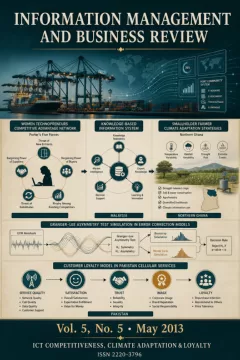 Vol. 5 No. 5 (2013)
ICT Competitiveness, Climate Adaptation & Loyalty
View issue contents
Published
Submissions
Have research to publish? Information Management and Business Review welcomes submissions.
Make a Submission