Abstract
The idea of this study is raised because of tough competition in cell phone industry of Pakistan. In this scenario, every organization after retaining customer tries to make him/her loyal. The loyalty, which has rigorously investigated, empirically tested with different combination of variables, which collectively help in making the customer loyal. Data were collected through 508 questionnaires. Respondents were pre-paid cell phone customers. Data was analyzed via factor loading and reliability of variables. Structural Equation Modeling (SEM) technique was used for the testing of hypotheses. Loyalty model was found significantly responsive for cellular phone services in Pakistan. Perceived service quality, satisfaction, trust and image have chained link of positive affects, which leads to loyalty of customers in the telecom sector of Pakistan. Customers do not take effect of perceived service quality. However, it is service quality, which satisfies customer through image of the organization. This loyalty model is more preferably applicable in the industry where competition is tough and switching rate is high. In future researches, this model can be tested across the culture. Moreover, more variables can be added to strengthen the loyalty model.
Keywords
References
- Ali, J. F., Ali, I., Rehman, K. u., Yilmaz, A. K., Safwan, N. & Afzal, H. (2010). Determinants of consumer retention in cellular industry. African Journal of Business Management , 2, 2402-2408.
- Alireza, F., Ali, K. & Aram, F. (2011). How Quality, Value, Image, and Satisfaction Create Loyalty at an Iran Telecom. International Journal of Business and Management , 3, 271-279.
- Anderson, E. W., Claes, F. & Donald, R. L. (1994). A customer satisfaction research prospectus, in Rust, R and Oliver, R (Eds), Service Quality: New Direction in Theory and Practice. Sage, 241-68.
- Anderson, J. C. & Narus, J. A. (1990). A Model of Distributor Firm and Manufacturer Firm Working Partnerships. J. Market. , 1, 42-58.
- Andreassen, T. W. & Lindestad, B. (1998). Customer loyalty and complex services: the impact of corporate image on quality, customer satisfaction and loyalty for customers with varying degrees of service expertise. Int J Serv Ind Manag ., 9(1), 7–23.
- Assael, H. (1992). Consumer behavior and marketing action In Consumer behavior and marketing action, by Henry Assael, 87. Boston: PWS-KENT Company.
- Aydin, S. & Ozer, G. (2005). National customer satisfaction indices: an implementation in the Turkish mobile telephone market. Marketing Intelligence & Planning , 23(5), 486-504.
- Barich, H. & Kotler, P. (1991). A framework for marketing image management. Sloan Management Review , 32(2), 94-104.
- Bloemer, J., Ruyter, K. & Wetzels, M. (1998). On the relationship between perceived service quality, service loyalty and switching costs. International Journal of Industry Management , 9(5), 436-53.
- Bolton, R. N. & Drew, J. H. (1991). A multistage model of customers’ assessments of service quality and value. Journal of Consumer Research , 17, 375- 384.
- Brady, M. K. & Robertson, C. J. (2001). Searching for a consensus on the antecedent role of service quality and satisfaction: an exploratory cross-national study. J Bus Res ., 51(1), 53–60.
- Christine, D., Moorman, Z. & Rohit, G. (1993). Factors affecting trust in market research relationships. J. Market. , 2, 81-101.
- Chu, K. M. (2009). The Construction Model of Customer Trust, Perceived Value and Customer Loyalty. J. Am. Acad. Bus., Cambridge , 14(2), 98-103.
- Cody, K. & Hope, B. (1999). EX-SERVQUAL: an instrument to measure service quality of extranets. Proceedings of the 10th Australasian Conference on Information Systems, Wellington, 1-3 December, p. 207.
- Cronin, J. J. Jr., Brady, M. K. & Hult, G. T. M. (2000). Assessing the effects of quality, value, and customer satisfaction on consumer behavioral intentions in service environments. Journal of Retailing , 76(2), 193-218.
- Dekimpe, M. G., Steenkamp, J. B. E. M., Mellens, M. & Abeele, P. V. (1997). Decline and variability in brand loyalty. International Journal of Research in Marketing , 14, 405-20.
- Dobni, D. & Zinkhan, G. M. (1990). In search of brand image: a foundation analysis. Advertising Consumer Research , 17(1), 110-119
- Doney, P. & Cannon, J. P. (1997). An examination of the nature of trust in buyer seller Relationships. J. Mark. , 61(2), 35-51.
- Ennew, C. T. & Binks, M. R. (1999). Impact of participative service relationships on quality, satisfaction, and retention: An exploratory study. Journal of Business Research , 46(2), 121–32.
- Eshghi, A., Haughton, D. & Topi, H., (2007). Determinants of customer loyalty in the wireless telecommunications industry. Telecommunications policy , 31(2), 93-106.
- Fishbein, M. & Ajzen, I. (1975). Belief, Attiude, Intention, and Behavior: An Introducing to Theory and Research, Addison-Wesley, Reading, MA.
- Fornell, C. (1992). A national customer satisfaction barometer: the Swedish experience. Journal of Marketing , 56, 6-21.
- Ganesh, J., Arnold, M. J. & Reynolds, K. E. (2000). Understanding the customer base of service providers: an examination of the differences between switchers and stayers. Journal of Marketing , 64, 65-87.
- Garbarino, E. & Johnson, M. S. (1999). The different role of satisfaction, trust, and commitment in customer relationships. J Mark ., 63(2), 70–87.
- Green, R. T. & White, P. D. (1976). Methodological considerations in cross-national research. Journal of Internationals Business Studies, 7, 81-88.
- Gotlieb, J. B., Grewal, D. & Brown, S. W. (1994). Customer satisfaction and perceived quality: complementary or divergent constructs. J Appl Psychol , 79(6), 875–85.
- Gronros, C. (2000). Service Management and Marketing: A Customer Relationship Management Approach. John Wiley & Sons Ltd (Second edition). ISBN: 0-471-72034-8.
- Haq, J. U., Ijaz, A. & Mehmood, S. (2011). The Influence of Customer Orientation on Customer Relationship in Telecom Services. Information Management and Business Review , 2, 222-227.
- Hart, A. E. & Rosenberger, P. J. (2004). The Effect of Corporate Image in the Formation of Customer Loyalty: An Australian Replication. Australasian Marketing Journal , 3, 88 - 96.
- Hennig-Thurau, T. & Klee, A. (1997). The Impact of Customer Satisfaction and Relationship Quality on Customer Retention: A Critical Reassessment and Model Development. Psychology & Marketing , 14(8), 737–764
- Ismail, I., Haron, H., Ibrahim, D. N. & Isa, S. M. (2006). Service quality, client satisfaction and loyalty towards audit firms: perceptions of Malaysian public listed companies. Manag. Audit. J. , 21(7), 738-756
- Johnson, M. D., Gustafsson, A., Andreassen, T. W., Lervik, L. & Cha, J. (2001). The evolution and future of national customer satisfaction index models. Journal of Economic Pcychology , 22, 217-45.
- Keller, K. (1993). Conceptualizing, measuring, managing customer based brand equity. Journal of Marketing , 57(1), 1-22.
- Kim, M. K., Park, M. C. & Jeong, D. H. (2004). The effects of customer satisfaction and switching barrier in customer loyalty in Korean mobile telecommunication services. Telecommunication Policy , 28(2), 145-159.
- Kline, R. B. (2005). Principles and practice of structural equation modelling (2nd Ed.). New York: The Guilford Press.
- Lai, F., Griffin, M. & Babin, B. J. (2009). How quality, value, image, and satisfaction create loyalty at a Chinese telecom. Journal of Business Research , 60(3), 980–6.
- Lam, S. Y., Venkatesh, S. M., Krishna, E. & Bvsan, M. (2004). Customer Value, Satisfaction, Loyalty, and Switching Costs: An Illustration from a Business-to-Business Service Context. J. Acad. Market. Sci. , 2, 293- 311.
- Lau, G. & Lee, S. (1999). Consumers’ trust in a brand and link to brand loyalty. Journal of Market Focused Management , 4, 341-70.
- Liang, C. J. & Wang, W. H. (2008). Do Loyal and More Involved Customers Reciprocate Retailer’s Relationship Efforts? Journal of Service Research , 8(1), 63- 90.
- MacInnis, D. J. & Price, L. L. (1987). The role of imagery in information processing: review and extensions. Journal of Consumer Research , 13, 473-91.
- Morgan, R. M. & Hunt, S. D. (1994). The commitment-trust theory of relationship marketing. Journal of Marketing , 58, 20-38.
- Mouri, N. (2005). A Consumer-based Assessment of Alliance Performance: An Examination of Consumer Value, Satisfaction and Post-purchase behavior. University of Central Florida, 2005. 156 pages: AAT 3193496.
- Nguyen, N. & Leblanc, G. (2001). Corporate image and corporate reputation in customers’ retention decisions in services. Journal of Retailing and Consumer Services , 8, 227-36.
- O’Loughlin, D. l., Szmigin, I. & Turnbull, P. (2004). Branding and relationships: customer and supplier perspectives. J. Financ. Serv. Mark. , 8(3), 218-230.
- Oliver, R. L., Roland, T. R. & Sajeev, V. (1997). Customer delight: Foundations, findings, and managerial insight. J. Retailing , 3, 311-336.
- Oliver, R. L. (1999). Whence Consumer Loyalty. The Journal of Marketing, Fundamental Issues and Directions for Marketing , 63, 33-44
- Ostrowski, P. L., O'Brien, T. V. & Gordon, G. L. (1993). Service quality and customer loyalty in the commercial airline industry. J Travel Res ., 32(2), 16–24.
- Parasuraman, A., Zeithamal, V. A., & Berry, L. L. (1988). SERVQUAL: A multiple-item scale for measuring consumer perceptions of service quality. J. Retail. , 64, 12-40.
- Raza, A. & Rehman, Z. (2012). Impact of relationship marketing tactics on relationship quality and customer loyalty: A case study of telecom sector of Pakistan. African Journal of Business Management , 50855092.
- Reichheld, F. F. & Phil, S. (2000). E-Loyalty: Your Secret Weapon on the Web. Howard Business Review, 105113.
- Singh, J. (2000). Performance Productivity and Quality of Frontline Employees in Service Organizations. J. Market. , 1, 15-34.
- Sirdeshmukh, D., Jagdip, S. & Barry, S. (2002). Consumer Trust, Value, and Loyalty in Relational Exchanges. J. Market. , 1, 15-37.
- Spath, D. & Fähnrich, K. P. (2007). Advances in Services Innovations. Springer, Berlin. ISBN: 978-3-54029858-8.
- Spreng, R. A., MacKenzie, S. B. & Olshavsky, R. W. (1996). A reexamination of the determinants of consumer satisfaction. J Mark., 60(3), 15–32.
- Tian, Y., Lai, F. & Daniel, F. (2008). An examination of the nature of trust in logistics outsourcing relationship: Empirical evidence from China. Ind. Manage. Data Syst. , 108(3), 346-367.
- Tse, D. K. & Wilton, P. C. (1988). Models of Consumer Satisfaction Formation: An Extension. Journal of Marketing Research , 25, 204-12.
- Venetis, K. A. & Ghauri, P. N. (2000). The importance of service quality on customer retention: an empirical study of business service relationships, Proceedings of the Marketing in a Global Economy Conference, Buenos Aires, June 28-July 1, 215-224.
- Wiele, T., Paul, B. & Martijn, H. (2002). Empirical evidence for the relationship between customer satisfaction and business performance. Manag. Serv. Qual. , 2, 184-193.
- Wolfgang, U. & Eggert, A. (2004). Relationship value and relationship quality: Broadening the nomological network of business-to-business relationships. European Journal of Marketing, 40(3/4), 311-327
- Yuille, J. C. & Catchpole, M. J. (1977). The role of imagery in models of cognition. Journal of Mental Imagery, 1, 171-80.
- Zaman, K., Hussain, F., Qureshi, T. M., Anjum, I., Samran, A. & Arshad, R. (2011). Only customer satisfaction and customer loyalty is not enough: A study of Pakistan’s telecom sector. African Journal of Business Management , 4, 10176-10181.
- Zeithaml, V. A. (1988). Consumer perceptions of price, quality, and value: a means-end model and synthesis of evidence. Journal of Marketing , 52(3), 2-22.
Downloads
No downloads have been recorded for this article yet. Figures appear here once readers begin downloading the full text.
How to Cite
Share this article
License
Copyright (c) 2013 Junaid-ul-haq, Muhammad Abrar, Rao Umer Nasir (Author)

This work is licensed under a Creative Commons Attribution 4.0 International License.
Author (s) should affirm that the material has not been published previously. It has not been submitted and it is not under consideration by any other journal. At the same time author (s) need to execute a publication permission agreement to assume the responsibility of the submitted content and any omissions and errors therein. After submission of revised paper in the light of suggestions of the reviewers, the editorial team edits and formats manuscripts to bring uniformity and standardization in published material.
This work will be licensed under Creative Commons Attribution 4.0 International (CC BY 4.0) and under condition of the license, users are free to read, copy, remix, transform, redistribute, download, print, search or link to the full texts of articles and even build upon their work as long as they credit the author for the original work. Moreover, as per journal policy author (s) hold and retain copyrights without any restrictions.
Keywords
Section
Published in
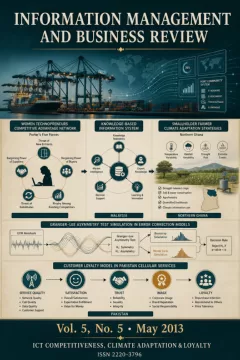 Vol. 5 No. 5 (2013)
ICT Competitiveness, Climate Adaptation & Loyalty
View issue contents
Published
Submissions
Have research to publish? Information Management and Business Review welcomes submissions.
Make a Submission