Abstract
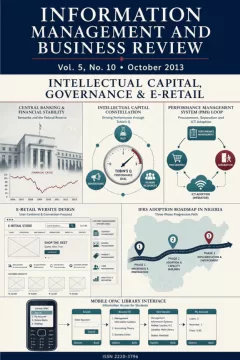
This study is aimed at revealing how performance management system (PMS) relates to procurement and separation among employees in an organization. Several researches have been embarked upon in determining how one or two human resource management (HRM) practice (s) influence employee performance, however, an approach to studying the mediating effect of ICT adoption between procurement and separation and performance management system is still begging for rigorous academic attention. To reduce this widely created gap, the paper aimed at determining whether the procurement and separation are correlated to performance management system. The results however obtained through SmartPLS confirmed that there is full mediation effect of ICT adoption on one relationship and a partial mediation effect on the other.
Keywords
- Performance Management System Search this journal for Performance Management System (opens in a new tab)
- Procurement Search this journal for Procurement (opens in a new tab)
- Separation Search this journal for Separation (opens in a new tab)
- ICT Adoption Search this journal for ICT Adoption (opens in a new tab)
- Nigeria Search this journal for Nigeria (opens in a new tab)
References
- Baron, R. & Kenny, D. (1986). The moderator-mediator variable distinction in social psychological research: conceptual, strategic, and statistical considerations. Journal of Personality and Social Psychology, 51 , 1173-82.
- Bowles, S., Cunnigham, C. C. J. L., De La Rosa, G. & Picano, J. (2007).Coaching leaders in middle and executive management: goals, performance, buy-in. Leadership & Organization Development Journal, 28(5), 388-408
- Beever, D. R. (2008). Integrating Succession and Career Development Strategies for Finance Professionals Victoria BC: Royal Roads University Canada.
- Cedar, C. (2005). Workforce technologies and service delivery approaches survey, 8th Annual Edition.
- Chang, W. & Chen, S. J. (2000). A study of the performance appraisal of the industrial designer in Taiwan. Journal of Technology, 15(3), 381-386
- Chin, W. W., Marcolin, B. L. & Newsted, P. N. (2003). A partial least squares latent variable modeling approach for measuring interaction effects: Results from a monte carlo simulation study and an electronic-mail emotion/adoption study. Information Systems Research , 14(2), 189–217.
- Den Hartog, D. & Verburg, R. (2004). High-performance work systems, organizational culture and firm effectiveness. Human Resource Management Journal, 14(1), 55-78.
- Handlogten, C. (2009). Implementation of e-recruitment. Amsterdam: Universiteit Twente.
- Heinen, J. S. & O’Neill, C. (2004). Managing talent to maximize performance. Employment Relations Today, 31(2), 67-82.
- Holton, E. & Trot, K. (2006).Competing for the future. Harvard Business Review, 72, 122-128.
- Huang, T. C. (2000). Are the human resource practices of effective firms distinctively different from those of poorly performing ones? Evidence from Taiwanese enterprises. International Journal of Human Resource Management, 11, 436–451
- Hussain, Z., Wallace, J. & Cornelius, N. (2007). The use and impact of human resource information systems on human resource management professionals. Information & Management, 44(1) , 74 – 89.
- Ishizaka, A. & Labib, A. (2011). Review of the main developments in the analytic hierarchy process. Expert Systems with Applications, 38(11), 14336–14345.
- Idris, F. (2011). Total quality management (TQM) and sustainable company performances: examining the relationship in Malaysian firms. International Journal of Business and Society, 12(1), 31-52
- Jaquenoud, L. (2005).How to maximize HR technology. Strategic HR Review, 5(1), 4.
- Kim, S. (2005). Individual-Level Factors and Organizational Performance in Government Organizations. Journal of Public Administration Research & Theory, 15(2), 245-261
- Kock, N. (2013). Advanced mediating effects tests, multi-group analyses and measurement model assessments in PLS-based SEM. Laredo, TX: ScriptWarp Systems.
- Meier, K. J. & Hicklin, A. (2008). Employee turnover and organizational performance: A theoretical extension and test with public sector data. Journal of Public Administration Research and Theory, 18(4), 573-590
- Moynihan, D. P. & Landuyt, N. (2008). Explaining turnover intention in state government: Examining the roles of gender, life cycle, and loyalty. Review of Public Personnel Administration, 28, 120-143.
- Namazie, P. & Frame, P. (2007). Developments in Human Resource Management in Iran. International Journal of Human Resource Managemnt, 18(1) , 159-171.
- O’Neal, T. (2005). Evolving a Successful University-Based Incubator: Lessons Learned from the UCF Technology Incubator. Engineering Management Journal, 17(3), 11-25
- Remus, U. (2007). Critical success factors for implementing enterprise portals: A comparison with ERP implementations. Business Process Management Journal , 15, 538-552.
- Richard, O. C. & Johnson, N. B. (2001). Understanding the impact of human resource diversity practices on firm performance. Journal of Management Issues , 13, 177–195.
- Ringle, C., Wende, S. & Will, A. (2005). SmartPLS 2.0 M3. Hamburg: University of Hamburg. Retrieved June 6th 2013, from http://www.smartpls.de
- Rothwell, W., Jackson, R., Knight, S. & Lindholm, J. (2005). Career planning and succession management: Developing your organization's talent-for today and tomorrow. Westport, CT: Greenwood Press.
- Ruël, H., Bondarouk, T. & Looise, J. (2004). E-HRM: Innovation or Irritation. Utrecht: Lemma Publishers.
- Sanayei, A. & Mirzaei, A. (2008). Designing a Model for Evaluating the Effectiveness of e-HRM (Case Study: Iranian Organizations). International Journal of Information Science and Technology, 6(2).
- Sodhi, M. S. & Lee, S. (2007). An analysis of sources of risk in the consumer electronics industry. JORS, 58(11), 1430-1439
- Stanton, J. M. & Coovert, M. D. (2004). Turbulent waters: The intersection of information technology and human resources. Human Resource Management, 43(2), 121−125
- Strohmeier, S. (2007). Research in e-HRM: Review and implications. Human Resource Management Review, 17, 19–37.
- Tabachnick, B. G. & Fidell, L. S. (2007). Using multivariate statistics (5th ed.). Boston: Pearson Education Inc.
- Townsend, A. M. & Bennett, J. T. (2003). Human resources and information technology. Journal of Labor Research, 24(3), 361−363
- Tzafrir, S. S. (2006). An universalistic perspective for explaining the relationship between HRM practices and firm performance at different points in time. Journal of Managerial Psychology, 21(2), 109-130
- Viswesvaran, C. (2003). Introduction to special issue: Role of technology in shaping the future of staffing and assessment. International Journal of Selection and Assessment, 11(2/3), 107−112
- Williams, H. (2010). The HRIS specialist: Resourcing the “right kind” of human capital. In S. Strohmeier & A. Diederichsen (Eds.), Evidence-based e-HRM? On the way to rigorous and relevant research, Proceedings of the 3rd European academic workshop on electronic human resource management, Bamberg.
- Yusoff, Y. M., Ramayah, T. & Ibrahim, H. (2010). E-HRM: A proposed model based on technology acceptance model. African Journal of Business Management, 4(13), 3039-3045.
Downloads
No downloads have been recorded for this article yet. Figures appear here once readers begin downloading the full text.
How to Cite
Share this article
License
Copyright (c) 2013 Abubakar Allumi Nura, Nor Hasni Osman (Author)

This work is licensed under a Creative Commons Attribution 4.0 International License.
Author (s) should affirm that the material has not been published previously. It has not been submitted and it is not under consideration by any other journal. At the same time author (s) need to execute a publication permission agreement to assume the responsibility of the submitted content and any omissions and errors therein. After submission of revised paper in the light of suggestions of the reviewers, the editorial team edits and formats manuscripts to bring uniformity and standardization in published material.
This work will be licensed under Creative Commons Attribution 4.0 International (CC BY 4.0) and under condition of the license, users are free to read, copy, remix, transform, redistribute, download, print, search or link to the full texts of articles and even build upon their work as long as they credit the author for the original work. Moreover, as per journal policy author (s) hold and retain copyrights without any restrictions.
Keywords
- Performance Management System Search this journal for Performance Management System (opens in a new tab)
- Procurement Search this journal for Procurement (opens in a new tab)
- Separation Search this journal for Separation (opens in a new tab)
- ICT Adoption Search this journal for ICT Adoption (opens in a new tab)
- Nigeria Search this journal for Nigeria (opens in a new tab)
Section
Published
Submissions
Have research to publish? Information Management and Business Review welcomes submissions.
Make a Submission