Abstract
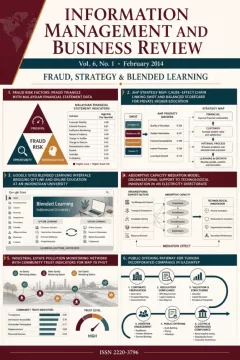
The current research studies the usefulness of Cressey’s fraud risk factor framework adopted from SAS No. 99 to prevent fraud from occurring. In accordance with Cressey’s theory, pressure, opportunity and rationalization are existing when fraud occurs. The study suggests variables as proxy measures for pressure and opportunity, and test these variables using publicly available information relating to a set of fraud firms and a sample of no-fraud firms. Two pressure proxies and two opportunity proxies are identified and suggested to be significantly related to financial statement fraud. We find that leverage and sale to account receivable are positively related to the likelihood of fraud. Audit committee size and board of directors’ size are also linked to decrease the level of financial statement fraud. A binary logistic model based on examples of fraud risk factors of fraud triangle model measures the likelihood of financial statement fraud and can assist experts.
Keywords
- Risk Factors Search this journal for Risk Factors (opens in a new tab)
- Financial Statement Fraud Search this journal for Financial Statement Fraud (opens in a new tab)
- Fraud Triangle Search this journal for Fraud Triangle (opens in a new tab)
- SAS 99 Search this journal for SAS 99 (opens in a new tab)
- Fraud Occurrence Search this journal for Fraud Occurrence (opens in a new tab)
References
- Albrecht, W. S., Albrecht, C. & Albrecht, C. C. (2008). Current trends in fraud and its detection. Information Security Journal: A global perspective , 17(1), 1-32.
- Albrecht, W. S. & Romney, M. B. (1986). Red-Flagging Management Fraud: A Validation. Advances in Accounting , 3, 323-334.
- Albrecht, C., Turnbull, C., Zhang, Y. & Skousen, C. J. (2010). The relationship between South Korean chaebols and fraud. Managerial Auditing Journal , 33(3), 1-25.
- Alleyne, P., Persaud, N., Alleyne, P., Greenidge, D. & Sealy, P. (2010). Perceived effectiveness of fraud detection audit procedures in a stock and warehousing cycle, Additional evidence from Barbados. Managerial Auditing Journal , 25 (6), 553-568.
- American Institute of Certified Public Accountants (AICPA). (1984). Audit Risk and Materiality in Conducting an Audit. Statement on Auditing Standards No. 47. New York, NY: AICPA.
- American Institute of Certified Public Accountants (AICPA). (2002). Consideration of fraud in a financial statement audit. Statement on Auditing Standards No. 99. New York, NY: AICPA.
- Apostolou, B., Hassell, J., Webber, S. & Sumners, G. (2001). The Relative Importance of Management Fraud Risk Factors. Behavioral Research in Accounting , 13, 1-24.
- Asare, S. K. & Wright, A. M. (2004). Audit: The effectiveness of alternative risk assessment and program planning tools in a fraud setting. Contemporary Accounting Research , 21(2), 325–352.
- Association of Certified Fraud Examiners (ACFE).0 (2012). Report to the Nations on Occupational Fraud and Abuse, 2012 Global Fraud Survey.
- Auditing Standards Board. (2002). Statement on Auditing Standards No.99: Consideration of Fraud in a Financial Statement Audit.
- Barth, M. & Hutton, A. (2004). Analyst Earnings Forecast Revisions and the Pricing of Accruals, Review of Accounting Studies , 91, 59-96.
- Beasley, M. (1996). An empirical analysis of the relation between the board of director composition and financial statement fraud. The Accounting Review , 71(4), 443-465.
- Bell, T. B. & Carcello, J. V. (2000). A decision aid for assessing the likelihood of fraudulent financial reporting. Auditing: A Journal of Practice and Theory , 19(1), 169-184.
- Blocher, E. & Cooper, J. C. (1988). A Study of Auditors Analytical Review Performance. Auditing: A Journal of Practice and Theory , 7(2), 1-28.
- Blocher, E. (1992). The Role of Analytical Procedures in Detecting Management Fraud. Institute of Management Accountants, Montvale, NJ.
- Bonner, S. E. & Lewis, B. L. (1990). Determinants of auditor expertise, Journal of Accounting Research, 3, 1-20.
- Calderon, T. G. & Green, B. P. (1994). Analysts’ Forecasts as an Exogenous Risk Indicator in Analytical Auditing. Advances in Accounting , 12, 281-300.
- Chen, K. Y. & Elder, R. J. (2007). Fraud Risk Factors and the Likelihood of Fraudulent Financial Reporting: Evidence from Statement on Auditing Standards No. 43 in Taiwan, Working paper.
- Claessens, S., Djankov, L. & Lang, L. (2000). The separation of ownership and control in East Asian Corporations. Journal of Financial Economics , 58, 81-112.
- Cressey, D. R. (1953). Other People’s Money. Montclair, NJ: Patterson Smith, pp.1-300.
- Hassink, H., Bollen, L. H., Meuwissen, R. H. G. &Vries, M. J. (2009). Corporate fraud and the audit expectations gap: A study among business managers. Journal of International Accounting, Auditing and Taxation , 18, 85-100.
- Heiman-Hoffman, V. B., Morgan, K. P. J. & Patton, M. (1996). The Warning Signs of Fraudulent Financial Reporting. Journal of Accountancy , 182(4), 75-81.
- International Auditing Standards Board. (2009). International Standard on Auditing No.240: the Auditor’s responsibilities relating to fraud in an audit of financial statements.
- Kaminski, K., Wetzel, T. & L. Guan. (2004). Can financial ratios detect fraudulent financial reporting? Managerial Auditing Journal , 19 (1), 15-28.
- Kwan, J. H. & Kwan, S. S. (2011). Violation of listing requirements and company value: Evidence from Bursa Malaysia. International Review of Business Research Papers , 7(2), 257-268.
- Loebbecke, J., Eining, M. & Willingham, J. (1989). Auditors’ Experience with Material Irregularities: Frequency, Nature, and Detectability, Auditing. A Journal of Practice & Theory , 9(1), 1-28.
- Libby, R. & Tan, H. T. (1994). Modeling the determinants of audit expertise. Accounting, Organizations and Society , 19(8), 701-716.
- Lister, L. M. (2007). A practical approach to fraud risk. Internal Auditor, 1-30.
- Ming, J. J. & T. J. Wong. (2003). Earnings management and tunneling through related party transactions: Evidence from Chinese corporate groups. EFA 2003 Annual Conference, Paper No.549.
- Moyes, G. D. & Hasan, I. (1996). An empirical analysis of fraud detection likelihood. Managerial Auditing Journal , 11(3), 41-46.
- Moyes G., Lin, P. & Landry-Jr, R. (2005). Raise the red flag. Internal Auditor, October: 47-51.
- Mui, G. Y. (2009). Defining auditor expert performance in fraud detection. Accounting and Finance Association of Australia and New Zealand (AFAANZ)
- Murdock, H. (2008). The three dimensions of fraud. Internal Auditor, 1-14.
- Nieschwietz, R., Schultz-Jr, J. & Zimbelman, M. (2000). Empirical research on external auditors’ detection of financial statement fraud. Journal of Accounting Literature , 19, 190-246.
- Persons, O. (1995). Using financial statement data to identify factors associated with fraudulent financial reporting. Journal of Applied Business Research , 11(3), 38-46.
- Rae, K. & Subramaniam, N. (2008). Quality of internal control procedures: Antecedents and moderating effect on organizational justice and employee fraud. Managerial Auditing Journal , 23(2), 1-43.
- Ramos, M. (2003). Auditors Responsibility for Fraud Detection. Journal of Accountancy , 195(1), 28-36.
- Skousen, C. & Wright, C. (2006). Contemporary risk factors and the prediction of financial statement fraud. Working Paper. University of Texas at Arlington and Oklahoma State University.
- Skousen, C. & Wright, C. (2008). Contemporaneous risk factors and the prediction of financial statement fraud. Journal of Forensic Accounting , 6, 37-62.
- Smith, M., Omar, N. H., Syad Idris, S. I. Z. & Baharuddin, I. (2005). Auditors’ perception on fraud risk indicators: Malaysian evidence. Managerial Auditing Journal , 20(1), 73-85.
- Vance, S. (1983). Corporate leadership: Boards, directors and strategy. New York: McGraw-Hill.
- Vona, L. W. (2008). Fraud risk assessment: Building a fraud audit program. Hoboken New Jersey: John Wiley and Sons.
- Wilks, T. J. & Zimbelman, M. F. (2004). Decomposition of Fraud-Risk Assessments and Auditors’ Sensitivity to Fraud Cues. Contemporary Accounting Research , 21(3), 719-745.
Downloads
No downloads have been recorded for this article yet. Figures appear here once readers begin downloading the full text.
How to Cite
Share this article
License
Copyright (c) 2014 Shabnam Fazli Aghghaleh, Takiah Mohd. Iskandar, Zakiah Muhammaddun Mohamed (Author)

This work is licensed under a Creative Commons Attribution 4.0 International License.
Author (s) should affirm that the material has not been published previously. It has not been submitted and it is not under consideration by any other journal. At the same time author (s) need to execute a publication permission agreement to assume the responsibility of the submitted content and any omissions and errors therein. After submission of revised paper in the light of suggestions of the reviewers, the editorial team edits and formats manuscripts to bring uniformity and standardization in published material.
This work will be licensed under Creative Commons Attribution 4.0 International (CC BY 4.0) and under condition of the license, users are free to read, copy, remix, transform, redistribute, download, print, search or link to the full texts of articles and even build upon their work as long as they credit the author for the original work. Moreover, as per journal policy author (s) hold and retain copyrights without any restrictions.
Keywords
- Risk Factors Search this journal for Risk Factors (opens in a new tab)
- Financial Statement Fraud Search this journal for Financial Statement Fraud (opens in a new tab)
- Fraud Triangle Search this journal for Fraud Triangle (opens in a new tab)
- SAS 99 Search this journal for SAS 99 (opens in a new tab)
- Fraud Occurrence Search this journal for Fraud Occurrence (opens in a new tab)
Section
Published
Submissions
Have research to publish? Information Management and Business Review welcomes submissions.
Make a Submission