Abstract
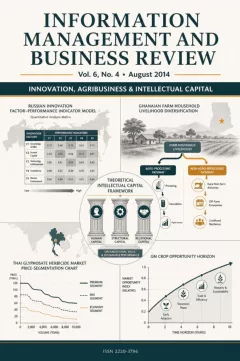
The purpose of this study is to find out the opportunities and challenges of the glyphosate market in Thailand, which is affected by product registration laws, demand, supply, and product positioning and price segmentation. The methodology of this study consists of primary data from 2013 market surveys both at dealer and farmer levels and secondary data collected from 2009-2013 using descriptive methods. The results show that herbicides, fungicides and insecticides werethetop three kinds of imported pesticides used for crop production in Thailand from 2009-2013. Herbicide imports increased fromUS$291.83 million (MUSD) and 53,615.20 tons in 2009, to 352.93 MUSD and 60,231.52 tons in 2012. Glyphosate was the leading pesticide import in 2012, in cost and amount, at 88.13 MUSD and 19,721 tons. Many glyphosate brands compete in a price-segmented market. Monsanto’s Roundup brand is the most expensive, at 18.12-18.75USD per four liters (/4 L). Brands such as Ecomax are priced in the medium range, at13.75-16.25 USD/4 L. This segment has other brands too, such as Market and Popular, and they are sold in different regions. Other brands are in the lowest price range, at 1.25-13.45 USD/4 L. Thailand has not yet approved genetically modified (GM) crops that can tolerate glyphosate, so the market for glyphosate is very limited at the moment. If the Thai government approves GM crops, the glyphosate market will have more opportunity for growth.
Keywords
- Glyphosate Search this journal for Glyphosate (opens in a new tab)
- Market Search this journal for Market (opens in a new tab)
- Opportunities Search this journal for Opportunities (opens in a new tab)
- Challenges Search this journal for Challenges (opens in a new tab)
- Thailand Search this journal for Thailand (opens in a new tab)
References
- CCM Information Science and Technology Company. (2008). Glyphosate Competitiveness Analysis in China. CCM International Limited: Guangzhou, China. Accessed from: http://www.researchandmarkets.com/reportinfo.asp?cat_id=o&report_id=649031&q=glyphosat e&p=1
- Cobb, H. A. & Reade, P. H. J. (2010). Herbicides and Plant Physiology. Wiley-Blackwell: New York, NY.
- Finney, J. R. (1998). World crop protection prospects: demisting the crystal ball. Proceedings of the Brighton Crop Protection Conference-Pests and Diseases: 3-14.
- Nandula, V. K. (2010). Glyphosate Resistance in Crops and Weeds: History, Development and Management, John Wiley& Sons: Hoboken, New Jersey.
- Office of Agriculture Economic. 2011. Agricultural Statistics of Thailand Crop Year 2010/2011. Ministry of Agriculture and Cooperative.
- Office of Agriculture Economic. 2012. Agricultural Statistics of Thailand Crop Year 2011/2012. Ministry of Agriculture and Cooperative.
- Office of Agriculture Economic. 2013. Agricultural Statistics of Thailand Crop Year 2012/2013. Ministry of Agriculture and Cooperative.
- Regulatory Division. 2009. Pesticide Statistics. Department of Agriculture, Ministry of Agriculture and Cooperative.
- Regulatory Division. 2010. Pesticide Statistics. Department of Agriculture, Ministry of Agriculture and Cooperative.
- Regulatory Division. 2011. Pesticide Statistics. Department of Agriculture, Ministry of Agriculture and Cooperative.
- Regulatory Division. 2012. Pesticide Statistics. Department of Agriculture, Ministry of Agriculture and Cooperative.
- Regulatory Division. 2013. Pesticide Statistics from January-June 2013. Department of Agriculture, Ministry of Agriculture and Cooperative.
- Poramacom, N. (2001). Pesticide Markets and Related Situations in Thailand. Kasetsart Journal: Social Sciences , 22, 205-211.
- Sopit, J. (2012). Effect of Glyphosate Herbicide Spraying Period on Growth and Yield of Cassava Variety Rayong 11. Thai Agricultural Research Journal , 30(2), 186-191.
- Wolinska J. R. (2003). Laboratory and field tests of Roundup 360 SL. Railways Technical and Scientific Center (CNTK):Warsaw, Poland.
Downloads
No downloads have been recorded for this article yet. Figures appear here once readers begin downloading the full text.
How to Cite
Share this article
License
Copyright (c) 2014 Adisak Suvittawat (Author)

This work is licensed under a Creative Commons Attribution 4.0 International License.
Author (s) should affirm that the material has not been published previously. It has not been submitted and it is not under consideration by any other journal. At the same time author (s) need to execute a publication permission agreement to assume the responsibility of the submitted content and any omissions and errors therein. After submission of revised paper in the light of suggestions of the reviewers, the editorial team edits and formats manuscripts to bring uniformity and standardization in published material.
This work will be licensed under Creative Commons Attribution 4.0 International (CC BY 4.0) and under condition of the license, users are free to read, copy, remix, transform, redistribute, download, print, search or link to the full texts of articles and even build upon their work as long as they credit the author for the original work. Moreover, as per journal policy author (s) hold and retain copyrights without any restrictions.
Keywords
- Glyphosate Search this journal for Glyphosate (opens in a new tab)
- Market Search this journal for Market (opens in a new tab)
- Opportunities Search this journal for Opportunities (opens in a new tab)
- Challenges Search this journal for Challenges (opens in a new tab)
- Thailand Search this journal for Thailand (opens in a new tab)
Section
Published in
 Vol. 6 No. 4 (2014)
Innovation, Agribusiness & Intellectual Capital
View issue contents
Published
Submissions
Have research to publish? Information Management and Business Review welcomes submissions.
Make a Submission