Abstract
The purpose of this study is to identify the key success factors that affect Thai entrepreneurial competitiveness in logistics business operations. Four main parameters and twelve variables were first identified from both a literature review and observations from the Thai context, and were then explored. The methodology of this research began with a literature review. Fifty entrepreneurs in the logistics sector then filled out questionnaires, which were analyzed using a mean and standard deviation (SD) model. Results showed that the responses were in the agreed level in which the mean=2.89 and SD=0.35. The mean of the variable Thailand Infrastructure is still incomplete, was 2.94. The mean of Fuel Prices still Continuously Increase, was 2.90; and the mean of Thai Entrepreneurs Mainly Use Road Transportation was 2.84. Responses showed the mean of the variable Thai Entrepreneurs Have Too Little Understanding of Effective Transportation System, was 3.04. The mean of Thai Entrepreneurs Lack Knowledge and Skills about Just-in-Time Concept, was 2.79; and the mean of the Logistics Management is Separately Managed, the Collaboration in each Department is Low, was 2.58. The mean of Domestic Laws and Regulations are not Competitive was 3.03. The mean of Cross-border Trade and Regulations need to be revamped, was 2.94; and the mean of International Transportation Rules must be changed, was 2.73. The mean of Thai Logistics Workforce Lacks Logistics Management Skills and Experience, was 3.45. The mean of Thai Logistics Workforce Productivity is Lower than Entrepreneurs’ Expectations, was 2.97 and the mean of English Proficiency of Thai Logistics Workforce is Low, was 2.73. Thai entrepreneurs need to improve their competitiveness by focusing on the key factors that affect logistics business success, such as figuring out how to cut operational management costs, improve ineffective inventory management and improve the quality of workforce skills and knowledge. Transportation costs are still high, and since these costs are influenced by Government policies, Thai entrepreneurs need the Government to establish plans for infrastructure investment, such as by focusing on rail transportation rather than relying on roads. This would help entrepreneurs to enhance their competitiveness and provide excellent customer service. Effective inventory management requires both upstream and downstream development because inventory management involves more than just one function, such as the purchasing department or workin-process responsibilities, so all functions should work together. Inventory management success requires good collaboration with suppliers, transportation providers, distributors, and customers.
Keywords
- Competitiveness Search this journal for Competitiveness (opens in a new tab)
- Entrepreneurs Search this journal for Entrepreneurs (opens in a new tab)
- Thailand Search this journal for Thailand (opens in a new tab)
- Logistics Search this journal for Logistics (opens in a new tab)
- Success Search this journal for Success (opens in a new tab)
References
- Asia News Monitor. (2013). Jan21.Office of Transportation and Traffic Policy and Planning to play important role in logistics infrastructure development. Retrieved from http://search.proquest.com/docview/1271590493?accountid=44783.
- Asia News Monitor. (2014). Jul21.Yusen calls for better border process. Retrieved from http://search.proquest.com/docview/1545826449?accountid=44783.
- Asia News Monitor. (2014). Jun3. North Star Logistics CEO comments on business situation. Retrieved from http://search.proquest.com/docview/1530948066?accountid=44783.
- Baker, P. (2007). An exploratory framework of the role of inventory and warehousing in international supply chains. The International Journal of Logistics Management, 18(1), 64- 80.
- Dischinger, J., Closs, D. J., McCulloch, E., Speier, C., Grenoble, W. & Marshal, L. D. (2006). The Emerging Supply Chain Management Profession. Supply Chain Management Review, 10(1), 62-68.
- Kovacs, G., Tatham, P. & Larson, D. P. (2012). What Skills Are Needed to be a Humanitarian Logistician? Journal of Business Logistics , 33(3), 245-258.
- Larry C., Giunipero, K. & Wai, K. L. (1990). Organizational Support for Just-in-Time Implementation. The International Journal of Logistics Management, 1(2), 35-40.
- Liker, J. K. (1998). Becoming Lean: Inside Stories of U.S. Manufacturers, Portland, OR. Productivity Press , 2, 107-108.
- Lowson, R. H. (2002). Assessing the operational cost of offshore sourcing strategies. The International Journal of Logistics Management, 13(2), 79-89.
- Rhonda, L. R. & Robert, J. V. (2000). The Role of Just-in-Time in Supply Chain Management. The International Journal of Logistics Management, 11(1), 89-98.
- National Economic and Social Development Board (NESDB). (2009). 2009 Thailand’s Logistics Annual Report. .
- Waters, C. D. G. (2002). Inventory Control and Management. Wiley, Chichester.
- Womack, J. P. & Jones, D. T. (1996). Lean Thinking: Banish Waste and Create Wealth in Your Corporation. Simon & Schuster, London.
- The World Bank, Human Development Sector. (2007). Malaysia and Knowledge Economy: Building a World-Class Higher Education System. Report No. 40397-MY. Washington D.C.
Downloads
No downloads have been recorded for this article yet. Figures appear here once readers begin downloading the full text.
How to Cite
Share this article
License
Copyright (c) 2014 Adisak Suvittawat (Author)

This work is licensed under a Creative Commons Attribution 4.0 International License.
Author (s) should affirm that the material has not been published previously. It has not been submitted and it is not under consideration by any other journal. At the same time author (s) need to execute a publication permission agreement to assume the responsibility of the submitted content and any omissions and errors therein. After submission of revised paper in the light of suggestions of the reviewers, the editorial team edits and formats manuscripts to bring uniformity and standardization in published material.
This work will be licensed under Creative Commons Attribution 4.0 International (CC BY 4.0) and under condition of the license, users are free to read, copy, remix, transform, redistribute, download, print, search or link to the full texts of articles and even build upon their work as long as they credit the author for the original work. Moreover, as per journal policy author (s) hold and retain copyrights without any restrictions.
Keywords
- Competitiveness Search this journal for Competitiveness (opens in a new tab)
- Entrepreneurs Search this journal for Entrepreneurs (opens in a new tab)
- Thailand Search this journal for Thailand (opens in a new tab)
- Logistics Search this journal for Logistics (opens in a new tab)
- Success Search this journal for Success (opens in a new tab)
Section
Published in
 Vol. 6 No. 6 (2014)
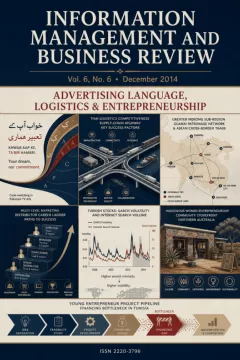
Advertising Language, Logistics & Entrepreneurship
View issue contents
Published
Submissions
Have research to publish? Information Management and Business Review welcomes submissions.
Make a Submission