Abstract
In East Asian cultures such as Thailand, existing patronage in local political and administrative structures can limit the ability of the state to affect its policies. Consequently, this research examines the extent to which these “guanxi” networks affect provincial small businesses, which lack the resources to persuade local provincial patronage providers to advantage them. This has implications for the ASEAN Economic Community, when cross-border economic activity is expected to increase, especially in the Greater Mekong Sub-region (GMS). Thailand is chosen for this study because of its long history of strong power patronage systems at the provincial level and for its regional economic prominence and rich cross-border trade activities with neighboring countries such as Laos, Myanmar, Cambodia and Malaysia in the GMS. Findings from interview-based data collected from 178 small firm respondents from 31 provinces suggest that “friends and family guanxi” networks matter most for provincial small businesses. While there is an ongoing relationship between political officers and top managers of buyer (not supplier) firms, these are likely to be large firms, not small firms. Consequently, it is likely that small provincial firms, whether Thai or from neighboring countries, will not need to foster connections with local politicians and government officials.
Keywords
- Provincial Patronage Search this journal for Provincial Patronage (opens in a new tab)
- Networks Search this journal for Networks (opens in a new tab)
- Mekong Sub-Region (GMS) Search this journal for Mekong Sub-Region (GMS) (opens in a new tab)
- ASEAN Economic Community (AEC) Search this journal for ASEAN Economic Community (AEC) (opens in a new tab)
References
- Akgungor, S. (2006) Textile and clothing industry history. Dokuz Eylül University, Turkey. http://people.deu.edu.tr/sedef.akgungor/textile.ppt
- Adorno, T. (2005). Minima Moralia: Reflections on a Damaged Life (London and New York: Verso, 2005), translated by E.F.N. Jephcott.
- Arunmas, P. (2003). Chiang Rai Slated for New Projects to Facilitate Thai-China Trade, Bangkok Post (December 8th ).
- Astrachan, J. H. (1988). Family firm and community culture. Family Business Review , 1(2), 165–89.
- Becker, G. & Bakal, D. A. (1970). Subject anonymity and motivational distortion in self report data. Journal of Clinical Psychology , 26(2), 207–209.
- Besser, T. L. (1998). The significance of community to business social responsibility. Rural Sociology , 8, 412–431.
- Besser, T. L. (1999). Community involvement and the perception of success among small business operators in small towns. Journal of Small Business Management, 37(4), 16–30.
- Bhat, S. & Fox, R. (1996). An investigation of jeopardy effects in store choice. Journal of Retailing and Consumer Services , 3(3), 129–133
- Bunyamanee, S. (2003). Companies from Yunnan to Build Industrial Estates in Thailand, Bangkok Post (December 9th , 2003).
- Carter, N., Williams, M. & Reynolds, P. (1997). Discontinuance among new firms in retail: The influence of initial resources, strategy, and gender. Journal of Business Venturing , 12(2), 125-45.
- Chaisang, C. (2009). Thai Democracy in Crisis: 27 Truths (Bangkok: The Institution of Democratization Studies, 2009).
- Chaloemtiarana, T. (2007). Thailand: The Politics of Despotic Paternalism (Chiang Mai: Silkworm Books, 2007).
- Choi, J. (2005). Economic Crisis, Poverty, and the Emergence of Populism in Thailand. Journal of International and Area Studies , 12(1), 49-60.
- Clark, H. & Ip, A. (1999). The Peifan – lucky star – a car for China. Des Manage Journal , 3, 21–28.
- Daily, C. M. & Dollinger, M. J. (1991). Family Firms Are Different. Review of Business , 13(1), 3-5.
- Davis, P. (1983). Realizing the potential of the family business. Organizational Dynamics, 5(1), 47-56.
- Deshpande, R., Farley, J. U. & Frederick, W. Jr. (1993). Corporate Culture, Customer Orientation, and Innovativeness in Japanese Firms: A Quadrad Analysis. Journal of Marketing , 57, 23-37.
- Dressel, B. (2009). Thailand’s Elusive Quest for a Workable Constitution, 1997-2007. Contemporary Southeast Asia: A Journal of International and Strategic Affairs , 31(2), 296-325.
- Dyer, W. G. (1986). Cultural change in family firms: Anticipating and managing business and family transitions. San Francisco: Jossey-Bass.
- Dyer, W. G., Jr. (1988). Culture and continuity in family firms. Family Business Review , 1(1), 37-50.
- Early, P. C. & Ang, S. (2003). Cultural Intelligence. Stanford, CA: Stanford University Press.
- Gallo, M. A. & Sveen, J. (1991). Internationalizing the family business: Facilitating and restraining factors. Family Business Review , 4(2), 181-190.
- Gomez-Mejia, L. R., Haynes, K., Nunez-Nickel, M., Jacobson, K. & Moyano- Fuentes, J. (2007). Family owned firms: risk loving or risk averse. Administrative Science Quarterly , 52(1), 106-37.
- Gordon, R. & Li, W. (2005). Tax Structure in Developing Countries: Many Puzzles and a Possible Explanation. National Bureau of Economic Research (NBER) Working Papers number 11267 http://www.nber.org/papers/w11267.pdf
- Granovetter, M. (1973). The strength of weak ties. American Sociology , 78, 1360–1380.
- Granovetter, M. (1985). Economic action and social structure: The problem of embeddedness. American Journal of Sociology , 91(3), 481–510.
- Guina, C. S. (2008). The GMS Economic Corridors. Regional Outlook , 3, 84-86.
- Hall, A., Melin, L. & Nordqvist, M. (2001). Entrepreneurship as radical change in the family business: Exploring the role of cultural patterns. Family Business Review, 14(3), 193– 208.
- Hansen, M. T. (1999). The Search-Transfer Problem: The Role of Weak Ties in Sharing Knowledge across Organization Subunits. Administrative Science Quarterly , 44, 82-111.
- Hansen, M. T.., Morrow J. L. & Batista, J. C. (2002). The impact of trust on cooperative membership retention, performance, and satisfaction: an exploratory study The International Food and Agribusiness. Management Review , 5(1), 41-59.
- Heck, R. K. Z. & Walker, R. (1993). Family-owned home-businesses: Their employees and unpaid helpers. Family Business Review , 6(4), 397- 415.
- Hoffman, L. (1981). Foundations of family therapy. New York: Basic Books.
- Hofstede, G. (1980). Culture's Consequences: International Differences in Work-related Values, Sage, Beverly Hills, CA.
- Hofstede, G. (1994). Foreword, in Kim et at (Eds), Individualism and Collectivism: Theory, Method, and Applications, 18, Cross-cultural research and methodology series, Sage Thousand Oaks, CA.
- Jitpleecheep, S. (2005). B7.5bn Hinges on Favorable Rules: Tesco-Lotus Waiting for Zoning Details, Bangkok Post (September 30th , 2005).
- Jitpleecheep, S. (2006). KFC Shifts Focus away from Big-Store Spaces, Bangkok Post (February 1st , 2006).
- Kanchoochat, V. (2008). Services, Servility, and Survival: the Accommodation of Big Retail, in Thai Capital after the 1997 Crisis, edited by Pasuk Phongpaichit and Chris Baker (Chiang Mai: Silkworm Books, 2008), pp.85-104.
- Keeble, D., Tyler, P., Broom, G. & Lewis, J. (1992). Business Success in the Countryside: the Performance of Rural Enterprises, HMSO for the Department of the Environment, London (1992).
- Kirchhoff, B. A. & Kirchhoff, J. J. (1987). Family contributions to productivity and profitability in small businesses. Journal of Small Business Management, 25(4), 25-31.
- Kleberg, S. S. (2001). Philanthropy: Adding value to family business. In G. McCann & N. Upton (Eds.), Destroying myths and creating value in family business, pp. 65– 71. Deland, FL: Stetson University.
- Lee, K. S., Lim, G. H., Tan, S. & Wee, C. H. (2001). Generic marketing strategies for small and medium-sized enterprises – conceptual framework and examples from Asia. Journal of Strategic Marketing , 9, 145–162.
- Levin, D. Z. & Cross, R. (2004). The strength of weak ties you can trust: the mediating role of trust in effective knowledge transfer. Management Science, 50, 1477–1490.
- Lin, C. Y. Y. & Zhang, J. (2005). Changing Structures of SME Networks: Lessons from the Publishing Industry in Taiwan. Long Range Planning, 38(2), 145-162.
- Machete, C. L. (1990). Factors contributing to poor performance of agricultural cooperatives in less developed areas. Agrekon, 29(4), 305–309.
- Miller, D. & Le Breton-Miller, I. (2003). Challenge versus advantage in family business. Strategic Organization , 1, 127–34.
- Miller, N. J. (1991). Local consumer spending: a reflection of rural community social and economic exchange . Journal of the Community Development Society, 29(2), 166–185.
- Narva, R. L. (2001). Heritage and tradition in family business: How family controlled enterprises connect the experience of their past to the promise of their future. In G. McCann & N. Upton (Eds.), Destroying myths and creating value in family business, pp. 65– 71. Deland, FL: Stetson University.
- Nisbett, R. (2003). The geography of thought: how Asians and Westerners think differently… and why. New York: The Free Press.
- Nooteboom, B. (1993). Firm Size Effects on Transaction Costs. Small Business Economics, 5, 283-295.
- Peng, M. W. & Luo, Y. (2000). Managerial ties and firm performance in a transitional economy: the nature of a micro-macro link. Academy of Management Journal, 43(3), 486-501.
- Portes, A. & Sensenbrenner, J. (1993). Embeddedness and immigration: notes on the social determinants of economic action. American Journal of Sociology , 98 (6), 1320–1350.
- Post, J. E. (1993). The greening of the Boston Park Plaza Hotel. Family Business Review, 6(2), 131-148.
- Prayukvong, W. (2005). A Buddhist economic approach to the development of community enterprises: a case study from Southern Thailand. Cambridge Journal of Economics, 29, 1171–1185.
- Putnam, R. D. (1993). The prosperous community: social capital and public life. The American Prospect , 4(13). http://www.philia.ca/files/pdf/ProsperousCommunity.pdf
- Quinn, R. & Cameron, K. (1983). Organizational life cycles and shifting criteria of effectiveness: Some preliminary evidence. Management Science , 29, 33-41.
- Reiss, D. (1982). The working family: A researcher’s view of health in household. American Journal of Psychiatry, 4, 1412-1420.
- Rosenblatt, P. C., deMik, L., Anderson, R. M. & Johnson, P. A. (1985). The family in business: Understanding and dealing with the challenges entrepreneurial families face. San Francisco: Jossey-Bass.
- Samudavanija, C. A. & Parichart, C. (1998). Beyond Transition in Thailand, in Larry Diamond and Marc F. Plattner, eds., Democracy in East Asia (Baltimore and London: The Johns Hopkins University Press, 1998), pp.147-67.
- Schein, E. H. (1995). The role of the founder in creating organizational culture. Family Business Review, 8(3), 221– 238.
- Smallbone, D., North, D. & Leigh, R. (1993). The growth and survival of mature manufacturing SMEs in the 1980s: an urban–rural comparison. J. Curran and D. Storey (Eds.), Small Firms in Urban and Rural Locations.
- Stafford, K., Duncan, K. A., Danes, S. M. & Winter, M. (1999). A research model of sustainable family business. Family Business Review, 12(3), 197–208.
- Steier, L. (2007). New Venture Creation and Organization: A Familial Sub-Narrative. Journal of Business Research , 60(10), 1099-1107.
- Uzzi, B. (1996). The sources and consequences of embeddedness for the economic performance of organizations: the network effect. American Sociological Review, 61, 674–698.
- Uzzi, B. (1997). Embeddedness in the making of financial capital: how social relations and networks benefit firms seeking financing. American Sociological Review, 64, 481–505.
- Walsh, J. & Pawana, T. (2007). Chinese Tourism in Thailand: Experiences and Satisfaction. ASEAN Journal on Hospitality and Tourism , 6(2), 105-13.
- Winichakul, T. (1994). Siam Mapped: A History of the Geo-Body of a Nation (Honolulu: University of Hawai’i Press, 1994)
- Zahra, S. A., Hayton, J. C. & Salvato, C. (2003). Organizational culture and entrepreneurship in family firms: A resources-based analysis. Paper presented at the Theories of the Family Enterprise Conference, University of Pennsylvania, Philadelphia, December.
Downloads
No downloads have been recorded for this article yet. Figures appear here once readers begin downloading the full text.
How to Cite
Share this article
License
Copyright (c) 2014 Lavanchawee Sujarittanonta, John Walsh (Author)

This work is licensed under a Creative Commons Attribution 4.0 International License.
Author (s) should affirm that the material has not been published previously. It has not been submitted and it is not under consideration by any other journal. At the same time author (s) need to execute a publication permission agreement to assume the responsibility of the submitted content and any omissions and errors therein. After submission of revised paper in the light of suggestions of the reviewers, the editorial team edits and formats manuscripts to bring uniformity and standardization in published material.
This work will be licensed under Creative Commons Attribution 4.0 International (CC BY 4.0) and under condition of the license, users are free to read, copy, remix, transform, redistribute, download, print, search or link to the full texts of articles and even build upon their work as long as they credit the author for the original work. Moreover, as per journal policy author (s) hold and retain copyrights without any restrictions.
Keywords
- Provincial Patronage Search this journal for Provincial Patronage (opens in a new tab)
- Networks Search this journal for Networks (opens in a new tab)
- Mekong Sub-Region (GMS) Search this journal for Mekong Sub-Region (GMS) (opens in a new tab)
- ASEAN Economic Community (AEC) Search this journal for ASEAN Economic Community (AEC) (opens in a new tab)
Section
Published in
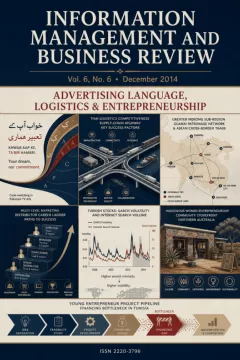 Vol. 6 No. 6 (2014)
Advertising Language, Logistics & Entrepreneurship
View issue contents
Published
Submissions
Have research to publish? Information Management and Business Review welcomes submissions.
Make a Submission