Abstract
Most previous studies have dealt with foreign competitors in host country by considering how the contractors compete in international environment. The purpose of this study is to develop a foreign competitor identification index (FCII) by assessing the global orientation of international contractors in Malaysia using various characteristics. The exploratory study is based on the secondary data from Engineering News Record (ENR, 2013) and Construction Industry Development Board (CIDB, 2013) Malaysia. The sampling frame was from the ENR top 250 international contractors operating in more than 100 countries worldwide. Their involvement in international projects includes general building, manufacturing, power, water supply, sewerage/solid waste, industrial process, petroleum, transportation, hazardous waste and telecommunications. Six (6) measurements were used to develop the FCII mode which were based on number of years of experience and number of consecutive years operating in Malaysia, number of countries they are working outside Malaysia, number of projects and number of diversity of projects undertaken in Malaysia, and ranking in ENR. The data was analysed descriptively to make the comparison and establish the findings. Thirty eight (38) out of 250 top international contractors listed by the ENR have been operating in Malaysia. It was observed that that the most competitive contractor with the highest FCII score has more than 12 year of consecutive years working in Malaysia working on 99 projects, operating in more than 20 countries outside Malaysia and ranked at 17th place by the ENR (2013). The study used a sampling frame of population based on ENR. Therefore, the proposed measurements shall be further validated by the subject matter experts. The study will assist local contractors to recognize the foreign competitors in Malaysia and a competitive index model will be further developed to guide the local contractors to prepare themselves to compete with the foreign contractors in Malaysia. Neglecting to properly assess the foreign contractors’ characteristics can lead to poor performance in their local business ventures. This study intends to contribute to an improved understanding foreign contractor’s competitiveness in relation to the local contractors towards the development of the FCII model. Although there have been various models related to competitive index, there is currently no model that attempts to show the effects of foreign contractors on the local contractors.
Keywords
- Competitor Index Search this journal for Competitor Index (opens in a new tab)
- Competitive Strategy Search this journal for Competitive Strategy (opens in a new tab)
- Foreign Contractors Search this journal for Foreign Contractors (opens in a new tab)
- Local Contractors Search this journal for Local Contractors (opens in a new tab)
- Malaysia Search this journal for Malaysia (opens in a new tab)
References
- Bhala, R. (2014). Trans-Pacific Partnership or Trampling Poor Partners?A Tentative Critical Review. International Economic Law , 11(1).
- Chaiprasit, S. & Swierczek, F. W. (2011). Competitiveness, Globalization And Technology Development In Thai Firms. Competitiveness Review: An International Business Journal Incorporating Journal of Global Competitiveness , 21(2), 188–204.
- Chia, F. C., Skitmore, M., Runeson, G. & Bridge, A. (2014). Economic development and construction productivity in Malaysia. Construction Management and Economics , 32(9), 874–887.
- Du, Q., Wang, Y., Ren, F., Zhao, Z., Liu, H., Wu, C. & Shen, Y. (2014). Measuring and Analysis of Urban Competitiveness of Chinese Provincial Capitals in 2010 under the Constraints of Major FunctionOriented Zoning Utilizing Spatial Analysis. Sustainability , 6(6), 3374–3399.
- Green, S. D., Larsen, G. D. & Kao, C. (2008). Competitive Strategy Revisited: Contested Concepts And Dynamic Capabilities. Construction Management and Economics , 26(1), 63–78.
- Gunhan, S. & Arditi, D. (2005). Factors Affecting International Construction. Journal of Construction Engineering and Management , 131, 273–282.
- Ibrahim, A. R., Bin-Roy, M. H., Ahmed, Z. & Imtiaz, G. (2010). An Investigation Of The Status Of The Malaysian Construction Industry. Benchmarking: An International Journal , 17(2), 294–308.
- Kamal, E. M., Haron, S. H., Ulang, N. & Baharum, F. (2012). The Critical Review on the Malaysian Construction Industry. Journal of Economics and Sustainable Development , 3(13), 81–87.
- Khan, R. A., Liew, M. S. & Ghazali, Z. (2014). Malaysian Construction Sector and Malaysia Vision 2020 : Developed Nation Status. Procedia - Social and Behavioral Sciences , 109, 507–513.
- Lu, W. (2014). Reliability of Engineering News-Record International Construction Data. Construction Management and Economics , (June), 1–15.
- Majid, S., Bakar, R. A., Sieh, L., Sieh, P. & Mei, L. (2004). Impact of AFTA on ACF member countries. The ASEAN Construction Federation (ACF) , 36–87.
- Muhamad, S., Sulaiman, N. F. C. & Sanusi, N. A. (2012). Innovative Capacity , Human Capital and Its Contribution to Economic Development in Malaysia. World Journal of Social Sciences , 2(6), 218–230.
- Orozco, F. A., Serpell, A. F., Molenaar, K. R., Asce, M. & Forcael, E. (2014). Modeling Competitiveness Factors and Indexes for Construction Companies : Findings of Chile. Journal of Construction Engineering and Management , 140, 1–13.
- Reina, P. & Tulacz, G. J. (2012). The Top 250 International Contractors (pp. 1–19).
- Sundaraj, G. (2006). The Way Forward : Construction Industry Master Plan 2006-2015. The Engenieur Sept, 6, 48–51.
- Ye, K., Shen, L. & Lu, W. (2014). Discriminant Model For Measuring Competition Intensity Of Construction Market. Engineering, Construction and Architectural Management , 21(2), 152–169.
Downloads
No downloads have been recorded for this article yet. Figures appear here once readers begin downloading the full text.
How to Cite
Share this article
License
Copyright (c) 2015 Nur Izzati Ab. Rani, Che Maznah Mat Isa, Christopher Nigel Preece (Author)

This work is licensed under a Creative Commons Attribution 4.0 International License.
Author (s) should affirm that the material has not been published previously. It has not been submitted and it is not under consideration by any other journal. At the same time author (s) need to execute a publication permission agreement to assume the responsibility of the submitted content and any omissions and errors therein. After submission of revised paper in the light of suggestions of the reviewers, the editorial team edits and formats manuscripts to bring uniformity and standardization in published material.
This work will be licensed under Creative Commons Attribution 4.0 International (CC BY 4.0) and under condition of the license, users are free to read, copy, remix, transform, redistribute, download, print, search or link to the full texts of articles and even build upon their work as long as they credit the author for the original work. Moreover, as per journal policy author (s) hold and retain copyrights without any restrictions.
Keywords
- Competitor Index Search this journal for Competitor Index (opens in a new tab)
- Competitive Strategy Search this journal for Competitive Strategy (opens in a new tab)
- Foreign Contractors Search this journal for Foreign Contractors (opens in a new tab)
- Local Contractors Search this journal for Local Contractors (opens in a new tab)
- Malaysia Search this journal for Malaysia (opens in a new tab)
Section
Published in
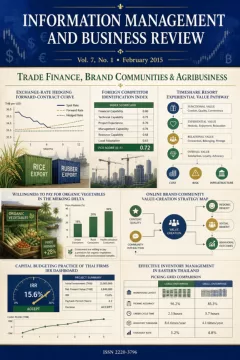 Vol. 7 No. 1 (2015)
Trade Finance, Brand Communities & Agribusiness
View issue contents
Published
Submissions
Have research to publish? Information Management and Business Review welcomes submissions.
Make a Submission