Abstract
Team work in competitive environment has attained greater Importance for organizations to enhance their performance. This paper is described the team conflict management with its antecedence like trust, task interdependence and managerial coping skill, whereas dependent variables i.e. team conflict management styles, employees satisfaction and organizational performance has been chosen as outcomes. To evaluate the deduction of other studies have been made part of this paper. This paper is conceptual in nature henceforth, relations between independently and dependent variables have been described. Studies proved that there is a strong relation between team conflict management with employee’s satisfaction and organizational Performance. It is recommended that to Executives, Managers Trust and Task interdependence between the team members have positive impact on TCMS (Team conflict management styles). Present paper provides the solution to handle the conflicts within the team and with the team. Future research is directed for its empirical testing of TCMS model” should be replaced with sound implication.
Keywords
- Team Conflict Search this journal for Team Conflict (opens in a new tab)
- Trust Search this journal for Trust (opens in a new tab)
- Culture Task Interdependence Search this journal for Culture Task Interdependence (opens in a new tab)
- Organizational Performance Search this journal for Organizational Performance (opens in a new tab)
References
- Alper, S., Tjosvold, D. & Law, K. S. (2000). Conflict management, efficacy, and performance in organizational teams. Personnel Psychology , 53, 625–642.
- Bain, P. G., Mann, A. & Pirola-Merlo. (2001). The innovation imperative: The relationship between team climate, innovation, and performance in research and development teams. Small Group Research , 32, 55-73.
- Barker, C. (1994). Research Methods in Clinical and Counseling Psychology. Chichester: John Wiley & Sons.
- Byrd, J. & Brown, P. (2003). The innovation equation: Building creativity and risk-taking in your organization. San Francisco: Jossey-Bass.
- Ayoko, O. B., Hartel, C. E. J. & Cullen, V. J. (2002). Resolving the puzzle of productive and destructive conflict in culturally heterogeneous work groups: A communication accommodation theory approach. International Journal of Conflict Management , 13, 165–187.
- De Dreu, C. & Van de Vliert, E. (1997). Using conflict in organizations. Beverly Hills, CA: Sage.
- Ehrhart, M. G. & Naumann, S. E. (2004). Organizational citizenship behavior in work groups: A group norms approach. Journal of Applied Psychology , 89, 960–974.
- Gillespie, N. A. & Mann, L. (2004). Transformational leadership and shared values: the building blocks of trust. Journal of Managerial Psychology , 19, 588−607.
- Grant, R. M. & Baden-Fuller, C. (2004). A knowledge accessing theory of strategic alliances. J Manage Stud , 41, 61–84.
- Griffith, T., Mannix, E. A. & Neale, M. A. (2003). Conflict in virtual teams. In S. G. Hempei, Zhang.
- Illgen, D. R., Hollenbeck, J. R., Johnson, M. & Jundt, D. (2006). Teams in organizations: From I-P-O models to IMOI models. Annual Review , 56, 517–543.
- Jehn, K. A. (1997). A qualitative analysis of conflict types and dimensions in organizational groups. Administrative Science Quarterly , 42, 530–557.
- Karp, D. A. (1983). The College Classroom: Some Observations on the Meanings of Student Participation, In Rube, H. and Clark, C. (Eds.), Social Interaction: Reading in Sociology. New York: St. Martin’s Press, 195–210.
- Karp, D. A. (2012). College 101 courses for application and student success (CCRC Paper). New York, NY: Columbia University, Teachers College, Community College Research Center. Manuscript in preparation.
- Kiffin-Petersen, S. A. (2004). Trust: A neglected variable in team effectiveness research. Journal of the Australian and New Zealand Academy of Management , 10(1), 38–53.
- Klein, K. J. (2000). A multilevel approach to theory and research in organizations: Contextual, temporal, and emergent processes.
- Kuhn, T. & Poole, M. (2000). Do conflict management styles affect group decision making? Evidence from a longitudinal field study. Human Communication Research , 26, 558–590.
- Langfred, C. W. (2007). The downside of self-management: A longitudinal study of the effects of conflict on trust, autonomy, and task independence in self-managing teams. Academy of Management Journal , 50, 885–900.
- Lazarus, R. S. & Folkman, S. (1984). Stress, appraisal, and coping. New York: Springer.
- Lee-Kelley. & Crossman, A. (2011). Trust, commitment and team working: the paradox of virtual organizations. Global Networks , 4(4), 376.
- Lee, X. Liu, R. M. (2008). Understanding the dimensions of virtual teams . International Journal of E- learning, 5 , 4, 507–52.
- Lewis, C. (2000) A Man’s Place: Fathers and Families in the UK. York: Joseph Rowntree Foundation.
- Morris, M. W., Williams, K. Y., Leung, K., Larrick, R., Mendoza, M. T., Bhatnagar, D., Li, J., Kondo, M., Luo, J. L. and Hu, J. C. (1998). Conflict management style: Accounting for cross-national differences’. Journal of International Business Studies , 29, 729–48.
- McEvily, B., Wilson, J. M. & Straus, S. G. (2006). All in due time: the development of trust in computermediated and face-to-face teams. Organ Behav Hum Decis Process , 99(1), 16–33.
- Nurmi. (2010). Coping with Coping Strategies: How Distributed Teams and Their Members Deal with the Stress of Distance, Time Zones and Culture, Department of Industrial Engineering and Management, Laboratory of Work Psychology and Leadership, Helsinki University of Technology, Finland.
- Michael, A. W. (2004). Aston University, Aston Business School, Birmingham B4 7ET, UK.
- Pirola-Merlo, A., Richver, A., Hirst, G., Mann, L. & Bain, P. (2004). Learning to lead: The development and testing of a model of leadership learning. The Leadership Quarterly , 15, 311–327.
- Rahim, M. A. (2001). Managing conflict in organizations (ed.). Westport: Quorum.
- Rahim, M. A., Antonioni, D. & Psenicka, C. (2001), A structural equations model of leader power, subordinates ‘styles of handling conflict, and job performance. International Journal of Conflict Management , 12(3), 191-211.
- Richter, A. W., West, M. A., van Dick, R. & Dawson, J. F. (2006). Boundary spanners’ identification, intergroup contact, and effective intergroup relations. The Academy of Management Journal , 49, 1252–1269.
- Rodgers, T. L., Brown, H. G. & Scott Poole, M. (2004). Interpersonal traits, complementarily, and trust in virtual collaboration. Journal of Management Information Systems , 20(4), 115-137.
- Rousseau, D. M., Sitkin, S. B., Burt, R. S. & Camerer, C. (1998). Not so different after all: A cross discipline view of trust. Academy of Management Review , 23, 393–404.
- Somech, A. & Lidgoster, H. (2010). Innovation and conflict management in work teams: The effects of team identification and task and relationship conflict. Negotiation and Conflict Management Research , 3(1), 28-48.
- Somech, A., Desivilya, H. S. & Lidogoster, H. (2009). Team conflict management and team effectiveness: the effects of task interdependence and team identification. Journal of Organizational Behavior , 30, 359-378.
- Syna, D., Somech, A. H. & Lidogoster, H. (2009). Team conflict management and team effectiveness: the effects of task interdependence and team identification. Journal of Organizational Behavior , 30(3), 359‐78.
- Tjosvold, D. (1993). Learning to manage conflict: Getting people to work together productively. New York: Lexington Books.
- Tjosvold, D. (1997). Conflict within interdependence: Its value for productivity and individuality. In C. K. W. De Dreu & E. Van de Vliert (Eds.), Using conflict in organizations (pp. 23–37). London: Sage.
- Tjosvold, D. & Law, K. S. (2000). Conflict management, efficacy, and performance in organizational teams. Personnel Psychology , 53, 625-642.
- Tjosvold, D., Hui, C., Ding, D. & Hu, J. (2003). Conflict values and team relationships: Conflict’s contribution to team effectiveness and citizenship in China. Journal of Organizational Behavior , 24, 69–88.
- Tjosvold. (2009). Conflict management between and within teams for trusting relationships and performance in China. Journal of Organization Behavior , 30, 41-43.
- Yetton, P. W. & Bottger, P. C. (1988). An integration of process and decision scheme explanations of group problem solving performance. Organizational Behavior and Human Decision Processes , 42, 234249. doi: 10.1016/0749-5978(88)90014-3. West, M. 2004 In: Professional Business and Technical Management. p. 25-28. 4 p.
Downloads
No downloads have been recorded for this article yet. Figures appear here once readers begin downloading the full text.
How to Cite
Share this article
License
Copyright (c) 2015 Asif Mehmood Rana, Faiz Ahmed, Dr.Kashif-ur-Rehman (Author)

This work is licensed under a Creative Commons Attribution 4.0 International License.
Author (s) should affirm that the material has not been published previously. It has not been submitted and it is not under consideration by any other journal. At the same time author (s) need to execute a publication permission agreement to assume the responsibility of the submitted content and any omissions and errors therein. After submission of revised paper in the light of suggestions of the reviewers, the editorial team edits and formats manuscripts to bring uniformity and standardization in published material.
This work will be licensed under Creative Commons Attribution 4.0 International (CC BY 4.0) and under condition of the license, users are free to read, copy, remix, transform, redistribute, download, print, search or link to the full texts of articles and even build upon their work as long as they credit the author for the original work. Moreover, as per journal policy author (s) hold and retain copyrights without any restrictions.
Keywords
- Team Conflict Search this journal for Team Conflict (opens in a new tab)
- Trust Search this journal for Trust (opens in a new tab)
- Culture Task Interdependence Search this journal for Culture Task Interdependence (opens in a new tab)
- Organizational Performance Search this journal for Organizational Performance (opens in a new tab)
Section
Published in
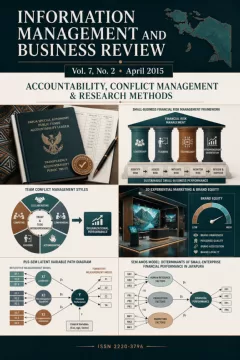 Vol. 7 No. 2 (2015)
Accountability, Conflict Management & Research Methods
View issue contents
Published
Submissions
Have research to publish? Information Management and Business Review welcomes submissions.
Make a Submission