Abstract
This study explores the effect of exhibitors’ brand equity on visitors’ purchase intention, as well as the moderating effect of visitors’ 3D experiential marketing on the above relationship. This study examined the visitors to a Taiwanese company’s exhibition booth at a famous India international mechanical fair. One hundred and fifty questionnaires were distributed and 103 valid surveys were returned, indicating a response rate of 68.67%. Empirical results indicated that exhibitors’ brand equity and visitors’ purchase intention are significantly and positively related; the interactive effect of visitors’ think experience and exhibitors’ brand equity is significantly related to visitors’ purchase intention.
Keywords
- Brand Equity Search this journal for Brand Equity (opens in a new tab)
- Purchase Intention Search this journal for Purchase Intention (opens in a new tab)
- Experiential Marketing Search this journal for Experiential Marketing (opens in a new tab)
- Exhibitor Search this journal for Exhibitor (opens in a new tab)
- Visitor Search this journal for Visitor (opens in a new tab)
References
- Aiken, L. S. & West, S. G. (1991). Multiple regression: Testing and interpreting interactions. Newbury Park, CA: Sage.
- Barwise, P. (1993). Brand equity: Snark or boojum. International Journal of Research in Marketing , 10(1), 93–104.
- Biedenbach, G., Bengtsson, M. & Wincent, J. (2011). Brand equity in the professional service context: Analyzing the impact of employee role behavior and customer–employee rapport. Industrial Marketing Management , 40(7), 1093–1102.
- Chen, C. F. & Chang, Y. Y. (2008). Airline brand equity, brand preference and purchase intentions - The moderating effects of switching costs. Journal of Air Transport Management , 14(1), 40–42.
- Cobb-Walgren, C. J., Ruble, C. A. & Donthu, N. (1995). Brand equity, brand preference and purchase intent. Journal of Advertising , 24(3), 25–40.
- Dekimpe, M. G., Francois, P., Gopalakrishna, S., Lilien, G. L. & Van den Bulte, C. (1997). Generalizing about trade show effectiveness: A cross-national comparison. Journal of Marketing , 61(4), 55–64.
- Dodds, W. B., Monroe, K. B. & Grewal, D. (1991). Effects of price, brand, and store information on buyers’ product evaluations. Journal of Marketing Research , 28(3), 307–319.
- Fishbein, M. & Ajzen, I. (1975). Belief, attitude, intention, and behavior: An introduction to theory and researc h . Reading, MA: Addison-Wesley.
- Fornell, C. & Larcker, D. F. (1981). Evaluating structural equation models with unobservable variables and measurement error. Journal of Marketing Research , 18(1), 39–50.
- Gopalakrishna, S., Lilien, G. L., Williams, J. D. & Sequeira, I. K. (1995). Do trade shows pay off? Journal of Marketing , 59(3), 75–83.
- Harder, J. W. (1991). Equity theory versus expectancy theory: The case of major league baseball free agents. Journal of Applied Psychology , 76(3), 458–464.
- Jin, X., Bauer, T. & Weber, K. (2010). China’s second-tier cities as exhibition destinations. International Journal of Contemporary Hospitality Management , 22(4), 552–571.
- Keller, K. L. (1993). Conceptualizing, measuring, managing customer-based brand equity. Journal of Marketing, 57(1), 1–22.
- Kim, J. H. & Hyun, Y. J. (2011). A model to investigate the influence of marketing-mix efforts and corporate image on brand equity in the IT software sector. Industrial Marketing Management , 40(3), 424–438.
- Kim, S. S. & Chon, K. (2009). An economic impact analysis of the Korean exhibition industry. International Journal of Tourism Research , 11(3), 311–318.
- Kirchgeorg, M., Jung, K. & Klante, O. (2010). The future of trade show: Insights from a scenario analysis. Journal of Business & Industrial Marketing , 25(4), 301–312.
- Kotler, P. & Keller, K. L. (2009). Marketing management (13th Ed.). Upper Saddle River, NJ: Prentice Hall.
- Kotler, P. & Pfoertsch, W. (2007). Being known or being one of many: The need for brand management for business-to-business companies. Journal of Business & Industrial Marketing , 22(6), 357–362.
- Lee, C. H. & Kim, S. Y. (2008). Differential effects of determinants on multi-dimensions of trade show performance: By three stages of pre-show, at-show, and post-show activities. Industrial Marketing Management , 37(7), 784–796.
- Lee, C. K., Lee, M. & Yoon, S. H. (2013). Estimating the economic impact of convention and exhibition businesses, using a regional input–output model: A case study of the Daejeon Convention Center in South Korea. Asia Pacific Journal of Tourism Research , 18(4), 330–353.
- Li, L. Y. (2007). Marketing resources and performance of exhibitor firms in trade shows: A contingent resource perspective. Industrial Marketing Management , 36(3), 360–370.
- McCabe, V. S. (2001). Career paths and labor mobility in the convention and exhibition industry in Eastern Australia: Results from a preliminary study. International Journal of Tourism Research , 3(6), 493–499.
- Michell, P., King, J. & Reast, J. (2001). Brand values related to industrial products. Industrial Marketing Management , 30(5), 415–425.
- Mitchell, T. R. & Biglan, A. (1971), Instrumentality theories: current uses in psychology. Psychological Bulletin , 76(6), 432–454.
- Noble, C. H. & Mokwa, M. P. (1999). Implementing marketing strategies: Developing and testing a managerial theory. Journal of Marketing , 63(4), 57–73.
- Pine, B. J. & Gilmore, J. H. (1998). Welcome to the experience economy. Harvard Business Review , 76(4), 97–105.
- Robinette, S., Brand, C. & Lenz, V. (2001). Emotion marketing : The hallmark way of winning customers for life . New York, NY: McGraw-Hill.
- Schiffman, L. G. & Kanuk, L. L. (2000). Consumer behavior. Upper Saddle River, NJ: Prentice-Hall.
- Schmitt, B. (1999a). Experiential marketing: How to get customers to sense, feel, think, act, and relate to your company and brand. New York, NY: The Free Press.
- Schmitt, B. (1999b). Experiential marketing. Journal of Marketing Management , 15(1-3), 53–67.
- Shin, D. H., Biocca, F. & Choo, H. (2013). Exploring the user experience of three-dimensional virtual learning environments. Behavior & Information Technology , 32(2), 203-214.
- Vroom, V. C. (1964). Work and motivation. New York, NY: John Wiley & Sons.
- Wang, C. L., Li, D., Barnes, B. R. & Ahn, J. (2012). Country image, product image and consumer purchase intention: Evidence from an emerging economy. International Business Review , 21(6), 1041–1051.
- Webster, F. E. & Keller, K. L. (2004). A roadmap for branding in industrial markets. Journal of Brand Management , 11(5), 388–402.
- Yoo, B. & Donth, N. (2001). Developing and validating multidimensional consumer-based brand equity scale. Journal of Business Research , 52(1), 1–14.
Downloads
No downloads have been recorded for this article yet. Figures appear here once readers begin downloading the full text.
How to Cite
Share this article
License
Copyright (c) 2015 Chao-Chih Hung, Chun-Han Lee, Wen-Long Zhuang (Author)

This work is licensed under a Creative Commons Attribution 4.0 International License.
Author (s) should affirm that the material has not been published previously. It has not been submitted and it is not under consideration by any other journal. At the same time author (s) need to execute a publication permission agreement to assume the responsibility of the submitted content and any omissions and errors therein. After submission of revised paper in the light of suggestions of the reviewers, the editorial team edits and formats manuscripts to bring uniformity and standardization in published material.
This work will be licensed under Creative Commons Attribution 4.0 International (CC BY 4.0) and under condition of the license, users are free to read, copy, remix, transform, redistribute, download, print, search or link to the full texts of articles and even build upon their work as long as they credit the author for the original work. Moreover, as per journal policy author (s) hold and retain copyrights without any restrictions.
Keywords
- Brand Equity Search this journal for Brand Equity (opens in a new tab)
- Purchase Intention Search this journal for Purchase Intention (opens in a new tab)
- Experiential Marketing Search this journal for Experiential Marketing (opens in a new tab)
- Exhibitor Search this journal for Exhibitor (opens in a new tab)
- Visitor Search this journal for Visitor (opens in a new tab)
Section
Published in
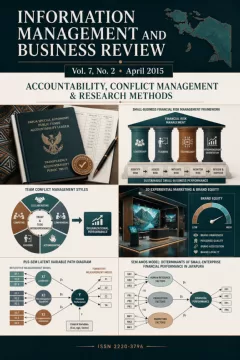 Vol. 7 No. 2 (2015)
Accountability, Conflict Management & Research Methods
View issue contents
Published
Submissions
Have research to publish? Information Management and Business Review welcomes submissions.
Make a Submission