Abstract
The Indian economy being one of the emerging economies among the twenty global traders with annual growth rate projected at 7.4% for the year 2014-15 as compared to 6.9% growth in the fiscal year 2013-14. With second largest population in world and third largest purchasing power parity India suffers from socio cultural issues such as poverty and unemployment. The major question here is on sustainable growth of the nation. An easy and affordable access to financial and banking services accounts for the financial inclusion particularly for the lower and vulnerable sections of the society. More the people earn more they invest and save more. In order to address the sate of inequality it is essential to give major priority for achieving 100 per cent or near to 100% Financial Inclusion. Gujarat being a rapidly growing state contributing 10% to India’s GDP despite efficient growth it lags behind in Financial Inclusion .The paper on Financial Inclusion in India: An empirical study of unorganized sector aims to do an in depth research in order to reason out for the unaccounted un-organized sector of the state. Unorganized sector refers to the people who drive their economic activities on daily basis by unregistered business firms or self employment. Dealing with primary data on Different parameters of Financial Inclusion pertaining to unorganized sector of Gujarat state and a regression model namely Logit Model is estimated to examine the relationship of Financial Inclusion parameter on various determining variables. Research work is on-going; we expect that Gujarat government has to focus on more spread of awareness among people of Gujarat who are not able to avail economic growth benefits equally despite an excellent performance in HDI, per capita GNI and other economic development parameters.
Keywords
- Financial Inclusion Search this journal for Financial Inclusion (opens in a new tab)
- Unorganized Sector in India Search this journal for Unorganized Sector in India (opens in a new tab)
- Gross State Domestic Product Search this journal for Gross State Domestic Product (opens in a new tab)
- Sustainable Development Search this journal for Sustainable Development (opens in a new tab)
- Inclusive Growth Search this journal for Inclusive Growth (opens in a new tab)
References
- CRISIL Inclusix. (2013). An Index to Measure India’s Progress on Financial Inclusion, CRISIL, June.
- Divya, K. H. (2013). A Study On Impact of Financial Inclusion With Reference To Daily Wage Earners. Journal of Business Management & Social Sciences , 2(6).
- Financial Access Survey. (2010). World Bank, Washington D.C.
- Meher, S. (2014). Financial Inclusion in India: An Inter-State Analysis, in Mishra, P. et al ed. Financial Inclusion, Inclusive Growth and The Poor, 2014, New Century Publication, New Delhi.
- Memdani, L. & Rajyalakshmi, K. (2013) . Financial Inclusion In India. International Journal of Applied Research and Studies , 2(8).
- MGLI. (2009). Evaluation of 100 per cent Financial Inclusion in Gandhinagar District of Gujarat, Mahatma Gandhi Labor Institute, Ahmadabad.
- Paramsivan, C. & Ganeshkumar, V. (2013) . An Overview of Financial inclusion in India. International Journal of Management and Development Studies , 3(1).
- Mckinsey. (2010). Global report on Financial Inclusion
- Raman, A. (2012). Financial inclusion and Growth of Indian Banking System. International Journal of Business and Management , 1(3).
- Ray, D. & Rout, H. (2014). Financial Inclusion Models in India’, in Mishra, P. et al ed. Financial Inclusion, Inclusive Growth and The Poor, 2014, New Century Publication, New Delhi.
- Report of The Expert Committee on Harnessing The India Post Network for Financial Inclusion. (2010). Department of Post, Ministry of It and Communication, GoI, New Delhi, June.
- Report of The Committee on Financial Inclusion. (2008). RBI, at www. rbi.org.in
- Sahoo, P. & Behera, A. (2014). Financial Inclusion Through Microfinance, in Mishra, P. et al ed. Financial Inclusion, Inclusive Growth and The Poor, 2014, New Century Publication, New Delhi.
- Shamaka, R. & Gakhar, S. (2015). Advancing Financial inclusion Beyond the Jan Dhan Yojana’, Brookings India
- Impact Series, Development and Governance January, Brookings Institution India Centre, New Delhi.
- Thorat, U. (2007). Deputy governor’s speech, RBI, at www. rbi.org.in
- United Nations. (2006). Building Inclusive Financial Sectors for Development, United Nations, New York
Downloads
No downloads have been recorded for this article yet. Figures appear here once readers begin downloading the full text.
How to Cite
Share this article
License
Copyright (c) 2015 Manoj Kumar Sahoo, Mudra Gomkale (Author)

This work is licensed under a Creative Commons Attribution 4.0 International License.
Author (s) should affirm that the material has not been published previously. It has not been submitted and it is not under consideration by any other journal. At the same time author (s) need to execute a publication permission agreement to assume the responsibility of the submitted content and any omissions and errors therein. After submission of revised paper in the light of suggestions of the reviewers, the editorial team edits and formats manuscripts to bring uniformity and standardization in published material.
This work will be licensed under Creative Commons Attribution 4.0 International (CC BY 4.0) and under condition of the license, users are free to read, copy, remix, transform, redistribute, download, print, search or link to the full texts of articles and even build upon their work as long as they credit the author for the original work. Moreover, as per journal policy author (s) hold and retain copyrights without any restrictions.
Keywords
- Financial Inclusion Search this journal for Financial Inclusion (opens in a new tab)
- Unorganized Sector in India Search this journal for Unorganized Sector in India (opens in a new tab)
- Gross State Domestic Product Search this journal for Gross State Domestic Product (opens in a new tab)
- Sustainable Development Search this journal for Sustainable Development (opens in a new tab)
- Inclusive Growth Search this journal for Inclusive Growth (opens in a new tab)
Section
Published in
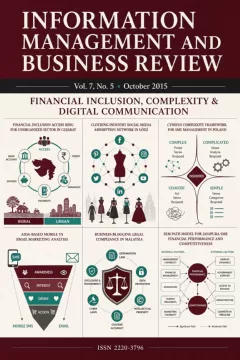 Vol. 7 No. 5 (2015)
Financial Inclusion, Complexity & Digital Communication
View issue contents
Published
Submissions
Have research to publish? Information Management and Business Review welcomes submissions.
Make a Submission