Abstract
A decision to establish foreign direct investment (FDI) involves a lot of critical thinking, especially in deciding a place to locate the investment. Evaluation and consideration comprise of costs and benefits of launching the FDI. This study focuses on time series data for the sample period of 1970 to 2009. The main objective of this study is to identify the major determinant of the inward flows of FDI for Malaysia by employing the bounds testing (ARDL) approach to cointegration. Of all the variables being tested, trade openness is found to be the most influential variable in attracting the inflows of FDI as it shows consistent results in the short run as well as in the long run in all models being tested. Since the trade openness which represents the liberalization of the Malaysian economy could induce the inflows of FDI, some policy actions can be taken up to enhance the trade openness.
Keywords
- Trade Openness Search this journal for Trade Openness (opens in a new tab)
- Foreign Direct Investment Search this journal for Foreign Direct Investment (opens in a new tab)
- Bounds Test Search this journal for Bounds Test (opens in a new tab)
- Cointegration Search this journal for Cointegration (opens in a new tab)
- Malaysia Search this journal for Malaysia (opens in a new tab)
References
- Almsafir, M. K., Latif, N. W. A. & Bekhet, H. A. (2011). Analyzing the Green Field Investment in Malaysia from 1970 to 2009: a Bound Testing Approach. Australian Journal of Basic and Applied Sciences, 5(3), 561570.
- Ang, J. B. (2008). Determinants of Foreign Direct Investment in Malaysia. Journal of Policy Modeling, 30, 185189.
- Asiedu, E. (2002). On the Determinants of Foreign Direct Investment to Developing Countries: Is Africa Different? World Development, 30(1), 107-119.
- Aw, T. Y. & Tang, T.-C. (2010). The Determinants of Inward Foreign Direct Investment: The Case of Malaysia. International Journal of Business and Society, 11(1), 59-76.
- Bende-Nabende, A. (2002). Foreign Direct Investment Determinants in Sub-Sahara Africa: A Co-integration Analysis. Economics Bulletin, 6(4), 1-19.
- Bevan, A. A. & Estrin, S. (2004). The Determinants of Foreign Direct Investment into European Transition Economies. Journal of Comparative Economics, 32, 775-787.
- Bjorvatn, K., Kind, H. J. & Nordas, H. K. (2001). The Role of FDI in Economic Development. SNF Working Paper 62/01.
- Cassidy, J. F. & Andreosso-O'Callaghan, B. (2006). Spatial Determinants of Japanese FDI in China. Japan and the World Economy, 18, 512-527.
- Cuyvers, L., Joseph, P., Soeng, R. & Bulcke, D. V. D. (2008). Determinants of Foreign Direct Investment in Cambodia: Country-Specific Factor Differentials. University of Antwerp. Research Paper 2008-003. D/2008/1169/003.
- Demirhan, E. & Masca, M. (2008). Determinants of Foreign Direct Investment Flows to Developing Countries: A Cross-Sectional Analysis. Prague Economic Papers, 4, 356-369.
- Fedderke, J. W. & Romm, A. T. (2006). Growth Impact and Determinants of Foreign Direct Investment into South Africa, 1956-2003. Economic Modelling, 23, 738-760.
- Gao, T. (2005). Labor Quality and the Location of Foreign Direct Investment: Evidence from China. China Economic Review, 16, 274-292.
- Hasan, Z. (2004). Determinants of FDI Flows to Developing Economies: Evidence from Malaysia. In H. S. Kehal (Ed.), Foreign Investment in Developing Countries (pp. 154-170). UK: Palgrave Macmillan.
- Ismail, R. & Yussof, I. (2003). Labor Market Competitiveness and Foreign Direct Investment: The Case of Malaysia, Thailand and the Philippines. Papers in Regional Science, 82, 389-402.
- Kang, S. J. & Lee, H. S. (2007). The Determinants of Location Choice of South Korean FDI in China. Japan and the World Economy, 19, 441-460.
- Kiyota, K. & Urata, S. (2004). Exchange Rate, Exchange Rate Volatility and Foreign Direct investment. The World Economy, 27(10), 1501-1536.
- Li, X. & Liu, X. (2005). Foreign Direct Investment and Economic Growth: An Increasingly Endogenous Relationship. World Development, 33(3), 393-407.
- Lim, E. G. (2001). Determinants of, and the Relation Between, Foreign Direct Investment and Growth: A Summary of the Recent Literature. IMF Working Paper, WP/01/175(November).
- Moosa, I. A. & Cardak, B. A. (2006). The Determinants of Foreign Direct Investment: An Extreme Bounds Analysis. Journal of Multinational Financial Management, 16, 199-211.
- Narayan, P. K. (2005). The Saving and Investment Nexus for China: Evidence from Cointegration Tests. Applied Economics, 37, 1979-1990.
- Narayan, P. & Siyabi, S. A. (2005). An Empirical Investigation of the Determinants of Oman's National Savings. Economics Bulletin, 3(51), 1-7.
- Noorbakhsh, F., Paloni, A. & Youssef, A. (2001). Human Capital and FDI Inflows to Developing Countries: New Empirical Evidence. World Development, 29(9), 1593-1610.
- Pesaran, M. H., Shin, Y. & Smith, R. J. (2001). Bounds Testing Approaches to the Analysis of Level Relationships. Journal of Applied Econometrics, 16, 289-326.
- Shahrudin, N., Yusof, Z. & Satar, N. M. (2010). Determinants of Foreign Direct Investment in Malaysia: What Matters Most? International Review of Business Research Papers, 6(6), 235-245.
- Solocha, A., Soskin, M. D. & Kasoff, M. J. (1989). Canadian Investment in Northern New York: Impact of Exchange Rates on Foreign Direct Investment. Growth and Change (Winter), 1-16.
- Yol, M. A. & Teng, N. T. (2009). Estimating the Domestic Determinants of Foreign Direct Investment Flows in Malaysia: Evidence from Cointegration and Error-Correction Model. Jurnal Pengurusan, 28, 3-22.
Downloads
No downloads have been recorded for this article yet. Figures appear here once readers begin downloading the full text.
How to Cite
Share this article
License
Copyright (c) 2015 Sabariah Nordin, Mohammed B. Yusoff, Gairuzazmi B. Mat Ghani (Author)

This work is licensed under a Creative Commons Attribution 4.0 International License.
Author (s) should affirm that the material has not been published previously. It has not been submitted and it is not under consideration by any other journal. At the same time author (s) need to execute a publication permission agreement to assume the responsibility of the submitted content and any omissions and errors therein. After submission of revised paper in the light of suggestions of the reviewers, the editorial team edits and formats manuscripts to bring uniformity and standardization in published material.
This work will be licensed under Creative Commons Attribution 4.0 International (CC BY 4.0) and under condition of the license, users are free to read, copy, remix, transform, redistribute, download, print, search or link to the full texts of articles and even build upon their work as long as they credit the author for the original work. Moreover, as per journal policy author (s) hold and retain copyrights without any restrictions.
Keywords
- Trade Openness Search this journal for Trade Openness (opens in a new tab)
- Foreign Direct Investment Search this journal for Foreign Direct Investment (opens in a new tab)
- Bounds Test Search this journal for Bounds Test (opens in a new tab)
- Cointegration Search this journal for Cointegration (opens in a new tab)
- Malaysia Search this journal for Malaysia (opens in a new tab)
Section
Published in
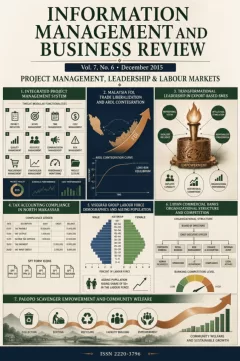 Vol. 7 No. 6 (2015)
Project Management, Leadership & Labour Markets
View issue contents
Published
Submissions
Have research to publish? Information Management and Business Review welcomes submissions.
Make a Submission