Abstract
The study is held to observe the impact of Management including Management levels and decision making on the growth of small firms. Study area is Punjab (Pakistan). Small firms have no proper firm structure; they do not follow the formal rules to run the organization. In spite of this, these firms are growing rapidly. If these firms have effective management levels and rational decision making than the firms will grow rapidly. The results show a significant increase in growth by using rational decision making and having effective management levels. Statistical results show that if we spend 1% on independent variable, then it shows an 80% increase in dependent variable.
Keywords
References
- Abor, J. & Quartey, P. (2010). Issues in SMEs in Ghana and South Africa international Research. Journal of finance and Economics, 39, 218-228.
- Bowman, C. & Swart, J. (2007). Whose Human Capital? The challenge of value capture when capital is embedded. Journal of Management studies, 44, 488505.
- Capellars, J. L., Mole, K., Greene, F. & Storey, D. (2008). Do more heavily regulated economies have poorer performing new ventures? Evidence from Britian and Spain. Journal of international Business studies, 39, 688-704.
- Carland, W. J. (1998). A productivity for Entrepreneurship: A comparison of Entrepreneurs, small Business owners, and corporate Managers. Journal of Business Venture, 14, 89-214.
- Chan, S. & Foster, M. (2001). Strategy formulation in small Business, The Hong Kong Experience. International Small Business Journal, 19, 56-71.
- Chandler, G., Hoing, B. & Wilkund, J. (2005). Antecedents, Moderators and Performance consequences of membership change in a new venture teams. Journal of Business venturing, 20, 705-725.
- Churchill, N. C. (1992). Research issues in Entrepreneurship. In the state of the art of E.Ed. 13. Sexton DL, Kasardra JD. Mass: PWS-Kent, Boston 579-596.
- Cohen, L. & Musson, G. (2000). Entrepreneurial identities: Reflection from two case studies. Organization, 7, 31-48.
- Davidsson, P. & Hoing, B. (2003). The role of social and human capital among nascent entrepreneurs. Journal of Business Venturing, 8, 301-331.
- Deakins, D. (2001). The Financial Management of the small Enterprises. Certified Accountants Educational Trust, London.
- Dutta, D. K. & Crossan, M. M. (2005). The Nature of entrepreneurial opportunities: Understanding the process using the 4i organizational learning framework. Entrepreneurship Theory and Practice, 29, 425-449.
- Grablowsky, B. J. (1984). Financial management of inventory. Journal of small Business Management, 3(2).
- Honing, B. (2001). Human capital and structural up heaval: A study of manufacturing firms in the west Bank. Journal of Business Ventures, 16, 575-594.
- Macpherson, A. & Holt, R. (2006). Knowledge, learning and small firm growth. A systematic Review of the Evidence, 36, 172-192.
- Mcpherson, M. (1996). Growth of Micro and small enterprises in southern Africa. Journal of Development Economics, 48, 253-277.
- Mintzberg, H. (1994). The fall and rise of strategic planning. Hayward Business Review 72: 107-114. 33.
- Posner BG (1985). Real entrepreneurs don’t plan, 7, 129-132.
- Muneer, S., Iqbal, S. M. J., Rehman, S. U. & Long, C. S. (2014). An Incorporated Structure of Perceived Organizational Support, Knowledge-Sharing Behavior, Organizational Trust and Organizational Commitment: A Strategic Knowledge Management Approach. Pakistan Journal of Commerce and Social Sciences, 8(1), 42- 57
- Qamar, A., Muneer, S., Jusoh, A. & Idris, H. (2013). The Relationship between Organizational Conduct and National Culture. Journal of Economics and Behavioral Studies, 5(2), 82-88
- Robinson, R. B., Pearce, J. A., Voziks, G. S. & Mescon, T. S. (1984). The Relationship between stage of Development and small firm planning and performance. Journal of small Business Management, 22, 45-52.
- Schwenk, C. R. & Sharader, C. B. (1993). Effects of formal strategic planning on financial performance in small firms: A Meta-analysis. Entrepreneurship Theory and Practice, 17, 53-64.
- Sexton, D. K. & Van Auken, P. (1982). Prevalence of strategic planning in small Businesses. Journal of small Business Management, 20, 6-20.
- Simon, J., McMillian, J. & Woodruff, C. (2002). Property Rights and Finance. American Economics Review, 92, 1335-1356.
- Tufail, M. S., Muneer, S. & Ishtiaq, M. (2016). Job Characteristics with Task and Contextual Performance: Moderating Role of Procedural Justice for Front Line Managers. Abasyn Journal of Social Sciences, Special Issue, 499-508.
Downloads
No downloads have been recorded for this article yet. Figures appear here once readers begin downloading the full text.
How to Cite
Share this article
License
Copyright (c) 2017 Khalid Jamil, Muhammad Zeeshan, Hamad Raza (Author)

This work is licensed under a Creative Commons Attribution 4.0 International License.
Author (s) should affirm that the material has not been published previously. It has not been submitted and it is not under consideration by any other journal. At the same time author (s) need to execute a publication permission agreement to assume the responsibility of the submitted content and any omissions and errors therein. After submission of revised paper in the light of suggestions of the reviewers, the editorial team edits and formats manuscripts to bring uniformity and standardization in published material.
This work will be licensed under Creative Commons Attribution 4.0 International (CC BY 4.0) and under condition of the license, users are free to read, copy, remix, transform, redistribute, download, print, search or link to the full texts of articles and even build upon their work as long as they credit the author for the original work. Moreover, as per journal policy author (s) hold and retain copyrights without any restrictions.
Keywords
Section
Published in
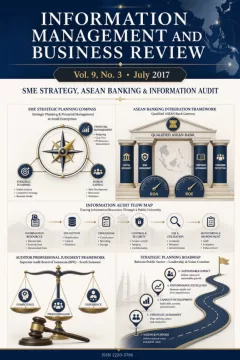 Vol. 9 No. 3 (2017)
SME Strategy, ASEAN Banking & Information Audit
View issue contents
Published
Submissions
Have research to publish? Information Management and Business Review welcomes submissions.
Make a Submission