Abstract
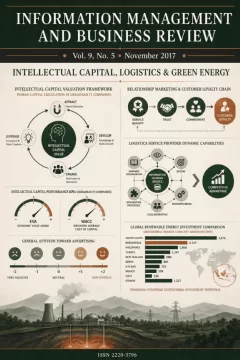
Nowadays the main potential for growth comes from the ability to innovate and succeed with breakthrough ideas. However, despite growing importance of the subject matter, there are still no standard practices that would perform such a measurement and employ tendencies of human capital circulation. Various attempts have been made over recent years, but none have achieved general acceptance among experts in business field. Although there is no universally accepted theory, each has its own strengths and weaknesses in deriving approximate value of intellectual capital for various companies. In this work, we looked over some theories that have been suggested to estimate intellectual capital and analysed data from Ukrainian IT companies in order to prove how important measurement of intellectual capital and human capital circulation trends to allow for much better representation of an organisation’s competitive position. Additionally, the impact of intellectual capital on various Key Performance Indicators, such as Economic Value Added and Weighted Average Cost of Capital, was examined with supporting financial analysis performed. The paper concludes with overview of methodological and managerial implications of the research, theoretical and practical limitations and possible improvements, and considerations for further research in the field of study.
Keywords
References
- Andersen, R. & McLean, R. (2000). Accounting for the Creation of Value: Ongoing research project sponsored by the Canadian Institute of Chartered Accountants.
- Andriessen, D. (2001). Weightless wealth: four modifications to standard IC theory. Journal of Intellectual Capital, 2, 204-214.
- Andriessen, D. (2004). IC valuation and measurement: classifying the state of the art. Journal of Intellectual Capital, 5(2), 230-242.
- Andriessen, D. (2004). Making Sense of Intellectual Capital: Designing a Method for the Valuation of Intangibles. Burlington, MA: Elsevier Butterworth Heinemann.
- Andriessen, D. & Tissen, R. (2000). Weightless Wealth: Finding Your Real Value in a Future of Intangible Assets. London: Financial Times/Prentice Hall.
- Andriesson, D. (2005). Implementing the KPMG Value Explorer: Critical success factors for applying IC measurement tools. Journal of Intellectual Capital, 6(4), 474-488.
- Brooking, A. (1996). Intellectual Capital: Core Assets for the Third Millennium. London, United Kingdom: Intl Thomson Business Press.
- Chui, M., Manyika, J. & Miremadi, M. (2016). Where machines could replace humans—and where they can’t (yet). July 2016, [online] http://www.mckinsey.com/business-functions/digital-mckinsey/ourinsights/where-machines-could-replace-humans-and-where-they-cant-yet
- Edvinsson, L. & Malone, M. S. (1997). Intellectual Capital, Piatkus, London.
- Edvinsson, L. (2000). Some perspectives on intangibles and intellectual capital 2000. Journal of Intellectual Capital, 1(1), 12-16.
- Fakty Ukraine. (2016). IT-отрасльвУкраине: очеммногоговорят, номалознают. Ноябрь, 23, 2016, [online] http://fakty.ictv.ua/ru/ukraine/20161123-it-galuz-v-ukrayini-pro-shho-bagato-govoryat-ale-maloznayut/
- Frey, C. & Osborne, M. (2013). The Future of Employment: How Susceptible are Jobs to Computerisation. September 17, 2013,[online] http://www.oxfordmartin.ox.ac.uk/downloads/academic/The_Future_of_Employment.pdf
- Kaplan, R. & Norton, D. (1996). Using the Balanced Scorecard as a strategic management system. Harvard Business Review, January-February 2016, 71-79.
- Luthy, D. H. (1998). Intellectual capital and its measurement. Paper presented at the Asian Pacific Interdisciplinary Research.
- Pulic, A. (1998). Measuring the performance of intellectual potential in Knowledge Economy. Paper presented at the 2nd World Congress on Measuring and Managing Intellectual Capital, McMaster University, Hamilton.
- Pulic, A. (2000). VAIC™–an accounting tool for IC management. International Journal of Technology Management, 20(5/6/7/8), 702-714.
- Pulic, A. (2004). Intellectual capital–does it create or destroy value? Measuring Business Excellence, 8(1), 62-68.
- PwC. Doing business and investing in Ukraine, 2016, [online] https://www.pwc.com/ua/en/survey/2016/assets/ukraine_doingbusiness_2016.pdf
- Ramanauskaitė, A. & Rudžionienė, K. (2013). Intellectual Capital Valuation: Methods and Their Classification, 2013, [online] http://www.journals.vu.lt/ekonomika/article/viewFile/1413/802
- Report of the Secretary-General Assembly of United Nations. In safety and dignity: addressing large movements of refugees and migrants. 21 April 2016, [online] http://refugeesmigrants.un.org/sites/default/files/in_safety_and_dignity_-_addressing_large_movements_of_refugees_and_migrants.pdf
- Sveiby, K. E. (1997). The New Organizational Wealth: Managing and Measuring Knowledge Based Assets, Berrett-Koehler Pub. Inc., San Francisco.
- Sveiby, K. E. (2004). Methods for Measuring Intangibles [online] www.sveiby.com
- Stewart T. A. (1997). Intellectual capital: the new wealth of organizations. New York, NY, USA: Doubleday.
- Tobin, J. (1969). A general equilibrium approach to monetary theory. Journal of Money, Credit and Banking, 1(1), 15-2.
- Understanding corporate value: managing and reporting intellectual capital, 2002, [online] http://www.cimaglobal.com/Documents/ImportedDocuments/intellectualcapital.pdf
- Vanderkam, L. (2014). Will Half Of People Be Working Remotely By 2020? Fast Company. August 14, 2014, [online] https://www.fastcompany.com/3034286/will-half-of-people-be-working-remotely-by-2020
Downloads
No downloads have been recorded for this article yet. Figures appear here once readers begin downloading the full text.
How to Cite
Share this article
License
Copyright (c) 2017 Iryna Oleynikova, Zhanna Balabaniuk (Author)

This work is licensed under a Creative Commons Attribution 4.0 International License.
Author (s) should affirm that the material has not been published previously. It has not been submitted and it is not under consideration by any other journal. At the same time author (s) need to execute a publication permission agreement to assume the responsibility of the submitted content and any omissions and errors therein. After submission of revised paper in the light of suggestions of the reviewers, the editorial team edits and formats manuscripts to bring uniformity and standardization in published material.
This work will be licensed under Creative Commons Attribution 4.0 International (CC BY 4.0) and under condition of the license, users are free to read, copy, remix, transform, redistribute, download, print, search or link to the full texts of articles and even build upon their work as long as they credit the author for the original work. Moreover, as per journal policy author (s) hold and retain copyrights without any restrictions.
Keywords
Section
Published
Submissions
Have research to publish? Information Management and Business Review welcomes submissions.
Make a Submission