Abstract
The basic intention of the present research was to explore the association between perceived academic performance and self-efficacy level of the students as it has been an un-explored research area in the Pakistan. Students were selected as an obvious target population. Sample consisted of 250 university students. Questionnaire was used as a data collection instrument. Major portion of the questionnaire had been taken form the research work done by Sherer et al. (1982). Out of 250 students, 212 students contributed in the data collection comprising 85% response rate for the study. SPSS 16.0 was used to analyze data. Findings of the study establish a weak positive association between level of self-efficacy (IV) and DV (perceived academic performance) as IV causes only 3.6% (.036) change in DV (academic performance). Hence, there is a weak dependency of perceived academic performance of students upon their level of selfefficacy.
Keywords
References
- Bandura, A. (1977). Self-efficacy: Toward a unifying theory of behavioral change. Psychological Review , 84, 191-215.
- Bandura, A. (1982). Self-efficacy mechanisms in human agency. American Psychologist, 37, 122-147.
- Bandura, A. (1997). Self-efficacy: The exercise of control. New York: W. H. Freeman.
- Csikszentmihalyi, M. (1997). Finding flow: The psychology of engagement with everyday life. New York: Basic Books.
- Lane, A. M. (2002). Relationships between performance toward accomplishment and self-efficacy in amateur boxing. Perceptual and Motor Skills, 94, 1056.
- Lane, A. M., Jones, L. & Stevens, M. (2002). Coping with failure: The effects of self-esteem and coping on changes in self-efficacy. Journal of Sport Behavior, 25, 331-345.
- Lane, J. & Lane, A. M. (2001). Self-efficacy and academic performance. Social Behavior and Personality, 29 , 687-694.
- Lane, J., Lane, A. M. & Cockerton, T. (2003). Prediction of academic performance from self-efficacy and performance accomplishments among master’s degree students. Journal of Hospitality, Leisure, Sport and Tourism Education, 2, 113-118.
- Lent, R. W. & Hackett, G. (1987). Career self-efficacy: Empirical status and future directions. Journal of Vocational Behavior, 30, 347-382.
- Manstead, A. S. R. & Van-Eekelen, S. A. M. (1998). Distinguishing between perceived behavioral control and self-efficacy in the domain of academic intentions and behaviors. Journal of Applied Social Psychology, 28, 1375-1392.
- Mone, M. A., Baker, D. D. & Jeffries, F. (1995). Predictive validity and time dependency of selfefficacy, selfesteem, personal goals, and academic performance. Educational & Psychological Measurement, 55, 716-727.
- Multon, K. D., Brown, S. D. & Lent, R. W. (1991). Relation of self-efficacy beliefs to academic outcomes: A metaanalytical investigation. Journal of Counseling Psychology, 38, 30-38.
- Newby-Fraser, E. & Schlebusch, L. (1998). Social support, self-efficacy and assertiveness as mediators of student stress. Journal of Human Behavior, 34, 61-69.
- Pajares, F. (1996). Self-efficacy beliefs in academic settings. Review of Educational Research, 66, 543-578.
- Rosenberg, M. (1965). Society and the adolescent child. Princeton, NJ: Princeton University Press.
- Sadri, G. & Robertson, I. T. (1993). Self-efficacy and work-related behavior: A review and metaanalysis. Applied Psychology, 42, 139-152.
- Schunk, D. H., Hanson, A. R., & Cox, P. D. (1987). Peer-model attributes and children’s achievement behaviors. Journal of Educational Psychology, 79, 54-61.
- Self-Efficacy Beliefs and Career Development. (n.d). Retrieved June 8, 2011 from http://www.123helpme.com/view.asp?id=35824.
- Sherer, M., Maddux, J.E., Mercandante, B., Prentice-Dunn, S., Jacobs, B. & Rogers, R.W. (1982). The self-efficacy Scale: Construction and Validation. Psychological Reports , 51, 663-671.
- Stajkovic, A. D., & Luthans, F. (1998). Self-efficacy and work-related performance: A meta-analysis. Psychological Bulletin, 124, 240-261.
- The Concept of Self-Efficacy. (n.d). Retrieved June 8, 2011 from http://www.123helpme.com/preview.asp?id=85270.
- Vialle, W. (n.d). Retrieve June 8, 2011 from http://www.aare.edu.au/98pap/and98319.htm.
- Vrugt, A. J., Langereis, M. P., & Hoogstraten, J. (1997). Academic self-efficacy and malleability of relevant capabilities as predictors of exam performance. Journal of Experimental Education, 66, 61-72.
- Weiner, B. (1986). An attributional theory of motivation and emotion. New York: Springer-Verlag.
- Wolters, C. A., & Pintrich, P. R. (1998). Contextual differences in student motivation and selfregulated learning in mathematics, English, and social studies classrooms. Instructional Science, 26, 27-47.
- Zimmerman, B. J., Bandura, A., & Martinez-Pons, M. (1992). Self-motivation for academic attainment: The role of self-efficacy beliefs and personal goal setting. American Educational Research Journal, 29, 663-676.
Downloads
No downloads have been recorded for this article yet. Figures appear here once readers begin downloading the full text.
How to Cite
Share this article
License
Copyright (c) 2011 Ishfaq Ahmed, Tehmina Fiaz Qazi, Shaista Jabeen (Author)

This work is licensed under a Creative Commons Attribution 4.0 International License.
Author (s) should affirm that the material has not been published previously. It has not been submitted and it is not under consideration by any other journal. At the same time author (s) need to execute a publication permission agreement to assume the responsibility of the submitted content and any omissions and errors therein. After submission of revised paper in the light of suggestions of the reviewers, the editorial team edits and formats manuscripts to bring uniformity and standardization in published material.
This work will be licensed under Creative Commons Attribution 4.0 International (CC BY 4.0) and under condition of the license, users are free to read, copy, remix, transform, redistribute, download, print, search or link to the full texts of articles and even build upon their work as long as they credit the author for the original work. Moreover, as per journal policy author (s) hold and retain copyrights without any restrictions.
Keywords
Section
Published in
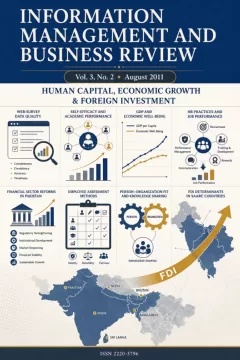 Vol. 3 No. 2 (2011)
Human Capital, Economic Growth & Foreign Investment
View issue contents
Published
Submissions
Have research to publish? Information Management and Business Review welcomes submissions.
Make a Submission