Abstract
The purpose of the study is to develop a framework beyond the technology acceptance model (TAM) whereby the study aims to understand the slow adoption of M-learning approach in HEIs. For this purpose, this study carries out an extensive review of the literature in order to design a conceptual framework to investigate how to enhance the utilization of this technology among lecturers and learners/students. The investigation was carried out using a deductive approach to examine the proposed hypothesizes. The findings from this study suggest a wide range of factors such as cultural dimension (i.e. uncertainty avoidance), psychological factors (i.e. perceived risk, self-efficacy) technical skills (i.e. digital literacy). These factors are regarded to be relevant towards enhancing the utilization of M-learning in HEIs. This study has the originality of ideas by providing insights into M-learning utilization beyond the conventional TAM. These identified factors require to be substantiated in this context.
Keywords
References
- Ajzen, I. (1991). The theory of planned behaviour. Organizational behaviour and human decision processes, 50(2), 179-211.
- Aljuaid, N. M. F., Alzahrani, M. A. R. & Islam, A. Y. M. (2014). Assessing mobile learning readiness in Saudi Arabia higher education: An empirical study. Malaysian Online Journal of Educational Technology, 2(2), 1-14.
- Alkhalaf, A. (2014). Identifying mobile learning challenges at male high schools in Saudi Arabia from the teachers’ point of view. International Journal of Learning and Teaching, 6(1), 30-37.
- Almutairy, S., Davies, T. & Dimitriadi, Y. (2014, November). The readiness of applying m-learning among Saudi Arabian students at higher education. In 2014 International conference on interactive mobile communication technologies and learning (IMCL2014) (pp. 102-106). IEEE.
- Al-Shehri, S. (2009). An outlook on future mobile learning in Saudi Arabia. Q Science Proceedings, (12th World Conference on Mobile and Contextual Learning [m Learn 2013), 9.
- Anderson, J. C. & Gerbing, D. W. (1988). Structural equation modelling in practice: A review and recommended two-step approach. Psychological bulletin, 103(3), 411.
- Davis, F. D., Bagozzi, R. P. & Warshaw, P. R. (1989). User acceptance of computer technology: a comparison of two theoretical models. Management science, 35(8), 982-1003.
- Fishbein, M. & Ajzen, I. (1975). Belief, attitude, intention and behaviour: An introduction to theory and research.
- Liu, Y., Han, S. & Li, H. (2010). Understanding the factors driving m-learning adoption: a literature review. Campus-Wide Information Systems, 27(4), 210-226.
- Al-Hujran, O., Al-Lozi, E. & Al-Debei, M. M. (2014). Get Ready to Mobile Learning”: Examining Factors Affecting College Students' Behavioural Intentions to Use M-Learning in Saudi Arabia. Jordan Journal of Business Administration, 10(1), 111-128.
- Mulaomerovic, E. & Trappey, C. V. (2013, June). The role of cultural dimensions in the acceptance of retail innovations. In Proceedings of the Management, Knowledge and Learning International Conference.
- Narayanasamy, F. S. & Mohamed, J. B. K. (2013). Adaptation of mobile learning in higher educational institutions of Saudi Arabia. International Journal of Computer Applications, 69(6).
- Nassuora, A. B. (2012). Students acceptance of mobile learning for higher education in Saudi Arabia. American Academic & Scholarly Research Journal, 4(2), 24-30.
- Venkatesh, V., Morris, M. G., Davis, G. B. & Davis, F. D. (2003). User acceptance of information technology: Toward a unified view. MIS Quarterly, 425-478.
Downloads
No downloads have been recorded for this article yet. Figures appear here once readers begin downloading the full text.
How to Cite
Share this article
License
Copyright (c) 2018 Abdelbaset Queiri, Araby Madbouly (Author)

This work is licensed under a Creative Commons Attribution 4.0 International License.
Author (s) should affirm that the material has not been published previously. It has not been submitted and it is not under consideration by any other journal. At the same time author (s) need to execute a publication permission agreement to assume the responsibility of the submitted content and any omissions and errors therein. After submission of revised paper in the light of suggestions of the reviewers, the editorial team edits and formats manuscripts to bring uniformity and standardization in published material.
This work will be licensed under Creative Commons Attribution 4.0 International (CC BY 4.0) and under condition of the license, users are free to read, copy, remix, transform, redistribute, download, print, search or link to the full texts of articles and even build upon their work as long as they credit the author for the original work. Moreover, as per journal policy author (s) hold and retain copyrights without any restrictions.
Keywords
Section
Published in
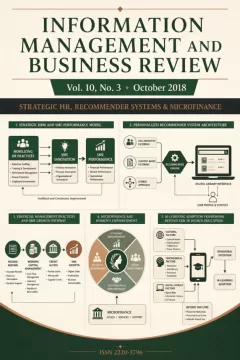 Vol. 10 No. 3 (2018)
Strategic HR, Recommender Systems & Microfinance
View issue contents
Published
Submissions
Have research to publish? Information Management and Business Review welcomes submissions.
Make a Submission