Abstract
GDP per capita often used in judgment about countries economic well-being, but any judgment based on it ignores some issues, therefore argues that a better index of economic well-being is IEWB (Index of Economic Well-being). Stevenson and Wolfers (2008), and Osberg and Sharpe (2001), mentioned that there is a positive relationship between GDP per capita and IEWB .in this paper we study a causal relationship between them; to this purpose we use the data of selected high income countries during 1980-2007.Finding shows that GDP is granger causal of IEWB except Norway that there aren’t any causal relationship between GDP and IEWB.
Keywords
- Causal Relationship Search this journal for Causal Relationship (opens in a new tab)
- Co-Integration Search this journal for Co-Integration (opens in a new tab)
- Granger Causality Search this journal for Granger Causality (opens in a new tab)
- Index of Economic Well-Being (IEWB) Search this journal for Index of Economic Well-Being (IEWB) (opens in a new tab)
References
- Abu-Badar, S. & Abu-Qarn, A. (2003). Government Expenditures, Military Spending and Economic Growth: Causality Evidence from Egypt, Israel, and Syria. Journal of Policy Modeling , 25,567-583. DOI: https://doi.org/10.1016/S0161-8938(03)00057-7
- Campbell, J., Y. & Perron, P. (1991). Pitfalls and Opportunities: What Macroeconomists Should Know about Unit Roots? NBER Technical Working Paper, 100. DOI: https://doi.org/10.3386/t0100
- Dickey, D. A. & Fuller, W. A. (1979). Distribution of the Estimators for Autoregressive Time Series with a Unit Root. Journal of the American Statistical Association , 74,427–431. DOI: https://doi.org/10.1080/01621459.1979.10482531
- Easterlin, R. A. (1974). Will raising the incomes of all increase the happiness of all? Journal of Economic Behavior and Organization, 27 (1), 35– 47. DOI: https://doi.org/10.1016/0167-2681(95)00003-B
- Granger, C. W. J. (1969). Investigating Causal Relations by Econometric Models: Cross Spectral Methods. Econometrica, 37(3), 424–438. DOI: https://doi.org/10.2307/1912791
- Granger, C. W. J. (1988). Some Recent Developments in a Concept of Causality. Journal of Econometrics , 39(1/2), 199–211. DOI: https://doi.org/10.1016/0304-4076(88)90045-0
- Hayo, B. & Seifert, W. (2003). Subjective Economic Well-being in Eastern Europe. Journal of Economic Psychology , 24, 329-348. DOI: https://doi.org/10.1016/S0167-4870(02)00173-3
- Hosseini, M. R. (2007). Analysis of Economic Wellbeing Trend in Iran by Composite Index (1989-2004). Islamic Azad University.
- Hosseini, M. R. & Samimi, J. A. (2009). A Composite Measurement of Economic Well-being in Iran. Journal of Applied Science Research , 5(10), 1732-1340.
- Samimi, J. A. (1996). Study of Causal Relationship Between Fix Capital Formation and Economic Growth in Iran an Empirical Analysis. Humanities Science of Alzahra University , 17, 28-131.
- Johansen, S. (1988). Statistical Analysis of Cointegration Vectors. Journal of Economic Dynamics and Contro l, 12(2/3), 231–254. DOI: https://doi.org/10.1016/0165-1889(88)90041-3
- Mozumder, P. & Marathe, A. (2007). Causality Relationship between Electricity Consumption and GDP in Bangladesh. Energy Policy , 35, 395-402. DOI: https://doi.org/10.1016/j.enpol.2005.11.033
- Osberg, L. (1985). The Measurement of Economic Well-Being Approaches To Economic Well-Being. Research Studies of the MacDonald Commission, (Toronto: University of Toronto Press), 26.
- Osberg, L. & Sharpe, A. (1998). An Index of Economic Well-Being for Canada. Human Resources Development Canada, Research Paper, (posted at www.csls.ca).
- Osberg, L. & Sharpe, A. (1999). An Index of Economic Well-being for Canada and the United States. Paper Presented to the Annual Meeting of the American Economic Association, New York, January 3-5, (posted at www.csls.ca).
- Osberg, L. & Sharpe, A. (2000). An Index of Economic Well-being for the Canadian Provinces. Centre for the Study of Living Standards, CSLS Research Report, (posted at www.csls.ca).
- Osberg, L. & Sharpe, A. (2000a). An Index of Economic Well-being for OECD Countries. Paper Presented to the Annual Meeting of the American Economic Association, Boston, Mass. January 5-7.
- Osberg, L. & Sharpe, A. (2001). Comparisons of Trends in GDP and Economic Well-being - the Impact of Social Capital. The Contribution of Human and Social Capital to Sustained Economic Growth and Well-Being, (Ottawa: HDRC), (Proceedings of an OECD/HRDC conference, Quebec, March 19-21).
- Osberg, L. & Sharpe, A. (2002). An Index of Economic Well-being for OECD Countries. Review of Income and Wealth, 48(3), 291-316. DOI: https://doi.org/10.1111/1475-4991.00056
- Osberg, L. & Sharpe, A. (2003). An Index of labour market Well-being for OECD Countries. CSLS Research Report, Centre for the Study of Living Standards, (posted at www.csls.ca).
- Osberg, L. & Sharpe, A. (2009). New Estimates of the Index of Economic Wellbeing for Canada and the Provinces, 1981-2008. CSLS Research Report, Centre for the Study of Living Standards, (posted at www.csls.ca).
- Osberg, L. & Sharpe, A. (2009a). New Estimates of the Index of Economic Wellbeing for Selected OECD Countries, 1980-2007. Centre for the Study of Living Standards, CSLS Research Report, (posted at www.csls.ca).
- Stevenson, B. & Wolfers, J. (2008). Economic Growth and Subjective Well-being: Reassessing the Easterlin Paradox. NBER Working Paper Series, Number 14284. DOI: https://doi.org/10.3386/w14282
- World Bank, (2010).Word Development Indicators (WDI) (2010). Available Online at http://databank.worldbank.org/ddp/home.do (accessed August 2010). DOI: https://doi.org/10.1596/978-0-8213-8232-5
Downloads
Full-text downloads recorded for this article, by month.
No downloads have been recorded for this article yet. Figures appear here once readers begin downloading the full text.
How to Cite
Share this article
License
Copyright (c) 2011 Ahmad Jafari Samimi, Kaveh Derakhshani Darabi (Author)

This work is licensed under a Creative Commons Attribution 4.0 International License.
Author (s) should affirm that the material has not been published previously. It has not been submitted and it is not under consideration by any other journal. At the same time author (s) need to execute a publication permission agreement to assume the responsibility of the submitted content and any omissions and errors therein. After submission of revised paper in the light of suggestions of the reviewers, the editorial team edits and formats manuscripts to bring uniformity and standardization in published material.
This work will be licensed under Creative Commons Attribution 4.0 International (CC BY 4.0) and under condition of the license, users are free to read, copy, remix, transform, redistribute, download, print, search or link to the full texts of articles and even build upon their work as long as they credit the author for the original work. Moreover, as per journal policy author (s) hold and retain copyrights without any restrictions.
Keywords
- Causal Relationship Search this journal for Causal Relationship (opens in a new tab)
- Co-Integration Search this journal for Co-Integration (opens in a new tab)
- Granger Causality Search this journal for Granger Causality (opens in a new tab)
- Index of Economic Well-Being (IEWB) Search this journal for Index of Economic Well-Being (IEWB) (opens in a new tab)
Section
Published in
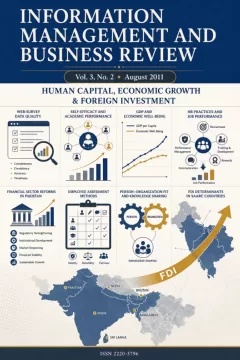 Vol. 3 No. 2 (2011)
Human Capital, Economic Growth & Foreign Investment
View issue contents
Published
Submissions
Have research to publish? Information Management and Business Review welcomes submissions.
Make a Submission