Abstract
In recent years, the management of waste treatment in Indonesia has become a critical issue among the stakeholders both in the government and the private sector. One way to significantly reduce waste in each region is to use incinerator technology. This technology has developed in Japan, South Korea and Europe. The burning of waste can produce electricity or the so-called waste to energy. However, to build a power plant that utilizes waste requires policy support from the Central and Regional Governments. This study seeks to identify the types of support that Central and Regional Governments can provide to develop waste to energy.
Keywords
- Waste to Energy Search this journal for Waste to Energy (opens in a new tab)
- Renewable Energy Search this journal for Renewable Energy (opens in a new tab)
- Fiscal Support Search this journal for Fiscal Support (opens in a new tab)
- Tipping Fee Search this journal for Tipping Fee (opens in a new tab)
- Feed in Tariff Search this journal for Feed in Tariff (opens in a new tab)
References
- Hermawan, F. (2017). Penerapan Teknologi Waste to Energy (WTE) Pada Rencana Pembangunan Intermediate Treatment Facility (ITF) Sunter Jakarta Utara, Dinas Lingkungan Hidup Provinsi DKI Jakarta, April 2017.
- Intergovernmental Panel on Climate Change. (2007). Climate Change 2007: Synthesis Report. Contribution of Working Groups I, II and III to the Fourth Assessment Report of the Intergovernmental Panel on Climate Change [Core Writing Team, Pachauri, R.K and Reisinger, A. (eds.)]. IPCC, Geneva, Switzerland, 104.
- Kementerian Energi dan Sumber Daya Mineral. (2015). Kebijakan Pengembangan Sampah Menjadi Energi di Indonesia. Buku Panduan, Direktorat Jenderal Energi Baru Terbarukan dan Konservasi Energi, Desember 2015.
- Kementerian Lingkungan Hidup dan Kehutanan. (2016). Pemanfaatan Sampah Rumah Tangga dan Sampah Sejenis Sampah Rumah Tangga Sebagai Bahan Bakar Alternatif Refuse-Derived Fuel (RDF).
- Kobayashi, M. et al. (2007). Physiological analysis of yeast cells by flow cytometry during serial-repitching of low-malt beer fermentation. Journal of Bioscience and Bioengineering, 103(5), 451-456.
- Kurniawan, F. & Shintarini, S. (2014). Klausula Tipping Fee Dalam Kontrak Kerjasama Pemerintah Dengan Swasta (Public-Private Partnership) Pengelolaan Persampahan. Jurnal Hukum Vol. IV No. 1, 2014, Fakultas Hukum Universitas Airlangga.
- Ministry of the Environment, Japan. (2014). History and Current State of Waste Management in Japan, Waste Management and Recycling Department, February 2014, compiled by: Japan Environmental Sanitation Center.
- Ministry of the Environment, Japan. (2017). Feasibility Study of Joint Crediting Mechanism Project by City to City Collaboration Waste to Energy Power Plant Project for Bali Province in Indonesia Final Report, 10th March, 2017 JFE Engineering Corporation Clean Authority of TOKYO.
- National Environment Agency Singapore. (2018). Waste-to-Energy Incineration Plants. Waste Management Infrastructure. Singapore Government.
- United Nations Environment Programme. (2015). International Solid Waste Association. Global Waste Management Outlook: Summary For Decision-Makers. United Nations Environment Programme.
Downloads
No downloads have been recorded for this article yet. Figures appear here once readers begin downloading the full text.
How to Cite
Share this article
License
Copyright (c) 2019 Agunan, P. Samosir (Author)

This work is licensed under a Creative Commons Attribution 4.0 International License.
Author (s) should affirm that the material has not been published previously. It has not been submitted and it is not under consideration by any other journal. At the same time author (s) need to execute a publication permission agreement to assume the responsibility of the submitted content and any omissions and errors therein. After submission of revised paper in the light of suggestions of the reviewers, the editorial team edits and formats manuscripts to bring uniformity and standardization in published material.
This work will be licensed under Creative Commons Attribution 4.0 International (CC BY 4.0) and under condition of the license, users are free to read, copy, remix, transform, redistribute, download, print, search or link to the full texts of articles and even build upon their work as long as they credit the author for the original work. Moreover, as per journal policy author (s) hold and retain copyrights without any restrictions.
Keywords
- Waste to Energy Search this journal for Waste to Energy (opens in a new tab)
- Renewable Energy Search this journal for Renewable Energy (opens in a new tab)
- Fiscal Support Search this journal for Fiscal Support (opens in a new tab)
- Tipping Fee Search this journal for Tipping Fee (opens in a new tab)
- Feed in Tariff Search this journal for Feed in Tariff (opens in a new tab)
Section
Published in
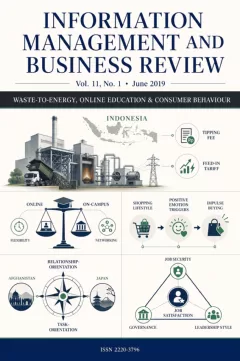 Vol. 11 No. 1 (2019)
Waste-to-Energy, Online Education & Consumer Behaviour
View issue contents
Published
Submissions
Have research to publish? Information Management and Business Review welcomes submissions.
Make a Submission