Abstract
The purpose of this paper is to analyze the leadership tendencies of Afghan and Japanese respondents by exploring their task and relationship orientations. While there are many published studies on the Japanese work culture and leadership practices, research about Afghan working adults is limited. Using the Style Questionnaire, this research collected and compared the leadership orientations of 400 respondents from each country based on national culture on the task and relationship-orientation continuums. To deepen the understanding of Afghan leadership tendencies, we explore their culture of “guzaara” (getting along) practices. Similarly, we discuss the Japanese concept of “ba” (interactive knowledge creation) as one example of a best practice that can be benchmarked by others in society. Both Afghanistan and Japan are high-context cultures; therefore, people are expected to be more relationship-oriented. While respondents from both countries do have a stronger focus on their relationships, data shows that Afghans have a significantly higher score on both the task-orientation as well as relationship-orientation continuums, compared to their Japanese counterparts. Implications, recommendations and limitations of the study are provided. The findings that Japanese and Afghan employees are indeed focused on their relationships, and that they have a moderately high task orientation scores, are useful for managers and expatriates working in these two Asian countries.
Keywords
- Afghan Leadership Orientation Search this journal for Afghan Leadership Orientation (opens in a new tab)
- Japan Cultural Orientations Search this journal for Japan Cultural Orientations (opens in a new tab)
- Guzaara Search this journal for Guzaara (opens in a new tab)
- Edaara Search this journal for Edaara (opens in a new tab)
- Rahbariat Search this journal for Rahbariat (opens in a new tab)
- Ba Search this journal for Ba (opens in a new tab)
- Relationship-Orientation Search this journal for Relationship-Orientation (opens in a new tab)
- Task-Orientation Search this journal for Task-Orientation (opens in a new tab)
References
- Abe, N. & Shimizutani, S. (2005). Employment policy and corporate governance: an empirical analysis on the stakeholder model in Japan. ESRI Discussion Paper Series, No. 136, Economic and Social Research Institute, Cabinet Office, Tokyo, Japan.
- Abegglen, J. C. (1958). Japanese Factory: Aspects of its Social Organization. Free Press: Glencoe, IL.
- Abegglen, J. C. (2006). 21st –Century Japanese Management. Palgrave Macmillan: New York.
- Adler, N. J. (1986). International Dimensions of Organizational Behavior. Kent Publishing: Boston, MA.
- Aoki, M. (1990). Toward an economic model of the Japanese firm. Journal of Economic Literature, 28(1), 1-28.
- Asanuma, B. (1989). Manufacturer-supplier relationships in Japan and the concept of relation-specific skill. Journal of the Japanese and International Economics, 3(1), 1-30.
- Badaracco, J. L. (1991). The Knowledge Link: How Firms Compete through Strategic Alliances. Harvard Business School Press: Cambridge, MA.
- Barnard, C. I. (1948). The nature of leadership, in Organization and Management: Selected Papers. Harvard University Press: Cambridge, MA, 80-110.
- Bass, B. M. (1990). Bass and Stogdill’s Handbook of Leadership: Theory, Research, and Managerial Applications, 3rd ed. Free Press: New York, NY.
- Bass, B. M. & Bass, R. (2008). The Bass Handbook of Leadership: Theory, Research, and Managerial Applications. Free Press: New York, NY.
- Campbell, D. J., Bommer, W. & Yeo, E. (1993). Perceptions of appropriate leadership style: participation versus consultation across two cultures. Asia Pacific Journal of Management, 10(1), 1-19.
- Cavico, F. J. & Mujtaba, B. G. (2011). Baksheesh or Bribe: Cultural Conventions and Legal Pitfalls. ILEAD Academy Publications; Davie, Florida, United States.
- Doi, T. (1973). The Anatomy of Dependence. Kodansha International: Tokyo.
- Dorfman, P. W. & House, R. J. (2004). Cultural influences on organizational leadership. In House, R. J., Hanges, P. J., Javidan, M., Dorfman, P. W. & Gupta, V. (Eds.), Culture, Leadership, and Organizations: The GLOBE Study of 62 Societies. Sage: Thousand Oaks, CA.
- Economic and Social Research Institute. (2010). Naigai M&A jijo chousa kenkyu hokoku 2010 (M&A conference report 2010).
- England, G. W. (1975). The Manager and his Values: An International Perspective. Ballinger: Cambridge, MA.
- England, G. W. (1983). Japanese and American management: Theory Z and beyond. Journal of International Business Studies, 14(2), 131-42.
- Entezar, E. (2008). Afghanistan 101: Understanding Afghan Culture. Xlibris Corporation: United States.
- Fleishman, E. A. (1967). Development of behavior taxonomy for describing human tasks: a correlationalexperimental approach. Journal of Applied Psychology, 51(1), 1-10.
- Fukushige, A. & Spicer, D. P. (2007). Leadership preferences in Japan: an exploratory study. Leadership & Organization Development Journal, 28(6), 508-30.
- Goffee, R. & Jones, G. (1996). What holds the modern company together? Harvard Business Review, November-December, 133-148.
- Haghirian, P. (2010). Understanding Japanese Management Practices. Business Expert Press: New York, NY.
- Hall, E. T. (1976). Beyond Culture. Anchor Books: New York, NY.
- Halpin, A. W. & Winter, B. J. (1957). A factorial study of the leader behavior descriptions Bureau of Business Research. Ohio State University, Research Monograph, 88, 30-51.
- Hersey, P. (2008). Personal Communication on Situational Leadership. One-week Train-the-Trainer Workshop by Dr. Hersey and facilitators of The Center for Leadership Studies, February 2008, Escondido, CA. Phone: (760) 741-6595.
- Hersey, P. (1984 & 1997). The Situational Leader. The Center for Leadership Studies: Escondido, CA.
- Hersey, Paul. & Campbell, Ron. (2004). Leadership: A Behavioral Science Approach (Book). The Center for Leadership Studies: Escondido, CA. ISBN: 0-931619-09-2
- Hersey, P., Blanchard, K. & Johnson, D. (2001). Management of Organizational Behavior. Eight edition. Prentice Hall. ISBN: 013-032518X.
- Hill, C. W. & Hult, G. T. (2017). International Business. New York: McGraw Hill Education.
- Hofstede, G. (1991). Culture and Organizations: Software of the Mind. McGraw-Hill: New York, NY.
- Hofstede, G. (1980). Culture's Consequences: International Differences in Work-Related Values. Sage: Beverly Hills, CA.
- Holzhausen, A. (2000). Japanese employment practices in transition: promotion policy and compensation systems in the 1990s. Social Science Japan Journal, 3(2), 221-35.
- Huang, C., Mujtaba, G. B., Cavico, F. & Sims, R. L. (July 2006). Ethics and Executives: A Cross-Cultural Comparison of Japan, Taiwan, and the United States. International Business and Economics Research Journal, 5(7), 9-22.
- Hughes, R. L., Ginnett, R. C. & Curphy, G. J. (2019). Leadership: Enhancing the Lessons of Experience, ninth edition. McGraw Hill: New York.
- Jackson, K. & Tomioka, M. (2004). The Changing Face of Japanese Management. Routledge: London.
- Jackson, G. & Miyajima, H. (2007). Varieties of capitalism, varieties of markets: Mergers and acquisitions in Japan, Germany, France, the UK and USA. RIETI Discussion Paper Series, 07-E-054.
- Kaifi, B., Mujtaba, B. G. & Xie, Y. (2009). The Perception of Afghan-American Leaders’ Role in Economic Development Efforts in Afghanistan: A Study of Gender Differences and Repatriation to the Motherland. Journal of Diversity Management, 4(3), 35-46.
- Nonaka, F. & Kano, T. (1998). The end of lifetime employment in Japan? Evidence from National Surveys and field research. Journal of the Japanese and International Economics, 15(4), 489-514.
- Kono, T. & Clegg, S. (2001). Trends in Japanese Management: Continuing Strengths, Current Problems and Changing Priorities. Palgrave: NY, New York.
- Lincoln, J. R. (1987). Japanese industrial organization in comparative perspective. Annual Review of Sociology, 13, 289-312.
- Matsuura, K., Politt, M., Takada, R. & Tanaka, S. (2003). Institutional restructuring in the Japanese Economy since 1985. Journal of Economic Issues, 31(4), 999-1022.
- Misumi, J. & Seki, F. (1971). Effects of achievement motivation on the effectiveness of leadership patterns. Administrative Science Quarterly, 16(1), 51-59.
- Misumi, J. (1986). The Behavioral Science of Leadership: An Interdisciplinary Japanese Research Program. University of Michigan Press: Ann Arbor, MI.
- Molz, J. & Mujtaba, B. G. (2011). Toyota’s Strides for Quality and Continuous Improvement: Japanese Pioneers in Value Creation and Lean Management. Proficient: An International Journal of Management, 3(5), 7-19.
- Mujtaba, B. G. (March 9-10, 2019). Leadership Orientation of Afghan and Japanese Respondents: A Study of “Guzaara” or Getting Along in Asia. ICESS Proceedings Book, 1, pp. 50-67. The 16th International Conference on Economics and Social Sciences (ICESS-2019). Meiji University, Nakano Campus, Nakano-Ku, Tokyo, Japan. Website: www.ifrnd.org
- Mujtaba, B. G. (2014). Managerial Skills and Practices for Global Leadership. ILEAD Academy: Davie, Florida.
- Mujtaba, B. G. & Isomura, K. (2012). Examining the Japanese leadership orientations and their changes. Leadership & Organization Development Journal, 33(4), 401–420.
- Mujtaba, B. G., Tajaddini, R. & Chen, L. Y. (2011). Business Ethics Perceptions of Public and Private Sector Iranians. Journal of Business Ethics, 104(3), 433-447.
- Mujtaba, B. G., Afza, T. & Habib, N. (2011). Leadership Tendencies of Pakistanis: Exploring Similarities and Differences based on Age and Gender. Journal of Economics and Behavioral Studies, 2(5), 199-212.
- Mujtaba, B. G. & Kaifi, B. A. (2010). An Inquiry into Eastern Leadership Orientation of Working Adults in Afghanistan. Journal of Leadership Studies, 4(1), 36-46.
- Mujtaba, B. G. & Sadat, S. K. (2010). Leadership Knowledge of Local and Expatriate Afghans: Are They Leaning More toward Tasks or Relationships? Journal of Business Studies Quarterly, 1(3), 1-12.
- Mujtaba, B. G. & Balboa, A. (2009). Comparing Filipino and American Task and Relationship Orientations. Journal of Applied Management and Entrepreneurship, 14(2), 82-98.
- Nakane, C. (1967). Kinship and Economic Organizations in Rural Japan. Athlone Press: London.
- Nakane, C. (1970). Japanese Society. University of California Press: Berkeley, CA.
- Nakane, C. (1974). Cultural anthropology in Japan. Annual Review of Anthropology, 3(1), 57-72.
- Nguyen, L. D., Mujtaba, B. G., Tran, C. N. & Rujis, A. (2013). Cross-culture management: an examination on task, relationship and work overload stress orientations of Dutch and Japanese working adults. International Journal of Strategic Change Management, 5(1), 41-58.
- Nguyen, L. D., Mujtaba, B. G. & Pham, L. N. T. (2013). Cross culture management: An examination on task, relationship and stress orientations of Japanese and Vietnamese. International Journal of Strategic Change Management, 5(1), 72-92.
- Northouse, P. G. (2007). Leadership: Theory and Practice, 4th ed. SAGE: Thousand Oaks, CA.
- Ogata, T. & Sanada, H. (1994). Ringi shisutemu wo chukaku toshita shin gyousei joho sisutemu (A new administration information system with Ringi systems as the core), Shingaku Giho, 93(435), 19-24.
- Olcott, G. (2009). Conflict and Change: Foreign Ownership and the Japanese Firm. Cambridge University Press: Cambridge.
- Ouchi, W. G. (1978). Markets, bureaucracies, and clans. Administrative Science Quarterly, 25(1), 129-41.
- Ouchi, W. G. (1980). Type Z organization: stability in the midst of mobility. Academy of Management Review, 3(2), 305-14.
- Ouchi, W. G. (2004). An interview with William Ouchi. Academy of Management Executive, 18(4), 108-16.
- Porter, M., Takeuchi, M. & Sakakibara, M. (2000). Can Japan Compete? Basic Books: New York, NY.
- Prahalad, C. K. (2010). The responsible manager. Harvard Business Review, 88(1), 36.
- Rebick, M. (2005). The Japanese Employment System: Adapting to a New Economic Environment. Oxford University Press: Oxford.
- Sanyal, R. E. (2005). Determinants of bribery in international business: the cultural and economic factors. Journal of Business Ethics, 59(1), 139-145.
- Scagliotti, G. V. & Mujtaba, B. G. (2010). Take a Bow: Culturally Preparing Expatriates for Doing Business in Japan. Journal of Comprehensive Research, 8(1), 71-87.
- Schneider, J. & Littrell, R. F. (2003). Leadership preferences of German and English managers. Journal of Management Development, 22(2), 130-148.
- Syed, J. & Kramar, R. (2009). Socially responsible diversity management. Journal of Management and Organization, 15(5), 639-651.
- Takezawa, S. & Whitehill, A. M. (1981). Work Way: Japan and America. Japan Institute of Labor: Tokyo.
- Thomas, D. C. & Au, K. (2002). The effect of cultural differences on behavioural responses to low job and satisfaction. Journal of International Business Studies, 33(2), 309-22.
- Tobe, R., Teramoto, Y., Kamata, S., Sugiono, T., Murai. T. & Nonaka, I. (1984). Sippai no honshitsu: Nihon gun no soshikiron teki kenkyu (The nature of failure: an organizational study on Japanese army. Diamond Sya: Tokyo.
- Trompenaars, F. (1993). Riding the Waves of Culture: Understanding Diversity in Global Business. Irwin: New York, NY.
- Whitewill, A. M. & Takezawa, S. (1968). The Other Worker: A Comparative Study of Industrial Relations in the United States and Japan. East-West Center Press: Honolulu, HI.
- Witt, M. A. (2006). Changing Japanese Capitalism: Societal Coordination and Institutional Adjustment. Cambridge University Press: Cambridge.
- Wolf, F. & Mujtaba, B. G. (2011). Sustainability in Service Operations. International Journal of Information Systems in the Service Sector (IJISSS), 3(1), 1-20.
- Xu, L. (1987). A cross-cultural study on the leadership behaviour of Chinese and Japanese Executives. Asia Pacific Journal of Management, 4(3), 203-209.
- Yamada, Y. (1985). Ringi to nemawashi (Ringi system and consensus building). Kodansha: Tokyo.
- Yoshitomi, Y. (2011). Kaigai M&A no atarashi nagare (New trends of M&A in foreign countries). MARR, 195, 10-16.
Downloads
No downloads have been recorded for this article yet. Figures appear here once readers begin downloading the full text.
How to Cite
Share this article
License
Copyright (c) 2019 Bahaudin G. Mujtaba (Author)

This work is licensed under a Creative Commons Attribution 4.0 International License.
Author (s) should affirm that the material has not been published previously. It has not been submitted and it is not under consideration by any other journal. At the same time author (s) need to execute a publication permission agreement to assume the responsibility of the submitted content and any omissions and errors therein. After submission of revised paper in the light of suggestions of the reviewers, the editorial team edits and formats manuscripts to bring uniformity and standardization in published material.
This work will be licensed under Creative Commons Attribution 4.0 International (CC BY 4.0) and under condition of the license, users are free to read, copy, remix, transform, redistribute, download, print, search or link to the full texts of articles and even build upon their work as long as they credit the author for the original work. Moreover, as per journal policy author (s) hold and retain copyrights without any restrictions.
Keywords
- Afghan Leadership Orientation Search this journal for Afghan Leadership Orientation (opens in a new tab)
- Japan Cultural Orientations Search this journal for Japan Cultural Orientations (opens in a new tab)
- Guzaara Search this journal for Guzaara (opens in a new tab)
- Edaara Search this journal for Edaara (opens in a new tab)
- Rahbariat Search this journal for Rahbariat (opens in a new tab)
- Ba Search this journal for Ba (opens in a new tab)
- Relationship-Orientation Search this journal for Relationship-Orientation (opens in a new tab)
- Task-Orientation Search this journal for Task-Orientation (opens in a new tab)
Section
Published in
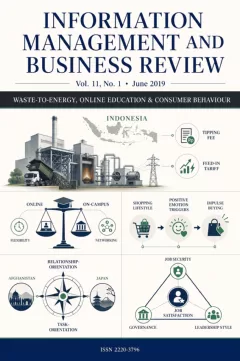 Vol. 11 No. 1 (2019)
Waste-to-Energy, Online Education & Consumer Behaviour
View issue contents
Published
Submissions
Have research to publish? Information Management and Business Review welcomes submissions.
Make a Submission