Abstract
Human resource management is an emerging field of study in Pakistan. The purpose of this study is to identify the best human resource practices in the context of Job performance and offer recommendations for future research. This study reviewed many published articles in the major academic journals, focusing on the most important human resource practices, the relations between human resource practices and job performance. This study finds that Pakistan-based research on the human resource practices has been actively discussed in the major theoretical debates in the literature, and that Pakistan-based studies have extended previous models by identifying additional intervening variables. A hypothesized model on the basis of extensive review of the literature has been developed. It is recommend that future research in this area be more responsive to emerging methodological concerns of the field, and pay more attention to Pakistan-specific issues that may have significant organizational consequences.
Keywords
- Human Resource Practices Search this journal for Human Resource Practices (opens in a new tab)
- Job Performance Search this journal for Job Performance (opens in a new tab)
- Job Analysis Search this journal for Job Analysis (opens in a new tab)
- Job Design Search this journal for Job Design (opens in a new tab)
- Job Evaluation Search this journal for Job Evaluation (opens in a new tab)
- Job Security Search this journal for Job Security (opens in a new tab)
- Public Sector Organizations Search this journal for Public Sector Organizations (opens in a new tab)
References
- Bae, J., & Lawler, J. J. (2000). Organizational and HRM strategies in Korea, Impact on firm performance in an emerging economy. Academy of Management Journal 43(3), 502–17.
- Batt, R. (2002). Managing customer services, Human resource practices, quit rates, and sales growth. Academy of Management Journal 45(3), 587.
- Clifford, J. (1994). Job analysis: Why do it, and how should it be done? Public Personnel Management, 23(2), 321.
- Conte, J. M., Dean, M. A. & Ringenbach, K. L. (2005). The Relationship between Work Attitudes and Job Analysis Ratings, Do Rating Scale Type and Task Discretion Matter? Human Performance , 18(1), 1–21.
- Siddique, M. C. (2004). Job analysis, a strategic human resource management practice. International Journal of Human Resource Management, 15(1), 219-244.
- Datta, D. K., Guthrie, P. J. & Wright. M. P. (2005). Human resource management and labor productivity, Does industry matter? Academy of Management Journal 48(1), 135–45.
- Delery, J. E. & Doty, H. D. (1996). Models of theorizing in strategic human resource management, Tests of Universalistic, Contingency and Configurational performance predictions. Academy of Management Journal 39(4), 802–35.
- Easterby-Smith, M. & Malina, D. (1999). Cross-cultural collaborative research, Towards reflexivity. Academy of Management Journal, 42(1), 76–86.
- Benson, S. G. (2006). Employee Development, Commitment and Intention to Turnover, a test of Employability’ Policies in Action. Human Resource Management Journal , 16(2), 173-192.
- Gerhart, B., Wright, M. P., McMahan,C. G. & Snell. A. S. (2000). Measurement error in research on human resources and firm performance, How much error is there and how does in influence effect size estimates? Personnel Psychology, 53(4), 803–34.
- Greer, C. R. (2001). Strategic Human Resource Management: A General Managerial Approach , 2nd ed. Englewood Cliffs, NJ: Prentice Hall.
- Griffeth, R., Hom, P. & Gaertner, K. (2000). A Meta-Analysis of Antecedents and Correlates of Employee Turnover, Update, Moderator Tests and Research Implications for the Next Millennium. Journal of Management , 26(3), 463–488.
- Guthrie, J. P. (2001). High-involvement work practices, turnover, and productivity, Evidence from New Zealand. Academy of Management Journal, 44(1), 180.
- Hom, P. & Kinicki, A. (2001). Toward a Greater Understanding of How Dissatisfaction Drives Employee Turnover. Academy of Management Journal , 44(5), 975–987.
- Horgan, J. & Mühlau, P. (2006). Human resource systems and employee performance in Ireland and the Netherlands, A test of the complementarity hypothesis. International Journal of Human Resource Management, 17(3), 414–39.
- Hurtz, G. M. & Donovan, J. J. (2000). Personality and Job Performance, The Big Five Revisited. Journal of Applied Psychology , 85 (6), 869-879.
- Huselid, M. (1995). The impact of human resource management practices on turnover, productivity, and corporate financial performance. Academy of Management Journal, 38, 635–72.
- Huselid, M. A. & Becker, E. B. (2000). Comment on ‘measurement error in research on human resources and firm performance, How much error is there and how does it influence effect size estimates?’ by Gerhart, Wright, McMahan, and Snell. Personnel Psychology, 53(4), 835–54.
- Judge, T. A. & Bono, J. E. (2001). Relationship of core Self-Evaluations Traits Self-Esteem, Generalized SelfEfficacy, Locus of Control And Emotional Stability With Job Satisfaction and Job Performance, A MetaAnalysis. Journal of Applied Psychology , 86, 80–92.
- Kirkman, B. L. & Shapiro, D. L. (2001). The impact of cultural values on job satisfaction and organizational commitment in self-managing work teams, The mediating role of employee resistance. Academy of Management Journal, 44(3), 557–69.
- Lowe, J., Delbridge, R. & Oliver, N. (1997). High-performance manufacturing, Evidence from the automotive components industry. Organization Studies, 18(5), 783–98.
- Lowery, C. M., Beadles II, N. A. & Krilowicz, T. J. (2004). Using Personality and Cognitive Ability to Predict Job Performance, An Empirical Study. International Journal of Management , 21 (3), 300-306.
- MacDuffie, J. P. (1995). Human resource bundles and manufacturing performance, Organizational logic and flexible production systems in the world auto industry. Industrial and Labor Relations Review, 48(2), 197–221.
- Kraimer, L. M. & Sparrowe, T. R. (2005). The Role of Job Security in Understanding the Relationship between Employee’s Perceptions of Temporary Workers and Employee’s Performance, Journal of Applied Psychology , 90(2), 389-398.
- Meyer, K. (2006). Asian management research needs more self-confidence. Asia Pacific Journal of Management 23, 119–37.
- Morgeson, F. P., & Humphrey, S. E. (2006). The Work Design Questionnaire (WDQ), Developing and Validating a Comprehensive Measure for Assessing Job Design and the Nature of Work. Journal of Applied Psychology , 91, 1321–1339.
- Peng, M. W. (2003). Institutional transitions and strategic choices. Academy of Management Review, 28(2), 275– 96.
- Pfeffer, J. (1994). Competitive advantage through people, Unleashing the power of the work force. Boston, Harvard Business School Press.
- Pizam, A. & Thornburg, S. W. (2000). Absenteeism and Voluntary Turnover in Central Florida Hotels, A Pilot Study. International Journal of Hospitality Management , 19(2), 211-217.
- Rehman, S., Waheed, A. & Khattak, R. H. (2010). Impact of job analysis on job performance, Analysis of a hypothesized model, Journal of Diversity Management , USA, 5(2 ) 17- 36.
- Rehman, S. & Waheed, A. (2010). An empirical study of impact of job satisfaction on job performance in the public sector organizations. (under publication), Interdisciplinary Journal of Contemporary Research in Business , UK.
- Sanchez, J. I. & Levine, E. L. (2000). Accuracy or Consequential Validity, Which is the Better Standard for Job Analysis Data? Journal of Organizational Behavior, 21(7), 809-818.
- Shenkar, O., & Glinow, M. A. (1994). Paradoxes of organizational theory and research, Using the case of China to illustrate national contingency. Management Science, 40(1), 56–71.
- Takeuchi, R., Lepak, P. D. Wang, H. & Takeuchi, K. (2007). An empirical examination of the mechanisms mediating between high-performance work systems and the performance of Japanese organizations. Journal of Applied Psychology, 92(4), 1069–83.
- Trevor, C. (2001). Interactions Among Actual Ease-of-Movement Determinants and Job Satisfaction in Prediction of Voluntary Turnover. Academy of Management Journal , 44(4), 621–638.
- Van Breukelen, W., Vlist, V. & Steensma, H. (2004).Voluntary Employee Turnover, Combining Variables from the ‘Traditional’ Turnover Literature with the Theory of Planned Behaviour, Journal of Organizational Behaviour , 25 (7), 893-914.
- Viswesvaran, C., Schmidt F. L. & Ones D. S. (2005). Is there a General Factor in Ratings of Job Performance? A Meta-Analytic Framework for Disentangling Substantive and Error Influences. Journal of Applied Psychology , 90,108–131.
- Wei, L. and Lau, C. (2008). The impact of market orientation and strategic HRM on firm performance, The case of Chinese enterprise. Journal of International Business Studies 39, 980–995.
- Welbourne, T. M. & Trevor, C. O. (2000). The Roles of Departmental and Position Power in Job Evaluation. Academy of Management Journal , 43(4), 761–771.
- Whitley, R. (2000). Divergent capitalisms, The social structuring and change of business systems. New York, Oxford University Press.
- Wright, P. M., Dunford, B. B. & Snell, A. S. (2001). Human resources and the resource based view of the firm. Journal of Management 27(6), 701–21.
- Wright, T. A. & Bonett, D. G. (2002). The Moderating Effects of Employee Tenure on the Relation between Organizational Commitment and Job Performance, A Meta-Analysis. Journal of Applied Psychology , 87(6), 1183–1190.
- Xiao, Z., and Björkman, I. (2006). High commitment work systems in Chinese organizations, A preliminary measure. Management and Organization Review 2(3), 403–22.
- Fried, Y., Grant, M. A., Levi, S. A., Hadani, M. & Slowik, H. L. (2007). Job design in temporal context, a career dynamics perspective. Journal of organizational behaviour. 28 (7), 911-927.
Downloads
No downloads have been recorded for this article yet. Figures appear here once readers begin downloading the full text.
How to Cite
Share this article
License
Copyright (c) 2011 M. Safdar Rehman (Author)

This work is licensed under a Creative Commons Attribution 4.0 International License.
Author (s) should affirm that the material has not been published previously. It has not been submitted and it is not under consideration by any other journal. At the same time author (s) need to execute a publication permission agreement to assume the responsibility of the submitted content and any omissions and errors therein. After submission of revised paper in the light of suggestions of the reviewers, the editorial team edits and formats manuscripts to bring uniformity and standardization in published material.
This work will be licensed under Creative Commons Attribution 4.0 International (CC BY 4.0) and under condition of the license, users are free to read, copy, remix, transform, redistribute, download, print, search or link to the full texts of articles and even build upon their work as long as they credit the author for the original work. Moreover, as per journal policy author (s) hold and retain copyrights without any restrictions.
Keywords
- Human Resource Practices Search this journal for Human Resource Practices (opens in a new tab)
- Job Performance Search this journal for Job Performance (opens in a new tab)
- Job Analysis Search this journal for Job Analysis (opens in a new tab)
- Job Design Search this journal for Job Design (opens in a new tab)
- Job Evaluation Search this journal for Job Evaluation (opens in a new tab)
- Job Security Search this journal for Job Security (opens in a new tab)
- Public Sector Organizations Search this journal for Public Sector Organizations (opens in a new tab)
Section
Published in
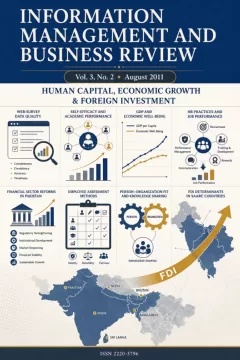 Vol. 3 No. 2 (2011)
Human Capital, Economic Growth & Foreign Investment
View issue contents
Published
Submissions
Have research to publish? Information Management and Business Review welcomes submissions.
Make a Submission