Abstract
This study investigates the nexus between career commitment, adaptability and motivation, and the mediation role of career adaptability on the relationships between career commitment and motivation. Data were collected randomly from marketers working in the telecommunication sector in the Kurdistan region of Iraq through online questionnaires. There were 121 out of 285 forms received and analyzed using the structural equation modeling approach. The findings indicate that both career commitment and adaptability have direct effects on career motivation. Furthermore, a mediation effect of career adaptability was identified in the relationship between career commitment and motivation. The findings of the study contribute to the career motivation literature by investigating the effects of individual factors, namely career commitment and career adaptability, on career motivation in the context of developing countries. The study also points out the compound effect of these factors on career motivation.
Keywords
- Career Motivation Search this journal for Career Motivation (opens in a new tab)
- Career Commitment Search this journal for Career Commitment (opens in a new tab)
- Career Adaptability Search this journal for Career Adaptability (opens in a new tab)
- Structural Equation Modeling Search this journal for Structural Equation Modeling (opens in a new tab)
References
- Affum-Osei, E., Adom Asante, E., Kwarteng Forkouh, S., & Abdul-Nasiru, I. (2020). Career adaptability and ambidextrous behavior among customer-service representatives: the role of perceived organizational support. Journal of Personal Selling and Sales Management, 40(1), 4–18. https://doi.org/10.1080/08853134.2019.1594241
- Aljanabi, A. R. A. (2018). The mediating role of absorptive capacity on the relationship between entrepreneurial orientation and technological innovation capabilities. International Journal of Entrepreneurial Behavior & Research, 24(4), 818–841.
- Aljanabi, A. R. A., Hamasaleh, S. H., & Noor, N. A. M. (2019). Cultural diversity and operational performance: entrepreneurial orientation as a mediator. International Journal of Quality & Reliability Management, 36(9), 1522–1539.
- Aljanabi, A. R. A., & Kumar, D. (2013). Talent Management Strategy and Absorptive Capacity as Antecedences of Innovation Capability: A Conceptual Framework. Research Journal of Social Sience & Management, 2(9), 115–123.
- Aljanabi, A. R. A., & Noor, N. A. M. (2015). Critical Determinants of Technological Innovation: A Conceptual Framework and a Case Study from Iraq. International Business Research, 8(2), 16–27. https://doi.org/10.5539/ibr.v8n2p16
- Aljanabi, A. R. A., Noor, N. A. M., & Kumar, D. (2014). The Mediating Role of Absorptive Capacity in Its Effect on Organizational Support Factors and Technological Innovation. Information Management and Business Review, 6(1), 25–41.
- Alnıaçık, Ü., Alnıaçık, E., Akçin, K. & Erat, S. (2012). Relationships Between Career Motivation, Affective Commitment and Job Satisfaction. In Procedia - Social and Behavioral Sciences (Vol. 58, pp. 355–362). https://doi.org/10.1016/j.sbspro.2012.09.1011
- Amin, S., Arshad, R., & Ghani, R. A. (2017). Spousal Support and Subjective Career Success: The Role of Work-Family Balance and Career Commitment as Mediator. Jurnal Pengurusan, 50(12), 133–142. Retrieved from https://web.b.ebscohost.com/ehost/pdfviewer/pdfviewer?vid=1&sid=df8a329e-9377-413e-87c5-430abf9693dd%40sessionmgr102
- Armstrong, J., & Overton, T. (1977). Estimating Nonresponse Bias in Mail Surveys. Journal of Marketing Research, 14(1), 396–402.
- Arthur, M. B., Khapova, S. N., & Wilderom, C. P. M. (2005). Career success in a boundaryless career world. Journal of Organizational Behavior, 26(2), 177–202. https://doi.org/10.1002/job.290
- Autin, K. L., Douglass, R. P., Duffy, R. D., England, J. W., & Allan, B. A. (2017). Subjective social status, work volition, and career adaptability: A longitudinal study. Journal of Vocational Behavior, 99(April), 1–10. https://doi.org/10.1016/j.jvb.2016.11.007
- Avram, E., Burtaverde, V., & Zanfirescu, A. ?erban. (2019). The incremental validity of career adaptability in predicting academic performance. Social Psychology of Education, 22(4), 867–882. https://doi.org/10.1007/s11218-019-09505-6
- Blau, G. J. (1985). The measurement and prediction of career commitment. Journal of Occupational Psychology, 58(4), 277–288.
- Bridgstock, R. (2009). The graduate attributes we’ve overlooked: Enhancing graduate employability through career management skills. Higher Education Research and Development, 28(1), 31–44. https://doi.org/10.1080/07294360802444347
- Day, R., & Allen, T. D. (2004). The relationship between career motivation and self-efficacy with protégé career success. Journal of Vocational Behavior, 64(1), 72–91. https://doi.org/10.1016/S0001-8791(03)00036-8
- De-Vos, A., & Soens, N. (2008). Protean attitude and career success: The mediating role of self-management. Journal of Vocational Behavior, 73(3), 449–456. https://doi.org/10.1016/j.jvb.2008.08.007
- Despina, S.-D., Argyropoulou, K., Drosos, N., Kaliris, A., & Mikedaki, K. (2015). Exploring Career Management Skills in Higher Education: Perceived Self-efficacy in Career, Career Adaptability and Career Resilience in Greek University Students. International Journal of Learning, Teaching and Educational Research, 14(2), 36–52. https://doi.org/10.3103/S0145875211040041
- Duffy, R. D., & Blustein, D. L. (2005). The relationship between spirituality, religiousness, and career adaptability. Journal of Vocational Behavior, 67(3), 429–440. https://doi.org/10.1016/j.jvb.2004.09.003
- Ebenehi, A. S., Rashid, A. M., & Bakar, A. R. (2016). Predictors of career adaptability skill among higher education students in Nigeria. International Journal for Research in Vocational Education and Training, 3(3), 212–229. https://doi.org/10.13152/IJRVET.3.3.3
- Fang, W., Zhang, Y., Mei, J., Chai, X., & Fan, X. (2018). Relationships between optimism, educational environment, career adaptability and career motivation in nursing undergraduates: A cross-sectional study. Nurse Education Today, 68(November), 33–39. https://doi.org/10.1016/j.nedt.2018.05.025
- Fawehinmi, O. O., & Yahya, K. K. (2018). Investigating the Linkage Between Proactive Personality and Social Support on Career Adaptability Amidst Undergraduate Students. Journal of Business and Social Review in Emerging Economies, 4(1), 81–92. https://doi.org/10.26710/jbsee.v4i1.370
- Fornell, C., & Larcker, F. (1981). Structural Equation Models With Unobservable Variables and Measurement Error: Algebra and Statistics. Journal of Marketing Research, 18(3), 382–389.
- Ginevra, M. C., Magnano, P., Lodi, E., Annovazzi, C., Camussi, E., Patrizi, P., & Nota, L. (2018). The role of career adaptability and courage on life satisfaction in adolescence. Journal of Adolescence, 62(May 2017), 1–8. https://doi.org/10.1016/j.adolescence.2017.11.002
- Greller, M. M. (2006). Hours invested in professional development during late career as a function of career motivation and satisfaction. Career Development International, 11(6), 544–559. https://doi.org/10.1108/13620430610692944
- Haibo, Y., Xiaoyu, G., Xiaoming, Z., & Zhijin, H. (2018). Career Adaptability With or Without Career Identity: How Career Adaptability Leads to Organizational Success and Individual Career Success? Journal of Career Assessment, 26(4), 717–731. https://doi.org/10.1177/1069072717727454
- Hair, J. F., Hult, G., Ringle, C., & Sarstedt, M. (2014). A primer on partial least squares structural equation modeling (PLS-SEM). Long Range Planning (1st ed). Singapore: Sage.
- Hair, J. F., Ringle, C., & Sarstedt, M. (2011). PLS-SEM: Indeed a Silver Bullet. The Journal of Marketing Theory and Practice, 19(2), 139–152.
- Hennekam, S. (2015). Career success of older workers: the influence of social skills and continuous learning ability. Journal of Management Development, 34(9), 1113–1133. https://doi.org/10.1108/JMD-05-2014-0047
- Heslev, P. A. (2005). Conceptualizing and evaluating career success. Journal of Organizational Behavior, 26(2), 113–136. https://doi.org/10.1002/job.270
- Hirschi, A., Herrmann, A., & Keller, A. C. (2015). Career adaptivity , adaptability , and adapting: A conceptual and empirical investigation. Journal of Vocational Behavior, 87, 1–10. https://doi.org/10.1016/j.jvb.2014.11.008
- Ito, J. K., & Brotheridge, C. M. (2005). Does supporting employees’ career adaptability lead to commitment turnover, or both? Human Resource Management, 44(1), 5–19. https://doi.org/10.1002/hrm.20037
- Jiang, Z., Hu, X., & Wang, Z. (2018). Career adaptability and plateaus: The moderating effects of tenure and job self-efficacy. Journal of Vocational Behavior, 104(October 2017), 59–71. https://doi.org/10.1016/j.jvb.2017.10.006
- Jiaxi, Z., Qing, W., Danmin, M., Xiaofei, Y., & Jiaxi, P. (2014). The Impact of Core Self-evaluations on Job Satisfaction: The Mediator Role of Career Commitment. Social Indicators Research, 116(3), 809–822.
- Kim, S., & Kim, E. (2018). Employees’ Learning Goals and Affective Organizational Commitment: The Mediating Role of Career Adaptability. Interdisciplinary Journal of Adult & Continuing Education, 21(4), 75–95.
- Koen, J., Klehe, U. C., Van Vianen, A. E. M., Zikic, J., & Nauta, A. (2010). Job-search strategies and reemployment quality. The impact of career adaptability. Journal of Vocational Behavior, 77(1), 126–139. https://doi.org/10.1016/j.jvb.2010.02.004
- Krejcie, R. V, & Morgan, D. W. (1970). Determining Sample Size for Research Activities. Educational and Psychological Measurement, 30(3), 607–610.
- Mccallum, S. Y., Forret, M. L., & Wolff, H. G. (2014). Internal and external networking behavior an investigation of relationships with affective, continuance, and normative commitment. Career Development International, 19(5), 595–614. https://doi.org/10.1108/CDI-08-2013-0101
- Meyer, J. P., & Parfyonova, N. M. (2010). Normative commitment in the workplace: A theoretical analysis and re-conceptualization. Human Resource Management Review, 20(4), 283–294. https://doi.org/10.1016/j.hrmr.2009.09.001
- Molly, A., & Michael, K. (2020). Career Training, Rewards System and Employee Commitment; Moderating Approach; Evidence from Kenyan Manufacturing Firms. Journal of Chemical Information and Modeling, 5(4), 28–39. https://doi.org/10.1017/CBO9781107415324.004
- Ohme, M., & Zacher, H. (2015). Job performance ratings: The relative importance of mental ability, conscientiousness, and career adaptability. Journal of Vocational Behavior, 87(April), 161–170. https://doi.org/10.1016/j.jvb.2015.01.003
- Praskova, A., Creed, P. A., & Hood, M. (2015). Career identity and the complex mediating relationships between career preparatory actions and career progress markers. Journal of Vocational Behavior, 87(April), 145–153. https://doi.org/10.1016/j.jvb.2015.01.001
- Quigley, N. R., & Tymon, W. G. (2006). Toward an integrated model of intrinsic motivation and career self-management. Career Development International, 11(6), 522–543. https://doi.org/10.1108/13620430610692935
- Ringle, C. M., Wende, S., & Becker, J.-M. (2015). SmartPLS 3. Bönningstedt: SmartPLS. Retrieved from http://www.smartpls.com
- Said, A. A., Mohd, R., Bahaman, R., Samah, A., Daud, A., Suzaimah, S., … Bush, S. R. (2015). A career success model for academics at Malaysian research universities. European Journal of Training and Development, 39(9), 815–835.
- Savickas, M. L., & Porfeli, E. J. (2012). Career Adapt-Abilities Scale: Construction, reliability, and measurement equivalence across 13 countries. Journal of Vocational Behavior, 80(3), 661–673. https://doi.org/10.1016/j.jvb.2012.01.011
- Sheard, M. (2009). Hardiness commitment, gender, and age differentiate university academic performance. British Journal of Educational Psychology, 79(1), 189–204. https://doi.org/10.1348/000709908X304406
- Srikanth, P. B., & Israel, D. (2012). Career Commitment & Career Success: Mediating Role of Career Satisfaction. Indian Journal of Industrial Relations, 48(1), 137–149.
- Umoh, G. I., Ph, D., Amah, E., Ph, D., & D, I. H. W. P. (2018). Employee Benefits and Continuance Commitment in the Nigerian Manufacturing Industry. Journal of Business and Management, 16(2), 69–74.
- Wang, Q., Weng, Q., McElroy, J. C., Ashkanasy, N. M., & Lievens, F. (2014). Organizational career growth and subsequent voice behavior: The role of affective commitment and gender. Journal of Vocational Behavior, 84(3), 431–441. https://doi.org/10.1016/j.jvb.2014.03.004
- Wayne, S. J., Liden, R. C., Kraimer, M. L., & Graf, I. K. (1999). The role of human capital, motivation and supervisor sponsorship in predicting career success. Journal of Organizational Behavior, 20(5), 577–595. https://doi.org/10.1002/(SICI)1099-1379(199909)20:5<577::AID-JOB958>3.0.CO;2-0
- Weibo, Z., Kaur, S., & Jun, W. (2010). New development of organizational commitment: A critical review (1960 - 2009). African Journal of Business Management, 4(1), 012–020.
- Welbourne, T. M., & Schlachter, S. (2019). Engagement Intent: Role Theory Perspectives for Balancing Individual and Firm-Level Engagement Outcomes. Compensation & Benefits Review, 51(4), 173–195. https://doi.org/10.1177/0886368719898932
- World Bank. (2017). Iraq Systematic Country Diagnostic. Retrieved from http://documents.worldbank.org/curated/en
- Yahya, K. K., & Tan, F. (2015). Enhancing career commitment: The influence of human resource management practices. International Journal of Business and Society, 16(2), 237–246.
- Zacher, H., Ambiel, R. A. M., & Noronha, A. P. P. (2015). Career adaptability and career entrenchment. Journal of Vocational Behavior, 88(June), 164–173. https://doi.org/10.1016/j.jvb.2015.03.006
Downloads
No downloads have been recorded for this article yet. Figures appear here once readers begin downloading the full text.
How to Cite
Share this article
License
Copyright (c) 2020 Hast Haval M.Najib, Abdulqadir Rahomee Ahmed Aljanabi (Author)

This work is licensed under a Creative Commons Attribution 4.0 International License.
Author (s) should affirm that the material has not been published previously. It has not been submitted and it is not under consideration by any other journal. At the same time author (s) need to execute a publication permission agreement to assume the responsibility of the submitted content and any omissions and errors therein. After submission of revised paper in the light of suggestions of the reviewers, the editorial team edits and formats manuscripts to bring uniformity and standardization in published material.
This work will be licensed under Creative Commons Attribution 4.0 International (CC BY 4.0) and under condition of the license, users are free to read, copy, remix, transform, redistribute, download, print, search or link to the full texts of articles and even build upon their work as long as they credit the author for the original work. Moreover, as per journal policy author (s) hold and retain copyrights without any restrictions.
Keywords
- Career Motivation Search this journal for Career Motivation (opens in a new tab)
- Career Commitment Search this journal for Career Commitment (opens in a new tab)
- Career Adaptability Search this journal for Career Adaptability (opens in a new tab)
- Structural Equation Modeling Search this journal for Structural Equation Modeling (opens in a new tab)
Section
Published in
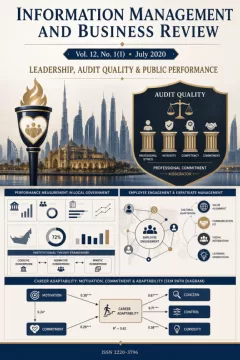 Vol. 12 No. 1(I) (2020)
Leadership, Audit Quality & Public Performance
View issue contents
Published
Submissions
Have research to publish? Information Management and Business Review welcomes submissions.
Make a Submission