Abstract
This paper develops an adjustment to utility measurement in integrative negotiation where the negotiation information context is incomplete. The developed function reveals not only win-win outcomes but also deceptive practices where negotiators accept a win-lose deal and then compensate their loss in a deceptive way and greedy practices where negotiators realize their strong competitive position and try to extremely maximize their gains. However, to realize the objective, the utility measurement function literature and theories are reviewed to determine the relevant function structure and the necessary attributes that reveal the desired outcome in an incomplete information context. After examination, relationship measurement is added to the function under two utilities: Decision Utility and Experienced Utility. The foundation of the utility measurement function contributes to revealing satisfying win-win outcomes in an incomplete information negotiation context. Therefore, it develops the negotiation field by designing win-win deals that are beneficial and satisfying in which the advantage is distributed between the negotiators.
Keywords
- Negotiation Search this journal for Negotiation (opens in a new tab)
- Integrative Negotiation Search this journal for Integrative Negotiation (opens in a new tab)
- Utility Measurement Search this journal for Utility Measurement (opens in a new tab)
- Relationships Search this journal for Relationships (opens in a new tab)
- Win-Win Outcomes Search this journal for Win-Win Outcomes (opens in a new tab)
References
- Becker, G. M., Degroot, M. H. & Marscha, J. (1964). Measuring Utility by a Single‐response Sequential Method. Journal of the Society for General Systems Research, 9(3), 7.
- Bell, D. (1982). Regret in Decision Making under Uncertainty. Operations Res., 20, 961–981.
- Bernoulli, D. (1954 [1738]). Exposition of a New Theory on the Measurement of Risk (Translation of Bernoulli D 1738 Specimen theoriae novae de mensura sortis; Papers Imp. Acad. Sci. St. Petersburg 5 175–192). Econometrica, 22(1), 23-36.
- Blavatskyy, P. (2010). Modifying the Mean-Variance Approach to Avoid Violations of Stochastic Dominance. Management Science, 56(11), 2050-2057.
- Blavatskyy, P. R. (2013). Which Decision Theory? Economics Letters, 120(1), 40-44.
- Brown, A. D. & Curhan, J. R. (2012). The Utility of Relationships in Negotiation. Oxford Handbooks Online, 139-151.
- Chew, S. H. (1983). A Generalization of the Quasilinear Mean with Applications to the Measurement of Income Inequality and Decision Theory Resolving the Allais Paradox. Econometrica, 51, 1065-1092.
- Chew, S. H., Larry, E. G. & Segal, U. (1991). Mixture Symmetry and Quadratic Utility. Econometrica, 59, 139–63.
- Chew, S. & MacCrimmon, K. (1979). Alpha-nu Choice Theory: a Generalisation of Expected Utility Theory. working paper 669, U. British Columbia.
- Chew, S., Larry, E. G. & Uzi, S. (1991). Mixture Symmetry and Quadratic Utility. Econometrica, 59, 139-163.
- Davidson, D. & Suppes, P. (1957). Decision Making: An Experimental Approach. Stanford University Press, 121.
- Dyer, J. (2005). MAUT ‐ Multi-Attribute Utility Theory. In Multiple Criteria Decision Analysis: State of the Art Surveys. Springer: New York, 265–295.
- Fisher, R. & Ury, W. (1981). Getting to Yes. United Kingdom: Penguin Group.
- Geldermann, J. & Schobel, A. (2011). On the Similarities of Some Multi-Criteria Decision Analysis Methods. Journal of Multi-Criteria Decision Analysis, 18, 219-230.
- Goyal, V. & Saxena, A. S. (2002). Von Neumann And Morgenstern Utility Function. Delhi: Department of Computer Science and Engineering - Indian Institute of Technology Delhi.
- Gul, F. (1991). A Theory of Disappointment Aversion. Econometrica, 59, 667-686.
- Hershey, J. C., Kunreuther, H. C. & Schoemaker, P. (1982). Sources of Bias in Assessment Procedures for Utility Functions. Management Science, 28(8), 936-954.
- Hicks, J. R. & Allen, R. (1934). A Reconsideration of the Theory of Value, Parts I and II. Economica, 1 (February, May): 52-76 and 196-219.
- Kahneman, D. & Tversky, A. (1979). Prospect Theory: An Analysis of Decision under Risk. Econometrica, 47(2), 263-291.
- Kahneman, D., Wakker, P. P. & Sarin, R. (1997). Back to Bentham? Explorations of Experienced Utility. Quarterly Journal of Economics, 112(2), 375-405.
- Karmarkar, U. S. (1974). The Effect of Probabilities on the Subjective Evaluation of Lotteries. Cambridge, Massachusetts: Massachusetts Institute of Technology.
- Kontek, K. (2010). Decision Utility Theory: Back to von Neumann, Morgenstern, and Markowitz. MPRA: Munich Personal RePEc Archive, 26.
- Loomes, G. & Sugden, R. (1987). Some Implications of a More General Form of Regret Theory. J. Econ. Theory, 41(2), 270–87.
- Market Business News. (2019). What Is Utility? Definition And Meaning. Retrieved from Market Business News: https://marketbusinessnews.com/financial-glossary/utility-definition-meaning/
- Markowitz, H. (1952). The Utility of Wealth. Journal of Political Economy, 60, 151-158.
- McCord, M. & de Neufville, R. (1983). Empirical Demonstration that Expected Utility Decision Analysis is Not Operational. Cambridge, USA: Massachusetts Institute of Technology.
- McDermott, R. (1998). Risk-Taking in International Politics. USA: The University of Michigan Press.
- Moscati, I. (2018). Measuring Utility: From the Marginal Revolution to Behavioral Economics. Oxford, UK: Oxford Scholarship Online.
- Mosteller, F. & Nogee, P. (1951). An Experimental Measurement of Utility. The Journal of Political Economy, 59(5), 371-404.
- Pareto, V. (1892-1893). Considerazioni sui principii fondamentali dell’economia politica pura (Considerations on the Fundamental Principles of Pure Political Economy), Parts I-V. Giornale degli Economisti, (March, 1892): 389-420; (June, 1892): 485-512; (August, 1892): 119-157; (January, 1893): 1-37; (October, 1893): 279-321.
- Quiggin, J. (1981). Risk perception and risk aversion among Australian farmers. Australian Journal of Agricultural Resource Economics, vol. 25, 160-169.
- Quiggin, J. (1982). A Theory of Anticipated Utility. Journal of Economic Behavior and Organization, 3, 323-343.
- Roy, B. & Bouyssou, D. (1993). Aide Multicritère á la Décision. Economica: Paris.
- Schmeidler, D. (1989). Subjective Probability and Expected Utility without Additivity. Econometrica, 57, 571-587.
- Shaheen, F., Wooldridge, M. & Jennings, N. R. (2009). An Analysis of Feasible Solutions for Multi-Issue Negotiation Involving Nonlinear Utility Functions. 8th International Conference on Autonomous Agents and Multiagent Systems (pp. 1041-1048). Budapest, Hungary: AAMAS.
- Simon, H. A. (1982). Models of Bounded Rationality. Volume 1: Economic Analysis and Public Policy. Volume 2: Behavioural Economics and Business Organization. MIT Press, 478-505.
- Starmer, C. (2000). Developments in Non-Expected Utility Theory: The Hunt for a Descriptive Theory of Choice under Risk. Journal of Economic Literature, 38, 332–382.
- Suppes, P. & Walsh, K. (1957). A Non-linear Model for the Experimental Measurement of Utility. Stanford, California: Applied Mathematics and Statistics Laboratory.
- Surbhi, S. (2016, 5 30). Difference Between Cardinal and Ordinal Utility. Retrieved from Key Differences: https://keydifferences.com/difference-between-cardinal-and-ordinal-utility.html
- Tversky, A. & Kahneman, D. (1992). Advances in Prospect Theory: Cumulative Representation of Uncertainty. Journal of Risk and Uncertainty, 5, 297-323.
- Viscusi, K. (1989). Prospective Reference Theory: Toward an Explanation of the Paradoxes. Journal of Risk and Uncertainty, 2, 235-264.
- Voigt, A. (1893). Zahl und Mass in der Ökonomik. Eine kritische Untersuchung der mathematischen Methode und der mathematischen Preistheorie - Number and Measure in Economics. A Critical Study of Mathematical Method and Mathematical Price Theory. Zeitschrift für die gesamte Staatswissenschaft - Journal for the Entire Political Science, 49(4), 577-609.
- von Neumann, J. & Morgenstern, O. (1953). Theory of Games and Economic Behavior (Third ed.). Princeton, NJ: Princeton University Press.
- von Neumann, J. & Morgenstern, O. (1944). Theory of Games and Economic Behavior. US: Princeton University Press.
- von Restorff, H. (1933). Uber die Wirkung von Bereichsbildungen im Spurenfeld [The effects of field formation in the trace field]. Psychologische Forschung, 18, 299–342.
- Wall Street Mojo. (2019). Economic Utility. Retrieved from Wall Street Mojo: https://www.wallstreetmojo.com/economic-utility/
- Wilkes, J. (2008). Utility Functions, Prices, and Negotiation. California, USA: John Wiley & Sons Inc, HP Development Company.
- Yaari, M. (1987). The Dual Theory of Choice under Risk. Econometrica, 55, 95-115.
- Zartman, I. W. (1988). Common Elements in the Analysis of the Negotiation Process. Negotiation Journal, 4:31-43.
Downloads
No downloads have been recorded for this article yet. Figures appear here once readers begin downloading the full text.
How to Cite
Share this article
License
Copyright (c) 2021 Latifa Ghalayini, Dana Deeb (Author)

This work is licensed under a Creative Commons Attribution 4.0 International License.
Author (s) should affirm that the material has not been published previously. It has not been submitted and it is not under consideration by any other journal. At the same time author (s) need to execute a publication permission agreement to assume the responsibility of the submitted content and any omissions and errors therein. After submission of revised paper in the light of suggestions of the reviewers, the editorial team edits and formats manuscripts to bring uniformity and standardization in published material.
This work will be licensed under Creative Commons Attribution 4.0 International (CC BY 4.0) and under condition of the license, users are free to read, copy, remix, transform, redistribute, download, print, search or link to the full texts of articles and even build upon their work as long as they credit the author for the original work. Moreover, as per journal policy author (s) hold and retain copyrights without any restrictions.
Keywords
- Negotiation Search this journal for Negotiation (opens in a new tab)
- Integrative Negotiation Search this journal for Integrative Negotiation (opens in a new tab)
- Utility Measurement Search this journal for Utility Measurement (opens in a new tab)
- Relationships Search this journal for Relationships (opens in a new tab)
- Win-Win Outcomes Search this journal for Win-Win Outcomes (opens in a new tab)
Section
Published in
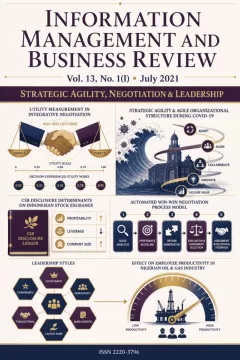 Vol. 13 No. 1(I) (2021)
Strategic Agility, Negotiation & Leadership
View issue contents
Published
Submissions
Have research to publish? Information Management and Business Review welcomes submissions.
Make a Submission