Abstract
The purpose of this study is to examine the effect of leadership style on employee productivity in the Nigerian oil and gas industry using Chevron Nigeria Limited as a case study. The study used a five-point Likert scale questionnaire consisting of forty questions covering autocratic, democratic, bureaucratic, laissezfaire, transactional, charismatic leadership styles and employee productivity variables. The questionnaire was deployed to one hundred and twenty-five respondents (125) and received ninety-three (93) valid responses. Statistical Package for the Social Sciences (SPSS) was used to analyze respondent responses. Demographic analysis, normality test, homoscedasticity, multicollinearity, reliability test (Cronbach’s Alpha) were presented; results affirm the validity and reliability of research findings. The results of the descriptive and regression analysis indicate that the autocratic leadership style is the most predominant leadership style in the Nigerian Oil and Gas followed by laissez-faire, bureaucratic, transactional, democratic and charismatic leadership styles. The study concludes that leadership styles significantly influence employee productivity albeit different leadership styles have varying effects on employee productivity and varying leadership styles can co-exist within the same organization. The study highlighted various policy implications and recommendations. This study adds to the existing literature on leadership practice and is intended to be a reference point to scholars and researchers for further studies on leadership practices in the oil and gas industry.
Keywords
- Leadership Style Search this journal for Leadership Style (opens in a new tab)
- Employee Productivity Search this journal for Employee Productivity (opens in a new tab)
- Regression Analysis Search this journal for Regression Analysis (opens in a new tab)
- Oil and Gas Industry Search this journal for Oil and Gas Industry (opens in a new tab)
- Nigerian Search this journal for Nigerian (opens in a new tab)
References
- Ajibade, E., Ajayi, O. & Shobowale, O. (2017). Leadership Styles and Employees’ Performance in Nigerian Federal Polytechnics: A Study of Federal Polytechnic, Ilaro, Ogun State. Journal of Public Administration, Finance and Law, 11(1), 17-30.
- Amiscua, M., Fernandez, M., Madanging, J. & Querido, J. (2018). The Impact of Leadership Styles on Employees' Productivity: A Qualitative Study of Employees' Experiences of Motivation in the Workplace. Available at: https://www.researchgate.net/requests/attachment/52212945 (Accessed 29/12/18)
- Aunga, D. & Masare, O. (2017). Effect of Leadership Styles on Teacher’s Performance in Primary Schools of Arusha District Tanzania. International Journal of Educational Policy Research and Review, 14(4), 42–52.
- Babatunde, O. (2015). The impact of leadership style on employee’s performance in an organization, Public Policy and Administration Research, 5(1), 195-206.
- Basit, A., Sebastian, V. & Hassan, Z. (2017). Impact of Leadership Style on Employee Performance (A case study on a private organization in Malaysia). International Journal of Accounting & Business Management, 5(2), 112-130.
- Bass, B. M. & Avolio, B. J. (2000). MLQ Multifactor Leadership Questionnaire. Redwood City: Mind Garden.
- Blazi, C. & Awolusi, O. D. (2020). Employee Engagement in Multinational Diverse Organization in Difficult Terrain: A Study of Non-Family Station Organization, Information Management and Business Review, 12(1), 45-62.
- Chevron. (2018). 2017 Corporate Responsibility Report Highlights. Available at: https://www.chevron.com/-/media/shared-media/documents/2017-corporate-responsibility-report.pdf (Accessed 11/09/18).
- Chowdhury, R. G. (2014). A Study on the Impact of Leadership Styles on Employee Motivation and Commitment: An Empirical Study of Selected Organizations in the Corporate Sector. Available at: http://www.dypatil.edu/schools/management/wp-content/uploads/2015/11/A-study-of-theImpact-of-Leadership-Styles-on-Employee-Motivation-and-Commitment-An-empirical-study-ofselected-organisations-in-Corporate-sector-Rima-Chowdhury.pdf (Accessed 22/09/18).
- Chowdhury, R. & Gopal, R. (2014). Leadership Styles and Employee Motivation: An Empirical Investigation in a Leading Oil Company in India. International Journal of Research in Business Management, 2(5), 1–10.
- Dalluay, V. S. & Jalagat, R. C. (2016). Impacts of Leadership Style Effectiveness of Managers and Department Heads to Employees' Job Satisfaction and Performance on Selected Small-Scale Businesses in Cavite, Philippines. International Journal of Recent Advances in Organizational Behavior & Decision Sciences, 2(2), 734-751.
- Easterby-Smith, M., Thorpe, R. & Jackson, P. (2012). Management Research. 4th ed. London: Sage Publications.
- Erskine, J. & Georgiou, G. (2017). Leadership Styles: Employee Stress, Well-being, Productivity, Turnover and Absenteeism. Available at: https://www.researchgate.net/requests/attachment/52212988 (Accessed 01/01/19).
- Ewell, J. (2018). Revitalizing a Student Organization by Applying Transformational Leadership. Journal of Leadership Education, 17(3), 208–218.
- Gaines, T. M. (2018). Strategies for virtual sales leaders to increase the productivity of remote employees. Available at: https://scholarworks.waldenu.edu/cgi/viewcontent.cgi?article=6287&context=dissertations (Assessed 03/10/18).
- Gastil, J. (2012). A meta-analytic review of the productivity and satisfaction of democratic and autocratic leadership. Small-Group Research, 25(3), 384-410.
- Graham, J. & Trendafilova, S. (2016). Implementing Self-Managed Teams at Western University: A Human Resource and Leadership Case Study. Case Studies in Sport Management, 5(1), 64–72.
- Getachew, D. S. & Erhua Z. (2018). The Influences of Transformational Leadership on Collective Efficacy: The Moderating Role of Perceived Organizational Support. International Journal of Organizational Innovation, 10(4), 7–15.
- Hassan, S. (2016). Impact of HRM Practices on Employee’s Performance. International Journal of Academic Research in Accounting, Finance and Management Sciences, 6(1), 15-22.
- House, R. J. (1971). A Path-Goal Theory of Leader Effectiveness. Journal of Administrative Science Quarterly, 16(1), 321-338.
- Iqbal, N., Anwar, S. & Haider, N. (2015). Effect of Leadership Style on Employee Performance. Arabian Journal of Business and Management Review, 5(5), 1-6.
- Ispas, A. (2012). The Perceived Leadership Style and Employee Performance in the Hotel Industry – a Dual Approach. Review of International Comparative Management / Revista De Management Comparat International, 13(2), 294-304.
- Kagwiria, L. (2016). Influence of Leadership on Employee Productivity at KCB Bank Kenya Ltd, Nairobi Region Branches. Available at: http://erepository.uonbi.ac.ke/bitstream/handle/11295/98559/LILIAN%20FINAL%20PROJECT.pdf?sequence=1&isAllowed=y (Accessed 22/09/18).
- Kohn, A. (1993). Why Incentive Plans Cannot Work. HBR. Available at: https://hbr.org/1993/09/whyincentive-plans-cannot-work (Accessed 10/06/18).
- Lawal, B. A. & Osifo S. J. (2018). Leadership Styles and Employee Performance: Empirical Evidence from Selected Banks in Edo State. Available at: https://www.researchgate.net/publication/329659647_Leadership_Styles_and_Employee_performance_Empirical_Evidence_from_Selected_Banks_in_Edo_State (Accessed 24/12/18).
- Luo, H. & Liu, S. (2014). Effect of Situational Leadership and Employee Readiness Match on Organizational Citizenship Behavior in China. Social Behavior & Personality: an international journal, 42(10), 1725–1732.
- Maisiba, N. L., Muturi, W. & Atambo, W. (2017). Effects of Working Capital Management on the profitability of Retail Firms in Kisii County, Kenya. International Journal of Social Sciences and Information Technology, 3(2), 23-36.
- Malik, S. H. (2013). Relationship between Leader Behaviors and Employees’ Job Satisfaction: A Path-Goal Approach. Pakistan Journal of Commerce & Social Sciences, 7(1), 209–222.
- Mangale, M. N. (2017). The Effects of Compensation on Employee Productivity: A Case Study of Kenya Literature Bureau, South C Nairobi. Available at: http://repository.mua.ac.ke/1570/1/Proposal.pdf (Accessed 22/09/2018).
- Marcus, G., Olowu, D., Solomon, A. & Akhimien, E. (2017). Leadership Styles and Employee Performance in Nigerian Higher Educational Institutions. American Journal of Environmental and Resource Economics, 12(1), 12-21.
- Matira, K. M. & Awolusi, O. D. (2020). Leaders and Managers Styles towards Employee Centricity: A Study of Hospitality Industry in the United Arab Emirates, Information Management and Business Review, 12(1), 1-21.
- Men, L. R. & Stacks, D. W. (2013). The impact of leadership style and employee empowerment on perceived organizational reputation. Journal of Communication Management, 17(2), 171-192.
- Mukonga, L. M. & Awolusi, O. D. (2019). Strategic Leadership in the Post-Conflict States: A Study of the Democratic Republic of Congo (DRC), Journal of Social and Development Sciences, 10(4), 36-51.
- Mulki, J. P., Caemmerer, B. & Heggde, G. S. (2015). Leadership style, salesperson's work effort and job performance: the influence of power distance. Journal of Personal Selling & Sales Management, 35(1), 3-22.
- Munir, F. & Aboidullah M. (2018). Gender Differences in Transformational Leadership Behaviors of School Principals and Teachers’ Academic Effectiveness. Bulletin of Education & Research, 40(1), 99–113.
- Mwangi, P. K. (2014). The Effect of Compensation on Employee Motivation: A Case study of Chloride Exide. Available at: http://erepo.usiu.ac.ke/bitstream/handle/11732/161/Patrick%20Mwangi.pdf?sequence=1&isAllowed=y (Accessed 24/09/18).
- Obasan, K. & Banjo, H. (2014). A Test of the Impact of Leadership Styles on Employee Performance: A Study of Department of Petroleum Resources. Available at: https://www.researchgate.net/publication/311231059_A_Test_of_the_Impact_of_Leadership_Styles_on_Employee_Performance_A_Study_of_Department_of_Petroleum_Resources (Accessed 24/09/15).
- Odunlami, S. A. & Awolusi, O. D. (2015). Multinational Corporation and economic development in Nigeria, American Journal of Environmental Policy and Management, 1(2), 16-24.
- Ohemeng, F., Amoaks-Asiedu, E. & Darko, T. (2018). The relationship between leadership style and employee performance: An exploratory study of the Ghanaian public service. International Journal of Public Leadership, 14(4), 274-296.
- Ojeleye, Y. C. (2017). The Impact of Remuneration on Employees' Performance: A Study of Abdul Gusau Polytechnic, Talata-Mafara and State College of Education Maru, Zamfara State. Arabian Journal of Business and Management Review (Nigerian Chapter), 4(2), 34-43.
- Olatunji, O. O. & Awolusi, O. D. (2019). Performance Evaluation and Improvement among Salesmen in the Nigerian Fast Moving Consumer Goods Sector, Journal of Social and Development Sciences, 10(4), 12-29.
- Onuoha, A. (2017). Top 50 Best Paying Companies in Nigeria. iDONSABI. Available at: https://idonsabi.com/top-50-best-paying-companies-in-nigeria/ (Accessed 08/06/18).
- Pradeep, D. & Prabhu, V. (2011). The Relationship between Effective Leadership and Employee Performance. 2011 International Conference on Advancements in Information Technology. Available at: https://pdfs.semanticscholar.org/2dc9/c1b1b36a7ac68a4b75b61d07a33860a28017.pdf (Accessed 23/09/18).
- Rego, A., Sousa, F., Marques, C. & Cunha, M. (2012). Authentic leadership promoting employees' psychological capital and creativity. Journal of Business Research, 65(1), 429-437.
- Rehman, S., Rahman, H., Zahid, M. & Asif, M. (2018). Leadership Styles, Organizational Culture and Employees’ Productivity: Fresh Evidence from Private Banks of Khyber-Pakhtunkhwa, Pakistan. Abasyn University Journal of Social Sciences, 1–15.
- Sayedi, N. S. (2016). Impact of Leadership Style on Employees’ Motivation: A Case Study of Access Bank Nigeria. Available at: https://www.researchgate.net/publication/328803891_Impact_of_Leadership_Style_on_Employees_%27_Motivation_A_Case_Study_of_Access_Bank_Nigeria (Accessed 26/12/18).
- Sharma, G. (2017). Pros and cons of different sampling techniques. International Journal of Applied Research, 3(7), 749-752.
- Singh, K. (2015). Leadership Style and Employee Productivity: A Case Study of Indian Banking Organizations. Journal of Knowledge Globalization, 8(2), 39-67.
- Vatcheva, K., Lee, M., McCormick, J. & Rahbar, M. (2016). Multicollinearity in Regression Analyses Conducted in Epidemiologic Studies. Epidemiol, 6(2), 23-34.
- Wilfred, N. O., Elijah, M. C. & Muturi, M. W. (2014). Effect of Remuneration on Employees Performance in the Ministry of Internal Security: A Case of Kisii County. International Journal of Human Resource Studies, 4(1), 223-231.
- Wright, K. (2017). Researching Internet-Based Populations: Advantages and Disadvantages of Online Survey Research, Online Questionnaire Authoring Software Packages, and Web Survey Services. Journal of Computer-Mediated Communication, 10(3), 23-35.
Downloads
No downloads have been recorded for this article yet. Figures appear here once readers begin downloading the full text.
How to Cite
Share this article
License
Copyright (c) 2021 Adegboyega Olayisade, Olawumi D. Awolusi (Author)

This work is licensed under a Creative Commons Attribution 4.0 International License.
Author (s) should affirm that the material has not been published previously. It has not been submitted and it is not under consideration by any other journal. At the same time author (s) need to execute a publication permission agreement to assume the responsibility of the submitted content and any omissions and errors therein. After submission of revised paper in the light of suggestions of the reviewers, the editorial team edits and formats manuscripts to bring uniformity and standardization in published material.
This work will be licensed under Creative Commons Attribution 4.0 International (CC BY 4.0) and under condition of the license, users are free to read, copy, remix, transform, redistribute, download, print, search or link to the full texts of articles and even build upon their work as long as they credit the author for the original work. Moreover, as per journal policy author (s) hold and retain copyrights without any restrictions.
Keywords
- Leadership Style Search this journal for Leadership Style (opens in a new tab)
- Employee Productivity Search this journal for Employee Productivity (opens in a new tab)
- Regression Analysis Search this journal for Regression Analysis (opens in a new tab)
- Oil and Gas Industry Search this journal for Oil and Gas Industry (opens in a new tab)
- Nigerian Search this journal for Nigerian (opens in a new tab)
Section
Published in
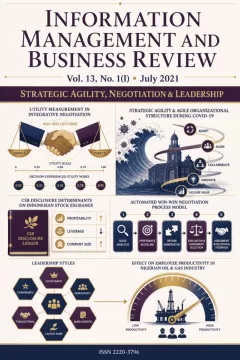 Vol. 13 No. 1(I) (2021)
Strategic Agility, Negotiation & Leadership
View issue contents
Published
Submissions
Have research to publish? Information Management and Business Review welcomes submissions.
Make a Submission