Abstract
The purpose of this study is to analyze the relationship among Person Organization Fit (POF), Organizational Commitment (OC) and Knowledge Sharing Attitude (KSA). The paper develops a conceptual frame based on a theory and literature review. A quantitative approach has been used to measure the level of POF and OC as well as to explore the relationship of these variables with KSA & with each other by using a sample of 315 academic managers of public sector institutions of higher education. POF has a positive relationship with OC and KSA. A positive relationship also exists between OC and KSA. It would be an effective contribution in the existing body of knowledge. Managers and other stakeholders may be helped to recognize the significance of POF, OC and KSA as well as their relationship with each other for ensuring selection of employee’s best fitted in the organization and for creating and maintaining a conducive environment for improving organizational commitment and knowledge sharing of the employees which will ultimately result in enhanced efficacy and effectiveness of the organization.
Keywords
- Person Organization Fit Search this journal for Person Organization Fit (opens in a new tab)
- Organizational Commitment Search this journal for Organizational Commitment (opens in a new tab)
- Knowledge Sharing Attitude Search this journal for Knowledge Sharing Attitude (opens in a new tab)
- Public Sector Higher Education Institutions of Pakistan Search this journal for Public Sector Higher Education Institutions of Pakistan (opens in a new tab)
References
- Anand, N., Gardner, H. K, & Morris, T. (2007). Knowledge-based Innovation: Emergence and Embedding of New Practice Areas in Management Consulting Firms. Academy of Management Journal , 50, 406– 428.
- Bartol, K. M. & Srivastava, A. (2002). Encouraging Knowledge Sharing: The Role of Organizational Reward Systems. Journal of Leadership and Organization Studies, 9, 64–76.
- Becerra-Fernandez, I. & Sabherwal, R. (2001).Organizational Knowledge Management: A Contingency Perspective. Journal of Management Information Systems, 18, 23–55.
- Billsberry, J., Ambrosini, P. J. G., Marsh, J., Moss, J. & Meurs, N. (2005). Towards a Composite Map of Organizational Person–Environment Fit, Paper presented at the British Academy of Management.
- Brown, A. L., Zimmerman, R. D. & Johnson, E. C. (2005). Consequences of individuals’ fit at work: A metaanalysis of person–job, person–organization, person–group, and person–supervisor fit. Personnel Psychology , 58, 281–342.
- Cable, D. M. & DeRue, D. S. (2002). The convergent and discriminant validity of subjective fit perceptions: Journal of Applied Psychology 87, 875-884.
- Chen, J., Silverthorne, C. & Hung, Y. (2006).Organization communication, job stress, organizational commitment, and job performance of accounting professionals in Taiwan and America: Leadership & Organization Development Journal , 27(4), 242-249.
- Chernyshenko, O. S., Stark, S. & Williams, A. (2009). Latent Trait Theory Approach to Measuring PersonOrganization Fit: Conceptual Rationale and Empirical Evaluation. International Journal of Testing , 9(4), 358–380.
- Coldwell, D., Billberry, J., Van Meurs, N. & Marsh, P. (2008). The effect of person organization fit on employee attraction and retention; towards a testable, explanatory model; workforce and retention study. Planning Institute of Australia (SA Division), 87-117.
- David. D. D., Andrews M. C. & Bucklew, N. S. (2010). Enhancing the ties that bind: mentoring as a moderator. Career Development International , 15(3), 259-278.
- Dyer, J. H. & Nobeoka, K. (2000). Creating and managing a high-performance knowledge-sharing network: the Toyota case. Strategic Management Journal , 21, 345-67.
- Guan, Y., Deng, H., Bond, H. M., Zhang, Z. & Hu, T. (2011).The Interplay between Social Cynicism Beliefs and Person–Organization Fit on Work-Related Attitudes among Chinese Employees: Journal of Applied Social Psychology , 41(1), 160–178.
- Han, T. Chiang, H. & Chang, A. (2010).Employee participation in decision-making, psychological ownership and knowledge sharing; mediating role of organizational commitment in Taiwanses high tech organizations: The International journal of Human Resource Management , 21(12), 2218–2233.
- Hoffman, B. J. & Woehr, D. J. (2006). A quantitative review of the relationship between person– organization fit and behavioral outcomes. Journal of Vocational Behavior, 68, 389–399.
- Jain, A. K., Giga, S. I., & Cooper, C. L. (2009). Employee wellbeing, control and organizational commitment. Leadership and Organization Development Journal , 30(3), 256-273.
- Khan, R. M., Ziauddin, M., Jam, F. A. & Ramay, M. I. (2010). The Impacts of Organizational Commitment on Employee Job Performance. European Journal of Social Sciences , 15(3), 292-298.
- Lok, P. & Crawford, J. (1999). The relationship between commitment and organizational culture, subculture, leadership style and job satisfaction in organizational change and development. Leadership & Organization Development Journal , 20(7), 365-373.
- Meyer, J. P. & Allen, N. J. (1997). Commitment in the Workplace: Theory, Research, and Application . Thousand Oaks, CA: Sage Publications.
- Muthusamy, V. (2009). Affective Commitment, Person–Organization Fit and Turnover Intention: Examining the effect of knowledge sharing. California Management Review , 76, 2230-2247.
- Salami, O. S. (2008). Demographic and Psychological Factors Predicting: Organizational Commitment among Industrial Workers Anthropologist , 10(1), 31-38.
- Sekiguchi, T. (2003). A contingency perspective on the importance of P-J fit and P-O fit in employee selection. Paper presented at the Annual Conference of Academy of Managemen t, Seattle, WA.
- Shore, L. M. Barksdale, K. & Shore, H. T. (1995). Managerial Perceptions of Employee Commitment to Organization. Academy of Management Journal , 38, 1593-1615
- Uygur, A. & Kilic, G. (2009). A Study into Organizational Commitment and Job Involvement: An Application towards the Personnel in the Central Organization for Ministry of Health in Turkey. Ozean Journal of Applied Sciences , 2(1), 113-125.
- Van Vianen, A. E. M. (2000). Person–organization fit: The match between newcomers’ and recruiters’ preferences for organizational cultures. Personnel Psychology , 53 , 113–149.
- Verquer, M. L., Beehr, T. A., & Wagner, S. H. (2003). A meta-analysis of relations between person– organization fit and work attitudes: Journal of Vocational Behavior, 63, 473– 489.
- Wheeler, A. R., Gallagher, V. C. Brouer, R. L. & Sablynski, C. J. (2007). When person–organization (mis)fit and (dis)satisfaction lead to turnover: The moderating role of perceived job mobility. Journal of Managerial Psychology , 22(2), 203–219.
- Yaniv, E. & Farkas, F. (2005). The Impact of Person-Organization Fit on the Corporate Brand Perception of Employees and of Customers: Journal of Change Management, 5(4), 447–461.
- Yousef, A. D. (1998). Satisfaction with job security as a predictor of organizational commitment and job performance in a multicultural environment: International Journal of Manpower, 19(3), 184-194.
Downloads
No downloads have been recorded for this article yet. Figures appear here once readers begin downloading the full text.
How to Cite
Share this article
License
Copyright (c) 2011 Wajid A. Saleem, Ghazanfar Adnan, Munazza Ambreen (Author)

This work is licensed under a Creative Commons Attribution 4.0 International License.
Author (s) should affirm that the material has not been published previously. It has not been submitted and it is not under consideration by any other journal. At the same time author (s) need to execute a publication permission agreement to assume the responsibility of the submitted content and any omissions and errors therein. After submission of revised paper in the light of suggestions of the reviewers, the editorial team edits and formats manuscripts to bring uniformity and standardization in published material.
This work will be licensed under Creative Commons Attribution 4.0 International (CC BY 4.0) and under condition of the license, users are free to read, copy, remix, transform, redistribute, download, print, search or link to the full texts of articles and even build upon their work as long as they credit the author for the original work. Moreover, as per journal policy author (s) hold and retain copyrights without any restrictions.
Keywords
- Person Organization Fit Search this journal for Person Organization Fit (opens in a new tab)
- Organizational Commitment Search this journal for Organizational Commitment (opens in a new tab)
- Knowledge Sharing Attitude Search this journal for Knowledge Sharing Attitude (opens in a new tab)
- Public Sector Higher Education Institutions of Pakistan Search this journal for Public Sector Higher Education Institutions of Pakistan (opens in a new tab)
Section
Published in
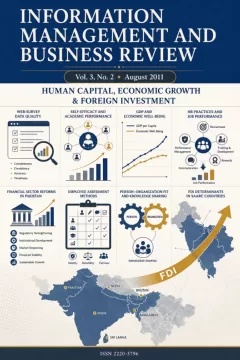 Vol. 3 No. 2 (2011)
Human Capital, Economic Growth & Foreign Investment
View issue contents
Published
Submissions
Have research to publish? Information Management and Business Review welcomes submissions.
Make a Submission