Abstract
The deplorable condition of energy supply and distribution, generally called vitality neediness has been distinguished as one noteworthy failure militating against the satisfaction of Nigeria's objective of achieving financial improvement. The objectives of this study are to identify the challenges that limit the development and accentuate the stagnancy and near decline in Nigeria's energy sector. AmartyaSen's Capability approach was the theory that provided the framework for the study. The comfort examining the system, the purposive inspecting procedure and the arbitrary determination method were utilized. The purposive examining strategy was utilized to choose five (5) respondents from the best administration staff of the power segment for the inside and out meetings, while the random sampling technique was utilized in selecting discussants for the Focus Group Discussions. Findings revealed that that the pervading challenges that impede the development of the electricity sector in the country are the insufficient financial capacity to purchase huge power generating sets or maintain the existing ones, the commercial unavailability of the electricity sector that renders it unattractive to prospective investors, consumers' unwillingness to pay for electricity units at cost-reflective prices. In conclusion, the findings of this research indicate that energy poverty possesses an adverse effect on both the individual and economic well-being of the nation. The study recommends that more funding, both from private individuals and government is required to enhance electricity generation, transmission and distribution in the country. It also recommends a revitalization of the country's electricity sector, to make it more commercially viable and attractive to an investor.
Keywords
- Energy Poverty Search this journal for Energy Poverty (opens in a new tab)
- Capability Theory Search this journal for Capability Theory (opens in a new tab)
- Purposive Sampling Technique Search this journal for Purposive Sampling Technique (opens in a new tab)
- Electricity Search this journal for Electricity (opens in a new tab)
- Power Search this journal for Power (opens in a new tab)
- Energy Search this journal for Energy (opens in a new tab)
- Indepth Interviews Search this journal for Indepth Interviews (opens in a new tab)
References
- Andadari, R. K., Mulder, P. & Reitveld, P. (2014). Energy Poverty Reduction by Fuel Switching. Impact Evaluation of the LPG Conversion Program in Indonesia. Energy Policy, 66(1), 436–449.
- Awolusi, O. D. & Atiku, O. S. (2019). Business Process Re-Engineering and Profitability in the Nigerian Oil and Gas Industry: The Mediating Influence of Operational Performance, Information Management and Business Review, 11(3), 13-26.
- Awolusi, O. D. (2021). Economic Growth and Socioeconomic Sustainability in BRICS Countries: A Vector Error Correction Modeling Approach, Journal of Economics and Behavioral Studies, 13(3), 1-23.
- Awolusi, O. D., Pelser, T. G. & Adelekan, A. S. (2016). Determinants of Foreign Direct Investment: New Granger Causality Evidence from Asian and African Economies, Journal of Economics and Behavioral Studies, 8(1), 104-119.
- Awosusi, O. O. & Awolusi, O. D. (2014). Technology Transfer, Foreign Direct Investment and Economic Growth in Nigeria, AfricaDevelopment, 39(2), 1–20.
- Day, R., Walker, G. & Simcock, N. (2016). Conceptualizing Energy Use and Energy Poverty using a Capabilities Framework. Energy Policy, 93(1), 255–264.
- DECC (Department for Energy and Climate Change Report). (2015). DECC, London.
- Eleri, E., Ogwu, O. & Onuvae, P. (2012). Expanding Access to Pro-Poor Energy Service in Nigeria.
- Fahmy, E. (2011). The definition and measurement of fuel poverty. A briefing paper to inform consumer focus’s submission to the Hills fuel poverty review, University of Bristol.
- González-Eguino, M. (2015). Energy Poverty: An Overview. Renew. Sustain. Energy Rev, 47(1), 377–385.
- Heindl, P. (2015). Measuring fuel poverty: general considerations and application to German household data. Finanz: Public Finance. Anal, 7(1), 178–215.
- ICEED. (2010). Low Carbon Jobs in an Interconnected World, www.iceednigeria.org
- IEA, UNDP and UNIDO. (2010). Energy Poverty. How to make Modern Energy Access Universal? Special Early Excerpt of the World Energy Outlook for the UN General Assembly on the Millennium Development Goals, International Energy Agency, Paris.
- IEA (International Energy Agency). (2011). Energy Poverty: The Missing Millennium Development Goal? Paris: International Energy Agency.
- Jean, P. H. & Marc, D. F. (2007). From a Forced Dependency to Positive Co-operation in the Field of Energy; WEC Energy Future in an Interdependent World.
- Krizanic, F. (2007). The European market of Electricity and Natural Gas. EIB forum, Ljubljana
- Lefkothea, P. & Dimitris, K. (2018). A Stochastic Model for Energy Poverty Analysis. Energy Policy, 153–164.
- Legendre, B. & Ricci, O. (2015). Measuring fuel poverty in France: which households are the most fuel vulnerable? Energy Econ, 49(1), 620–628.
- Mbisiogu, F. (2013). EXPOSED: OBJ spent N1.6trillion on power! [Online] Nigeria Standard Newspaper Available at: http://nigeriastandardnewspaper.com/ng/exposed-obj-spent-n1-6trillion-on-power/
- UNDP NBS-CBN-NCC. Collaborative Survey (2011) Annual Socio-Economic Survey Report.
- Nussabaumer, P., Bazilian, M. & Modi, V. (2012). Measuring energy poverty: focusing on what matters. Renew. Sustain. Energy Rev, 16(1), 231–243.
- Odoko, F. O. (2003). The Pricing of Crude oil and refined products in the Nigerian Economy: In CBN's Contemporary Economic Policy Issues in Nigeria.
- Odunlami, S. A., Awosusi, O. O. & AwolusiI, O. D. (2017). The Influence of Leadership Styles on Employees’ Performance: A study of Selected Private Universities in Ogun State, Nigeria, Global Journal of Commerce and Management Perspective, 6(2), 5-13.
- Oladejo, M. J. & Awolusi, O. D. (2017). Effect of Work-Family Role Conflicts on Employees’ Commitment and Organisational Performance: A study of AKLAD Interlink concept, Nigeria, Global Journal of Commerce and Management Perspective, 7(2), 81-96.
- Olayisade, A. & Awolusi, O. D. (2021). The Effect of Leadership Styles on Employee's Productivity in the Nigerian Oil and Gas Industry, Information Management and Business Review, 13(1), 47-64.
- Pachauri, S. (2012). Energy Access for Development. The Global Energy Assessment: Toward a More Sustainable Future, IIASA, Laxenburg, Austria and Cambridge University Press, Cambridge, UK and New York, USA.
- Pereira, M. G., Freitas, M. A. V. & Da Silva, N. F. (2011). The Challenge of Energy Poverty: Brazilian Case Study. Energy Policy, 39(1), 167–175.
- Sadath, C. A. & Acharya, H. R. (2017). Assessing the Extent and Intensity of Energy Poverty using Multidimensional Energy Poverty Index: Empirical Evidence from Households in India. Energy Policy, 102(1), 540-548. www.elsevier.com/locate/enpol
- Sanusi, A. & Owoyele, S. G. (2016). Energy Poverty and its Spatial Differences in Nigeria: Reversing the Trend. Africa-E.U Renewable Energy Research and Innovation Symposium. Tlemcen, Algeria.
- Schuessler, R. (2014). Energy poverty indicators: conceptual issues - Part I: the ten-per-cent-rule and double median/mean indicators. SSRN Electron. J. http://www.ssrn.com/abstract=2459404〉.).
- Sen, A. (2014). Global Warming is just one of many Environmental Threats that demand our attention. New Republic, 〈 http://www.newrepublic.com/article/118969/environmentalists-obsess-about-globalwarming-ignore-poor-countries〉
- Sher, F., Abbas, A. & Awan, R. U. (2014). An Investigation of Multidimensional Energy Poverty in Pakistan: A Province Level Analysis, International J. Energy Economics and Policy, 4(1), 65-75.
- Sissoko, M. (2012). Corruption stalls Nigeria‘s Economic Growth – UN. 2013 International Anti-Corruption Day in Abuja. [Online] The Sun Newspaper, Available at: http://sunnewsonline.com/new/?p=45692
- Sovacool, B. K. (2013). Confronting Energy Poverty behind the Bamboo Curtain: A Review of Challenges and Solutions for Myanmar (Burma). Energy Sustain. Dev, 17(1), 305–314.
- Szakonyi, D. & Urpelainen, J. (2015). Energy Poverty among Urban Street Vendors in India: Evidence from Patna, Bihar. Energy Sustain. Dev, 24(1), 44–49.
- Tang, X. & Liao, H. (2014). Energy Poverty and Solid Fuels use in Rural China: Analysis Based on National Population Census. Energy Sustain. Dev, 23(1), 122–129.
- UNDP (United Nations Development Programme). (2010). Energy for Sustainable Future. United Nations Development Program New York, USA.
- Wang, Wang. & Wei, K. (2015). Energy Poverty in China: An Index-Based Comprehensive Evaluation. Renew. Sustain. Energy Rev, 47(1), 308–323.
- World Bank. (2016). World Development Indicators: Power Outages in Firms in a Typical Month. www.data.worldbank.org/indicator/IC.ELC.OUTG
Downloads
No downloads have been recorded for this article yet. Figures appear here once readers begin downloading the full text.
How to Cite
Share this article
License
Copyright (c) 2021 Aladejuyigbe Oluwafemi, Olawumi Dele Awolusi (Author)

This work is licensed under a Creative Commons Attribution 4.0 International License.
Author (s) should affirm that the material has not been published previously. It has not been submitted and it is not under consideration by any other journal. At the same time author (s) need to execute a publication permission agreement to assume the responsibility of the submitted content and any omissions and errors therein. After submission of revised paper in the light of suggestions of the reviewers, the editorial team edits and formats manuscripts to bring uniformity and standardization in published material.
This work will be licensed under Creative Commons Attribution 4.0 International (CC BY 4.0) and under condition of the license, users are free to read, copy, remix, transform, redistribute, download, print, search or link to the full texts of articles and even build upon their work as long as they credit the author for the original work. Moreover, as per journal policy author (s) hold and retain copyrights without any restrictions.
Keywords
- Energy Poverty Search this journal for Energy Poverty (opens in a new tab)
- Capability Theory Search this journal for Capability Theory (opens in a new tab)
- Purposive Sampling Technique Search this journal for Purposive Sampling Technique (opens in a new tab)
- Electricity Search this journal for Electricity (opens in a new tab)
- Power Search this journal for Power (opens in a new tab)
- Energy Search this journal for Energy (opens in a new tab)
- Indepth Interviews Search this journal for Indepth Interviews (opens in a new tab)
Section
Published in
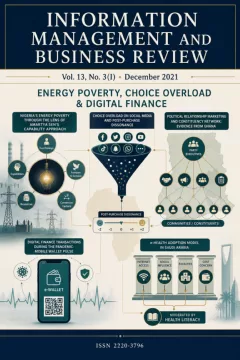 Vol. 13 No. 3(I) (2021)
Energy Poverty, Choice Overload & Digital Finance
View issue contents
Published
Submissions
Have research to publish? Information Management and Business Review welcomes submissions.
Make a Submission