Abstract
Social media tools have emerged as an imperative source of information for customers. However, the relationship between information volume on social media and consumer choice quality remains blurred in literature. The study sought to examine the relationship between choice overload on social media and product choice quality, and how choice quality influences post-purchase dissonance. The study employed a positivist research paradigm and an explanatory design to examine the relationship between the various constructs. Using a purposive sampling method, Responses from 249 respondents were quantitatively analyzed. Structural equation modeling (SEM) was utilized. The outcome revealed a direct significant effect of choice overload on poor choice quality and a strong positive association between choice quality and postpurchase dissonance using social media tools. The distinctiveness of the study adds to the existing literature by extending the current understanding of post-purchase dissonance and consumer behaviour in general.
Keywords
- Social Media Search this journal for Social Media (opens in a new tab)
- Choice Search this journal for Choice (opens in a new tab)
- Post-Purchase Dissonance Search this journal for Post-Purchase Dissonance (opens in a new tab)
- Choice Deficiency Search this journal for Choice Deficiency (opens in a new tab)
- Poor Choice Quality Search this journal for Poor Choice Quality (opens in a new tab)
References
- Agarwal, N. & Yiliyasi, Y. (2010, November). Information quality challenges in social media. In ICIQ.
- Agresta, S. & Bough, B. B. (2010). Perspectives on social media marketing. Nelson Education.
- Ainin, S., Parveen, F., Moghavvemi, S., Jaafar, N. I. & Shuib, N. L. M. (2015). Factors influencing the use of social media by SMEs and its performance outcomes. Industrial Management & Data Systems.
- Alalwan, A. A., Rana, N. P., Dwivedi, Y. K. & Algharabat, R. (2017). Social media in marketing: A review and analysis of the existing literature. Telematics and Informatics, 34(7), 1177-1190.
- Ala-Mutka, K., Broster, D., Cachia, R., Centeno, C., Feijóo, C., Haché, A. & Punie, E. Y. (2009). The Impact of Social Computing on the EU Information Society and Economy (2009). European Commission Joint Research Centre Institute for Prospective Technological Studies: Seville (Spain).
- Almeida-Santana, A. & Moreno-Gil, S. (2017). New trends in information search and their influence on destination loyalty: Digital destinations and relationship marketing. Journal of destination marketing & management, 6(2), 150-161.
- Baeza-Yates, R. (2009, April). User-generated content: how good is it? In Proceedings of the 3rd workshop on Information Credibility on the web (pp. 1-2).
- Barger, V., Peltier, J. W. & Schultz, D. E. (2016). Social media and consumer engagement: a review and research agenda. Journal of Research in Interactive Marketing.
- Beldad, A., De Jong, M. & Steehouder, M. (2010). How shall I trust the faceless and the intangible? A literature review on the antecedents of online trust. Computers in human behavior, 26(5), 857- 869.
- Bontcheva, K., Gorrell, G. & Wessels, B. (2013). Social media and information overload: Survey results. arXiv preprint arXiv:1306.0813.
- Botha, E., Farshid, M. & Pitt, L. (2011). How sociable? An exploratory study of university brand visibility in social media. South African Journal of Business Management, 42(2), 43-51.
- Creswell, J. W. (2014). Qualitative, quantitative and mixed methods approach. Sage.
- Cronbach, L. J. (1951). Coefficient alpha and the internal structure of tests. Psychometrika, 16(3), 297-334.
- Dankwah, J. B. & Mensah, K. (2021). Political marketing and social media influence on young voters in Ghana. SN Social Sciences, 1(6), 1-19.
- Del Hawkins, I. & L Mothersbaugh, D. (2010). Consumer Behaviour Building Marketing Strategy.
- Dessart, L., Veloutsou, C. & Morgan-Thomas, A. (2015). Consumer engagement in online brand communities: a social media perspective. Journal of Product & Brand Management.
- Duffett, R. G. (2015). Facebook advertising’s influence on intention-to-purchase and purchase amongst Millennials. Internet Research.
- Engel, J. F., Kollat, D. T. & Blackwell, R. D. (1978). Consumer behavior, 3rd ed. Hinsdale, IL: Dryden
- Eşkisu, M., Hoşoğlu, R. & Rasmussen, K. (2017). An investigation of the relationship between Facebook usage, Big Five, self-esteem and narcissism. Computers in Human Behavior, 69, 294-301.
- Fornell, C. & Larcker, D. F. (1981). Structural equation models with unobservable variables and measurement error: Algebra and statistics.
- Gao, H., Tate, M., Zhang, H., Chen, S. & Liang, B. (2018). Social media ties strategy in international branding: An application of resource-based theory. Journal of International Marketing, 26(3), 45-69.
- Ge, M. & Helfert, M. (2007). A review of information quality research—develop a research agenda. In Paper presented at the International Conference on Information Quality 2007.
- Gensler, S., Völckner, F., Liu-Thompkins, Y. & Wiertz, C. (2013). Managing brands in the social media environment. Journal of interactive marketing, 27(4), 242-256.
- Hajli, N. (2018). Ethical environment in the online communities by information credibility: a social media perspective. Journal of Business Ethics, 149(4), 799-810.
- Hamade, S. N. (2013). Perception and use of social networking sites among university students. Library Review.
- Hamilton, M., Kaltcheva, V. D. & Rohm, A. J. (2016). Social media and value creation: the role of interaction satisfaction and interaction immersion. Journal of Interactive Marketing, 36, 121-133.
- Hinojosa, A. S., Gardner, W. L., Walker, H. J., Cogliser, C. & Gullifor, D. (2017). A review of cognitive dissonance theory in management research: Opportunities for further development. Journal of Management, 43(1), 170-199.
- Kaiser, H. F. (1970). A second generation little jiffy. Psychometrika, 35(4), 401-415.
- Kaplan, A. M. & Haenlein, M. (2010). Users of the world, unite! The challenges and opportunities of Social Media. Business Horizons, 53(1), 59-68.
- Karanatsiou, D., Misirlis, N. & Vlachopoulou, M. (2017). Bibliometrics and altmetrics literature review: Performance indicators and comparison analysis. Performance Measurement and Metrics.
- Kardes, F. R., Cline, T. W. & Cronley, M. L. (2011). Consumer behaviour: Science and practice.
- Kietzmann, J. H., Hermkens, K., McCarthy, I. P. & Silvestre, B. S. (2011). Social media? Get serious! Understanding the functional building blocks of social media. Business Horizons, 54(3), 241-251.
- Knoll, J. (2016). Advertising in social media: a review of empirical evidence. International Journal of Advertising, 35(2), 266-300.
- Kumar, v. & Singh, n. (2019). Post-purchase experience of consumers in life insurance policies: an empirical study. Skyline business journal, 14(2).
- Kushwaha, B. P. (2020). Implementing Sustainable Marketing through Integration of Employees, Customers and Technology. PalArch's Journal of Archaeology of Egypt/Egyptology, 17(6), 2089-2099.
- Lamberton, C. & Stephen, A. T. (2016). A thematic exploration of digital, social media, and mobile marketing: Research evolution from 2000 to 2015 and an agenda for future inquiry. Journal of Marketing, 80(6), 146-172.
- Lee, J. & Hong, I. B. (2016). Predicting positive user responses to social media advertising: The roles of emotional appeal, informativeness, and creativity. International Journal of Information Management, 36(3), 360-373.
- Li, F., Larimo, J. & Leonidou, L. C. (2021). Social media marketing strategy: definition, conceptualization, taxonomy, validation, and future agenda. Journal of the Academy of Marketing Science, 49(1), 51-70.
- Li, M. & Choudhury, A. H. (2021). Using website information to reduce post-purchase dissonance: A mediated moderating role of perceived risk. Psychology & Marketing, 38(1), 5669.
- Liang, T. P. & Lai, H. J. (2002). Effect of store design on consumer purchases: an empirical study of online bookstores. Information & management, 39(6), 431-444.
- Liao, T. H. & Keng, C. J. (2013). Online shopping delivery delay: Finding a psychological recovery strategy by online consumer experiences. Computers in Human Behaviour, 29(4), 1849-1861.
- Malhotra, N. K. & Birks, D. (2007). Marketing Research, an Applied Approach, European Edition.
- Mangold, W. G. & Faulds, D. J. (2009). Social media: The new hybrid element of the promotion mix. Business Horizons, 52(4), 357-365.
- McCann, M. & Barlow, A. (2015). Use and measurement of social media for SMEs. Journal of small business and enterprise development.
- Muzondo, N. (2016). Modelling consumer behaviour conceptually through the seven Ps of marketing: A revised theoretical generic consumer stimulus-response model.
- NGUYEN, V. & BANG, J. (2019). E-tailing & brand communication in facebook: Comparing Germans and Koreans. The Journal of Distribution Science, 17(8), 99-106.
- Odoom, R., Anning-Dorson, T. & Acheampong, G. (2017). Antecedents of social media usage and performance benefits in small-and-medium-sized enterprises (SMEs). Journal of Enterprise Information Management.
- Odoom, R., Anning-Dorson, T. & Acheampong, G. (2017). Antecedents of social media usage and performance benefits in small-and-medium-sized enterprises (SMEs). Journal of Enterprise Information Management.
- Osei, B. A. & Abenyin, A. N. (2016). Applying the Engell–Kollat–Blackwell model in understanding international tourists’ use of social media for travel decisions to Ghana. Information Technology & Tourism, 16(3), 265-284.
- Powers, T. L. & Jack, E. P. (2015). Understanding the causes of retail product returns. International Journal of Retail & Distribution Management.
- Saxena, A. & Khanna, U. (2013). Advertising on social network sites: A structural equation modelling approach. Vision, 17(1), 17-25.
- Sinclaire, J. K. & Vogus, C. E. (2011). Adoption of social networking sites: an exploratory adaptive structuration perspective for global organizations. Information Technology and Management, 12(4), 293-314.
- Singh, S. & Sonnenburg, S. (2012). Brand performances in social media. Journal of interactive marketing, 26(4), 189-197.
- Sweeney, J. C., Hausknecht, D. & Soutar, G. N. (2000). Cognitive dissonance after purchase: A multidimensional scale. Psychology & Marketing, 17(5), 369-385.
- Taylor, D. G., Lewin, J. E. & Strutton, D. (2011). Friends, fans, and followers: do ads work on social networks: how gender and age shape receptivity. Journal of advertising research, 51(1), 258-275.
- Toffler, A. (1984). Previews and premises. Black Rose Books Limited.
- Van Osch, W. & Coursaris, C. K. (2013, January). Organizational social media: A comprehensive framework and research agenda. In 2013 46th Hawaii International Conference on System Sciences (pp. 700-707). IEEE.
- Voramontri, D. & Klieb, L. (2019). Impact of social media on consumer behaviour. International Journal of Information and Decision Sciences, 11(3), 209-233.
- Whiting, A. & Williams, D. (2013). Why people use social media: a uses and gratifications approach. Qualitative market research: an international journal.
- Xu, A., Liu, Z., Guo, Y., Sinha, V. & Akkiraju, R. (2017, May). A new Chabot for customer service on social media. In Proceedings of the 2017 CHI conference on human factors in computing systems, 3506-3510.
- Zeelenberg, M. & Pieters, R. (2004). Beyond valence in customer dissatisfaction: A review and new findings on behavioural responses to regret and disappointment in failed services. Journal of Business Research, 57(4), 445-455.
- Zeng, B. & Gerritsen, R. (2014). What do we know about social media in tourism? A review. Tourism management perspectives, 10, 27-36.
- Zhou, L., Zhang, D., Yang, C. C. & Wang, Y. (2018). Harnessing social media for health information management. Electronic commerce research and applications, 27, 139-151.
Downloads
No downloads have been recorded for this article yet. Figures appear here once readers begin downloading the full text.
How to Cite
Share this article
License
Copyright (c) 2021 Kobby Mensah, Justice Boateng Dankwah, Gilbert Kofi Mensah, Judith Aku Masope-Crabbe (Author)

This work is licensed under a Creative Commons Attribution 4.0 International License.
Author (s) should affirm that the material has not been published previously. It has not been submitted and it is not under consideration by any other journal. At the same time author (s) need to execute a publication permission agreement to assume the responsibility of the submitted content and any omissions and errors therein. After submission of revised paper in the light of suggestions of the reviewers, the editorial team edits and formats manuscripts to bring uniformity and standardization in published material.
This work will be licensed under Creative Commons Attribution 4.0 International (CC BY 4.0) and under condition of the license, users are free to read, copy, remix, transform, redistribute, download, print, search or link to the full texts of articles and even build upon their work as long as they credit the author for the original work. Moreover, as per journal policy author (s) hold and retain copyrights without any restrictions.
Keywords
- Social Media Search this journal for Social Media (opens in a new tab)
- Choice Search this journal for Choice (opens in a new tab)
- Post-Purchase Dissonance Search this journal for Post-Purchase Dissonance (opens in a new tab)
- Choice Deficiency Search this journal for Choice Deficiency (opens in a new tab)
- Poor Choice Quality Search this journal for Poor Choice Quality (opens in a new tab)
Section
Published in
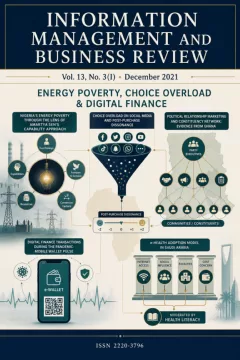 Vol. 13 No. 3(I) (2021)
Energy Poverty, Choice Overload & Digital Finance
View issue contents
Published
Submissions
Have research to publish? Information Management and Business Review welcomes submissions.
Make a Submission