Abstract
This study aimed to examine the role of internet access, social influence, facility access, and cost concerns on E-health adoption in Saudi Arabia with moderating role of E-health literacy. Saudi citizens were the targeted population of this study. To fulfill the objectives of this study, quantitative research methods with a cross-sectional technique were applied. A self-administrative survey was employed with a questionnaire to collect the data. This study used the purposive sampling method for the collection. Structure equation modeling was applied by using Smart PLS 3 to analyze the data. The findings of the current study show that internet access, social influence, and facility access have significant and positive effects on E-health adoption. Cost concerns have a significant and negative influence on the Adoption of E-Health Management services. Results revealed that E-health literacy has a significant and positive moderating role in the association of internet access, facility access, and cost concerns on E-health adoption. Results of this study contribute to the body of literature by finding that internet access, social influence, facility access, and cost concerns have a significant effect on the Adoption of E-Health Management services and E-health literacy is essential to improve the Adoption of E-Health Management services.
Keywords
- E-Health Adoption Search this journal for E-Health Adoption (opens in a new tab)
- E-Health Literacy Search this journal for E-Health Literacy (opens in a new tab)
- Internet Access Search this journal for Internet Access (opens in a new tab)
- Social Influence Search this journal for Social Influence (opens in a new tab)
- Facilities Access Search this journal for Facilities Access (opens in a new tab)
- Cost Concerns Search this journal for Cost Concerns (opens in a new tab)
References
- Abraham, C. & Sheeran, P. (2015). The health belief model. Predicting health behavior: Research and practice with social cognition models, 2, 30-55.
- Ahadzadeh, A. S., Sharif, S. P., Ong, F. S. & Khong, K. W. (2015). Integrating health belief model and technology acceptance model: an investigation of health-related internet use. Journal of medical Internet research, 17(2), e3564.
- Ahmad Sabir, S., Mohammad, H. & Kadir Shahar, H. (2019). The role of overconfidence and past investment experience in herding behavior with a moderating effect of financial literacy: evidence from Pakistan stock exchange. Asian Economic and Financial Review, 9(4), 480-490.
- Ahuja, V. & Khazanchi, D. (2016). Creation of a conceptual model for adoption of mobile apps for shopping from e-commerce sites–An Indian context. Procedia Computer Science, 91, 609-616.
- Ajzen, I. (1991). The theory of planned behavior. Organizational behavior and human decision processes, 50(2), 179-211.
- Ajzen, I. (2020). The theory of planned behavior: Frequently asked questions. Human Behavior and Emerging Technologies, 2(4), 314-324.
- Al-Azzam, M. & Alazzam, M. B. (2019). Smart city and smart-health framework, challenges and opportunities. Int. J. Adv. Comput. Sci. Appl, 10(2), 171-176.
- Al-Azzam, M. K., Alazzam, M. B. & Al-Manasra, M. K. (2019). MHealth for decision-making support: A case study of EHealth in the public sector. International Journal of Advanced Computer Science and Applications, 10(5), 381-387.
- Al-Khowaiter, W. A., Dwivedi, Y. K. & Williams, M. D. (2015). Examining the role of social influence, usefulness and ease of use for determining the mandatory use of a human resource information system in the context of Saudi Ministries. International Journal of Electronic Government Research (IJEGR), 11(3), 24-42.
- Alaiad, A., Alsharo, M. & Alnsour, Y. (2019). The determinants of m-health adoption in developing countries: An empirical investigation. Applied clinical informatics, 10(05), 820-840.
- Alhuwail, D. & Abdulsalam, Y. (2019). Assessing electronic health literacy in the state of Kuwait: Survey of internet users from an Arab state. Journal of medical Internet research, 21(5), e11174.
- Alsahafi, Y. A., Gay, V. & Khwaji, A. A. (2020). Factors affecting the acceptance of integrated electronic personal health records in Saudi Arabia: The impact of e-health literacy. Health Information Management Journal, 1833358320964899.
- Asada, A., Basheerb, M. F., Irfanc, M., Jiangd, J. & Tahir, R. (2020). Open-Innovation and Knowledge Management in Small and Medium-Sized Enterprises (SMEs): The role of External Knowledge and Internal Innovation. Revista Argentina de Clínica Psicológica, 29(4), 80-90.
- Ashraf, B. N. (2020). Stock markets’ reaction to COVID-19: Cases or fatalities? Research in International Business and Finance, 54, 101249.
- Aydin, S., Özer, G. & Arasil, Ö. (2005). Customer loyalty and the effect of switching costs as a moderator variable: A case in the Turkish mobile phone market. Marketing intelligence & planning.
- Aziz, R., Zulkifli, F. Y. & Rahardjo, E. T. (2016). Dual-arm modified-spiral textile antenna for wearable medical communication applications. Paper presented at the 2016 International Conference on Electromagnetics in Advanced Applications (ICEAA).
- Basheer, M., Siam, M., Awn, A. & Hassan, S. (2019). Exploring the role of TQM and supply chain practices for firm supply performance in the presence of information technology capabilities and supply chain technology adoption: A case of textile firms in Pakistan. Uncertain Supply Chain Management, 7(2), 275-288.
- Basheer, M. F., Hameed, W. U., Sabir, S. A. & Jehangir, M. S. (2019). Islamic Business Ethics and Islamic Banks Performance in Malaysia: Does Sincerity Matter? Hamdard Islamicus, 42(4), 225-241.
- Basheer, M. F., Raoof, R., Jabeen, S. & Hassan, S. G. (2021). Exploring the Nexus Among the Business Coping Strategy: Entrepreneurial Orientation and Crisis Readiness–A Post-COVID-19 Analysis of Pakistani SMEs Handbook of Research on Entrepreneurship, Innovation, Sustainability, and ICTs in the PostCOVID-19 Era (pp. 317-340): IGI Global.
- Bautista Jr, R., Jeong, L. S. & Pandey, S. (2020). Will Cause-Related Marketing Affect the American and Filipino College Students' Purchase Intention? Asia-Pacific Social Science Review, 20(4).
- Bhattacherjee, A., Davis, C. J., Connolly, A. J. & Hikmet, N. (2018). User response to mandatory IT use: A coping theory perspective. European Journal of Information Systems, 27(4), 395-414.
- Bol, N., Helberger, N. & Weert, J. C. (2018). Differences in mobile health app use: a source of new digital inequalities? The Information Society, 34(3), 183-193.
- Boland, D. H., Juntunen, C. L., Kim, H. Y., Adams, E. M. & Navarro, R. L. (2019). Integrated behavioral health curriculum in counseling psychology training programs. The Counseling Psychologist, 47(7), 1012-1036.
- Boontarig, W., Chutimaskul, W., Chongsuphajaisiddhi, V. & Papasratorn, B. (2012). Factors influencing the Thai elderly intention to use smartphone for e-Health services. Paper presented at the 2012 IEEE symposium on humanities, science and engineering research.
- Bossuyt, P., Pouillon, L., Bonnaud, G., Danese, S. & Peyrin-Biroulet, L. (2017). E-health in inflammatory bowel diseases: more challenges than opportunities? Digestive and Liver Disease, 49(12), 1320-1326.
- Briones, R. (2015). Harnessing the web: how e-Health and e-Health literacy impact young adults’ perceptions of online health information. Medicine, 2.0, 4(2).
- Burnham, T. A., Frels, J. K. & Mahajan, V. (2003). Consumer switching costs: a typology, antecedents, and consequences. Journal of the Academy of Marketing Science, 31(2), 109-126.
- Cajita, M. I., Hodgson, N. A., Lam, K. W., Yoo, S. & Han, H. R. (2018). Facilitators of and barriers to mHealth adoption in older adults with heart failure. Computers, informatics, nursing: CIN, 36(8), 376.
- Cheong, J. H. & Park, M. C. (2005). Mobile internet acceptance in Korea. Internet research.
- Chong, A. Y. L., Chan, F. T. & Ooi, K. B. (2012). Predicting consumer decisions to adopt mobile commerce: Cross country empirical examination between China and Malaysia. Decision support systems, 53(1), 34-43.
- Ciranka, S. & van den Bos, W. (2021). Adolescent risk-taking in the context of exploration and social influence. Developmental Review, 61, 100979.
- Coşkun, S. & Bebiş, H. (2015). Psychometric evaluation of a Turkısh version of the e-health literacy scale (eheals) in adolescents. , 57(4), 378.
- Dahleez, K. A., Bader, I. & Aboramadan, M. (2020). E-health system characteristics, medical performance and healthcare quality at UNRWA-Palestine health centers. Journal of Enterprise Information Management.
- Dashti, S., Peyman, N., Tajfard, M. & Esmaeeli, H. (2017). E-Health literacy of medical and health sciences university students in Mashhad, Iran in 2016: a pilot study. Electronic physician, 9(3), 3966.
- Domínguez-Mayo, F. J., Escalona, M., Mejías, M., Aragón, G., García-García, J. A., Torres, J. & Enríquez, J. (2015). A strategic study about quality characteristics in e-health systems based on a systematic literature review. The Scientific World Journal, 2015.
- Du, S., Liu, W., Cai, S., Hu, Y. & Dong, J. (2020). The efficacy of e-health in the self-management of chronic low back pain: A meta-analysis. International journal of nursing studies, 106, 103507.
- Duarte, P. & Pinho, J. C. (2019). A mixed-methods UTAUT2-based approach to assess mobile health adoption. Journal of Business Research, 102, 140-150.
- Fornell, C. & Lacker, D. (1981). Two structural equation models with unobservable variables and measurement error. 18.
- George, D. & Mallery, P. (2003). Reliability analysis. SPSS for Windows, step by step: a simple guide and reference, 14th Ed. Boston: Allyn & Bacon, 222-232.
- Gong, S. (2015). The Mobile Technology Acceptance Mechanism of Ningbo Electronic Commerce Enterprise under Government Intervention. Paper presented at the International Conference on Materials Engineering and Information Technology Applications (MEITA 2015).
- Greenhalgh, T., Wherton, J., Papoutsi, C., Lynch, J., Hughes, G., Hinder, S. & Shaw, S. (2017). Beyond adoption: a new framework for theorizing and evaluating non-adoption, abandonment, and challenges to the scale-up, spread, and sustainability of health and care technologies. Journal of medical Internet research, 19(11), e367.
- Hameed, W. U., Waseem, M., Sabir, S. A. & Dahri, A. S. (2020). Effect of enterprise risk management system and implementation problem on financial performance: An empirical evidence from Malaysian listed firms. Abasyn Journal of Social Sciences, 12.
- Henseler, J., Ringle, C. M. & Sinkovics, R. R. (2009). The use of partial least squares path modeling in international marketing New challenges to international marketing: Emerald Group Publishing Limited.
- Hirschman, E. C. & Holbrook, M. B. (1982). Hedonic consumption: emerging concepts, methods and propositions. Journal of Marketing, 46(3), 92-101.
- Hoque, M. R. & Bao, Y. (2015). Cultural influence on adoption and use of e-Health: evidence in Bangladesh. Telemedicine and e-Health, 21(10), 845-851.
- Hosseini, M. H., Fatemifar, A. & Rahimzadeh, M. (2015). Effective factors of the adoption of mobile banking services by customers. Kuwait Chapter of the Arabian Journal of Business and Management Review, 4(6), 1.
- Khan, I., Xitong, G., Ahmad, Z. & Shahzad, F. (2019). Investigating factors impelling the adoption of e-health: a perspective of African expats in China. SAGE Open, 9(3), 2158244019865803.
- Khasawneh, R. A., Nusair, M. B., Arabyat, R. M., Karasneh, R. & Al-Azzam, S. (2021). The Association Between eHealth Literacy and Willingness to Deprescribe Among Patients with Chronic Diseases: A Cross-Sectional Study from Jordan. Telemedicine and e-Health.
- Khatimah, H., Susanto, P. & Abdullah, N. L. (2019). Hedonic motivation and social influence on behavioral intention of e-money: The role of payment habit as a mediator. International Journal of Entrepreneurship, 23(1), 1-9.
- Khatri, C., Chapman, S. J., Glasbey, J., Kelly, M., Nepogodiev, D., Bhangu, A. & Committee, S. (2015). Social media and internet-driven study recruitment: evaluating a new model for promoting collaborator engagement and participation. PloS one, 10(3), e0118899.
- Kim, H. & Xie, B. (2017). Health literacy in the eHealth era: A systematic review of the literature. Patient education and counseling, 100(6), 1073-1082.
- Kim, M. N., Yoo, Y. S., Hwang, K. H. & Cho, O. H. (2019). The effects of office workers' attitudes to internet health information, e-health literacy on health information-seeking behavior and health-related behavioral intention. Journal of Digital Convergence, 17(11), 357-367.
- Klinger, E. V., Carlini, S. V., Gonzalez, I., Hubert, S. S., Linder, J. A., Rigotti, N. A. & Haas, J. S. (2015). Accuracy of race, ethnicity, and language preference in an electronic health record. Journal of general internal medicine, 30(6), 719-723.
- Koenig-Lewis, N., Marquet, M., Palmer, A. & Zhao, A. L. (2015). Enjoyment and social influence: predicting mobile payment adoption. The Service Industries Journal, 35(10), 537-554.
- Koivumäki, T., Pekkarinen, S., Lappi, M., Väisänen, J., Juntunen, J. & Pikkarainen, M. (2017). Consumer adoption of future MyData-based preventive eHealth services: an acceptance model and survey study. Journal of medical Internet research, 19(12), e429.
- Korkmaz Aslan, G., Kartal, A., Turan, T., Taşdemir Yiğitoğlu, G. & Kocakabak, C. (2021). Association of electronic health literacy with health‐promoting behaviors in adolescents. International Journal of Nursing Practice, 27(2), e12921.
- Koumakis, L., Kondylakis, H., Katehakis, D., Iatraki, G., Argyropaidas, P., Hatzimina, M. & Marias, K. (2017). A content-aware analytics framework for open health data. Paper presented at the International Conference on Biomedical and Health Informatics.
- Lazuras, L. & Dokou, A. (2016). Mental health professionals' acceptance of online counseling. Technology in Society, 44, 10-14.
- Lee, Y. Y., Le, L. K. D., Lal, A., Engel, L. & Mihalopoulos, C. (2021). The cost-effectiveness of delivering an ehealth intervention, MoodGYM, to prevent anxiety disorders among Australian adolescents: A model-based economic evaluation. Mental Health & Prevention, 24, 200210.
- Leung, L. & Chen, C. (2019). E-health/m-health adoption and lifestyle improvements: Exploring the roles of technology readiness, the expectation-confirmation model, and health-related information activities. Telecommunications Policy, 43(6), 563-575.
- Lin, F.-R., Lu, I. Y. & Hsieh, P. S. (2011). Understanding the adoption of wireless sensor network service in households. Paper presented at the 2011 International Joint Conference on Service Sciences.
- Mackert, M., Mabry-Flynn, A., Champlin, S., Donovan, E. E. & Pounders, K. (2016). Health literacy and health information technology adoption: the potential for a new digital divide. Journal of medical Internet research, 18(10), e264.
- Magsamen-Conrad, K., Dillon, J. M., Billotte Verhoff, C. & Faulkner, S. L. (2019). Online health-information seeking among older populations: Family influences and the role of the medical professional. Health communication, 34(8), 859-871.
- Maringer, M., van’t Veer, P., Klepacz, N., Verain, M. C., Normann, A., Ekman, S. & Geelen, A. (2018). User-documented food consumption data from publicly available apps: an analysis of opportunities and challenges for nutrition research. Nutrition Journal, 17(1), 1-13.
- Mattila, J., Koivumäki, J., Caldwell, D. G. & Semini, C. (2017). A survey on control of hydraulic robotic manipulators with projection to future trends. iEeE/ASME Transactions on Mechatronics, 22(2), 669-680.
- Mehmood, Z., Ghani, A., Chen, G. & Alghamdi, A. S. (2019). Authentication and secure key management in EHealth services: A robust and efficient protocol using biometrics. IEEE Access, 7, 113385-113397.
- Mitsutake, S., Shibata, A., Ishii, K. & Oka, K. (2016). Associations of eHealth literacy with health behavior among adult internet users. Journal of medical Internet research, 18(7), e192.
- Mulyadi, S., Rahardjo, W. & Basuki, A. H. (2016). The role of parent-child relationship, self-esteem, academic self-efficacy to academic stress. Procedia-Social and Behavioral Sciences, 217, 603-608.
- Murray, D. R. & Schaller, M. (2016). The behavioral immune system: Implications for social cognition, social interaction, and social influence Advances in experimental social psychology, 53, 75-129.
- Nadri, H., Rahimi, B., Afshar, H. L., Samadbeik, M. & Garavand, A. (2018). Factors affecting acceptance of hospital information systems based on extended technology acceptance model: a case study in three paraclinical departments. Applied clinical informatics, 9(02), 238-247.
- Nkosi, M. T. & Mekuria, F. (2010). Cloud computing for enhanced mobile health applications. Paper presented at the 2010 IEEE Second International Conference on Cloud Computing Technology and Science.
- Pagliari, C., Sloan, D., Gregor, P., Sullivan, F., Detmer, D., Kahan, J. P. & MacGillivray, S. (2005). What is eHealth (4): a scoping exercise to map the field. Journal of medical Internet research, 7(1), e391.
- Paige, S. R., Stellefson, M., Krieger, J. L., Anderson-Lewis, C., Cheong, J. & Stopka, C. (2018). Proposing a transactional model of eHealth literacy: concept analysis. Journal of medical Internet research, 20(10), e10175.
- Park, H. H. & Sullivan, P. (2009). Market segmentation with respect to university students' clothing benefits sought: Shopping orientation, clothing attribute evaluation, and brand repatronage. International Journal of Retail & Distribution Management.
- Pedersen, S., Grønhøj, A. & Thøgersen, J. (2015). Following family or friends. Social norms in adolescent healthy eating. Appetite, 86, 54-60.
- Petty, R. E., Briñol, P. & Tormala, Z. L. (2002). Thought confidence as a determinant of persuasion: the self-validation hypothesis. Journal of personality and social psychology, 82(5), 722.
- Pitchford, L. C., Alves, L. L., Bartschat, K., Biagi, S. F., Bordage, M. C., Bray, I. & Chachereau, A. (2017). Lxcat: An open‐access, web‐based platform for data needed for modeling low-temperature plasmas. Plasma Processes and Polymers, 14(1-2), 1600098.
- Quaosar, G. A. A., Hoque, M. R. & Bao, Y. (2018). Investigating factors affecting elderly's intention to use mhealth services: an empirical study. Telemedicine and e-Health, 24(4), 309-314.
- Rahardjo, D., Lubis, D. P. & HARIJATI, İ. S. (2016). Internet Access and Usage in Improving Students’ SelfDirected Learning in Indonesia Open University. Turkish Online Journal of Distance Education, 17(2).
- Rahimi, B., Nadri, H., Afshar, H. L. & Timpka, T. (2018). A systematic review of the technology acceptance model in health informatics. Applied clinical informatics, 9(03), 604-634.
- Raoof, R., Basheer, M. F., Shabbir, J., Ghulam Hassan, S. & Jabeen, S. (2021). Enterprise resource planning, entrepreneurial orientation, and the performance of SMEs in a South Asian economy: The mediating role of organizational excellence. Cogent Business & Management, 8(1), 1973236.
- Saeed, N., Yang, Y. & Sinnappan, S. (2009). User acceptance of Second Life: An extended TAM with hedonic consumption behaviors.
- Sharps, M. & Robinson, E. (2017). Perceived eating norms and children's eating behavior: An informational social influence account. Appetite, 113, 41-50.
- Sumaedi, S. & Sumardjo, S. (2020). Factors influencing internet usage for health purposes. International Journal of Health Governance.
- Sumaedi, S., Sumardjo, S., Saleh, A. & Syukri, A. F. (2021). A model of digital health communication media uses during the Covid-19 pandemic. Health Education.
- Sun, J. & Tang, J. (2011). A survey of models and algorithms for social influence analysis Social network data analytics (pp. 177-214): Springer.
- Sun, Y., Wang, N., Guo, X. & Peng, Z. (2013). Understanding the acceptance of mobile health services: a comparison and integration of alternative models. Journal of electronic commerce research, 14(2), 183.
- Tennant, B., Stellefson, M., Dodd, V., Chaney, B., Chaney, D., Paige, S. & Alber, J. (2015). eHealth literacy and Web 2.0 health information seeking behaviors among baby boomers and older adults. Journal of medical Internet research, 17(3), e3992.
- Vamos, C. A., Griner, S. B., Kirchharr, C., Green, S. M., DeBate, R., Daley, E. M. & Christiansen, S. (2019). The development of a theory-based eHealth app prototype to promote oral health during prenatal care visits. Translational behavioral medicine, 9(6), 1100-1111.
- Van Deen, W. K., van der Meulen-de, A. E., Parekh, N. K., Kane, E. Z. A., DiNicola, C. A. & Ha, C. Y. (2016). Development and validation of an inflammatory bowel diseases monitoring index for use with mobile health technologies. Clinical gastroenterology and hepatology, 14(12), 1742-1750. e1747.
- Van Deursen, A. J. & Helsper, E. J. (2015a). A nuanced understanding of Internet use and non-use among the elderly. European journal of communication, 30(2), 171-187.
- Van Deursen, A. J. & Helsper, E. J. (2015b). The third-level digital divide: Who benefits most from being online? Communication and information technologies annual: Emerald Group Publishing Limited.
- Van Deursen, A. J. & Van Dijk, J. A. (2019). The first-level digital divide shifts from inequalities in physical access to inequalities in material access. New media & society, 21(2), 354-375.
- van Laar, E., van Deursen, A. J., van Dijk, J. A. & de Haan, J. (2019). Determinants of 21st-century digital skills: A large-scale survey among working professionals. Computers in human behavior, 100, 93-104.
- van Zelst, C. M., Kasteleyn, M. J., van Noort, E. M., Rutten-van Molken, M. P., Braunstahl, G. J. & Chavannes, N. H. (2021). The impact of the involvement of a healthcare professional on the usage of an eHealth platform: a retrospective observational COPD study. Respiratory Research, 22(1), 1-8.
- Varshney, H., Allahloh, A. S. & Sarfraz, M. (2019). IoT Based eHealth Management System Using Arduino and Google Cloud Firestore. Paper presented at the 2019 International Conference on Electrical, Electronics and Computer Engineering (UPCON).
- Vázquez, A., Jenaro, C., Flores, N., Bagnato, M. J., Pérez, M. C. & Cruz, M. (2018). E-health interventions for adult and aging population with intellectual disability: a review. Frontiers in psychology, 9, 2323.
- Venkatesh, V., Thong, J. Y. & Xu, X. (2012). Consumer acceptance and use of information technology: extending the unified theory of acceptance and use of technology. Mis Quarterly, 157-178.
- Walsh, L., Hemsley, B., Allan, M., Adams, N., Balandin, S., Georgiou, A. & Hill, S. (2017). The e-health literacy demands of Australia's my health record: a heuristic evaluation of usability. Perspectives in health information management, 14(Fall).
- Wong, Y. (2018). The New Chinese e-Health Revolution; Healthcare Bus. Int.: London, UK.
- Yan, R., Basheer, M. F., Irfan, M. & Rana, T. N. (2020). Role of Psychological Factors in Employee Well-being and Employee Performance: An Empirical Evidence from Pakistan. Revista Argentina de Clínica Psicológica, 29(5), 638.
- Yarbrough, A. K. & Smith, T. B. (2007). Technology acceptance among physicians: a new take on TAM. Medical Care Research and Review, 64(6), 650-672.
- Yu, K., Tan, L., Lin, L., Cheng, X., Yi, Z. & Sato, T. (2021). Deep-learning-empowered breast cancer auxiliary diagnosis for 5GB remote E-health. IEEE Wireless Communications, 28(3), 54-61.
- Yuan, S., Ma, W., Kanthawala, S. & Peng, W. (2015). Keep using my health apps: Discover users' perception of health and fitness apps with the UTAUT2 model. Telemedicine and e-Health, 21(9), 735-741.
- Zhao, X., Yang, B. & Wong, C. W. (2018). Analyzing trend for US immigrants’ e-Health engagement from 2008 to 2013. Health communication.
- Zimmerman, M. S. & Shaw Jr, G. (2020). Health information-seeking behavior: a concept analysis. Health Information & Libraries Journal, 37(3), 173-191.
Downloads
No downloads have been recorded for this article yet. Figures appear here once readers begin downloading the full text.
How to Cite
Share this article
License
Copyright (c) 2021 Waleed Mansi G Alshammari, Fahad Maiyah M Alshammari, Faiz Mayah M Alshammry (Author)

This work is licensed under a Creative Commons Attribution 4.0 International License.
Author (s) should affirm that the material has not been published previously. It has not been submitted and it is not under consideration by any other journal. At the same time author (s) need to execute a publication permission agreement to assume the responsibility of the submitted content and any omissions and errors therein. After submission of revised paper in the light of suggestions of the reviewers, the editorial team edits and formats manuscripts to bring uniformity and standardization in published material.
This work will be licensed under Creative Commons Attribution 4.0 International (CC BY 4.0) and under condition of the license, users are free to read, copy, remix, transform, redistribute, download, print, search or link to the full texts of articles and even build upon their work as long as they credit the author for the original work. Moreover, as per journal policy author (s) hold and retain copyrights without any restrictions.
Keywords
- E-Health Adoption Search this journal for E-Health Adoption (opens in a new tab)
- E-Health Literacy Search this journal for E-Health Literacy (opens in a new tab)
- Internet Access Search this journal for Internet Access (opens in a new tab)
- Social Influence Search this journal for Social Influence (opens in a new tab)
- Facilities Access Search this journal for Facilities Access (opens in a new tab)
- Cost Concerns Search this journal for Cost Concerns (opens in a new tab)
Section
Published in
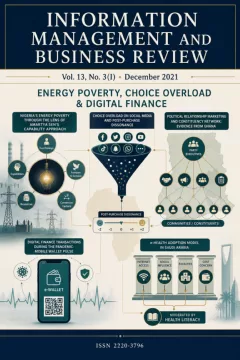 Vol. 13 No. 3(I) (2021)
Energy Poverty, Choice Overload & Digital Finance
View issue contents
Published
Submissions
Have research to publish? Information Management and Business Review welcomes submissions.
Make a Submission