Abstract
The purpose of this study was to investigate and evaluate the WTP limits of irrigation water in the Sheva region of the Northern Amhara region of Ethiopia to understand whether irrigation water is feasible. Data were collected from primary research sources. An upright bivariate model was used to determine households' willingness to address irrigation water problems in the study area. Using data from a sample of 800 farmers, the results show that WTP is positive for irrigation water in the North Sheva region. The results show that the average household can obtain irrigation water for about 3,001.47 0.25 hectares of land in Ethiopia, which is a one-time irrigation land value of US$100.05 at the current exchange rate. In addition, the study found that household size, agricultural experience, household costs, irrigated land, livestock capital education level, and measured tropical livestock live-stock units had a positive effect on willingness to pay for irrigation water. Capital is adversely affected by family age, but market access for farmers is not guaranteed. Based on the pursuit, convincing reliability constraints, increasing market access through information and irrigation schemes, and increasing farmers' awareness of irrigation water and its use, is the efficient use of irrigation and irrigation water. Valid maintenance conditions are recommended. Stick to discipline.
Keywords
- Bivariate Probabilistic Model Search this journal for Bivariate Probabilistic Model (opens in a new tab)
- Decision-Making Search this journal for Decision-Making (opens in a new tab)
- Irrigation Search this journal for Irrigation (opens in a new tab)
- Sustainability Search this journal for Sustainability (opens in a new tab)
- Willingness to Pay Search this journal for Willingness to Pay (opens in a new tab)
References
- Abera, A., Ahmed, F. & Abebe, A. (2017). Factors Influencing Participation in Irrigation Practices and Their Impact on Responsible Income on Family Farms: The Case of Boloso Sore Woreda, Warita District, Southern Ethiopia. International Journal of Contemporary Research and Review. https://doi.org/10.15520/ijcrr/2017/8/09/313
- Addai, K. N. & Danso-Abbeam, G. (2014). Dunkwa-on-Offin addressing readiness determinants improve solid waste management in Ghana. Journal of Agricultural and Environmental Sciences, 3(1).
- AleMayehu, T. (2004). Smallholder farmers will revise their irrigation water rates. Thank you for your unexpected appreciation for the Ethiopian Brain Irrigation Project. Journal of Economics and Sustainability, 5(19).
- Alhassan, M., Loomis, J., Frasier, M., Davies, S. & Andales, A. (2013). Estimating farmers' willingness to raise irrigation wages: An economic study of the Bontanga irrigation scheme in the North Sea, Ghana. Journal of Agriculture _ _ https://doi.org/10.5539/jas.v5n4p31
- Aman, M., Shumeta, Z. & Kebede, T. (2020). Economic assessment of increasing irrigation water use: the case of Mezcal, southern Ethiopia. Persuasive Environmental Science, 6(1), 1843311.
- Arbués, F., García-Valiñas, M. & Martinez-Espiñera, R. (2003). What is needed to assess residential water use: a state-of-the-art review? Socioeconomic, 32(1). https://doi.org/10.1016/S1053-5357(03)00005-2
- Berhanu, B., Seleshi, Y. & Melesse, A. M. (2014). Surface and water resources in Ethiopia: Potential challenges for water resource development. The Nile Basin: Economics, Climate Change, Hydrology and Political Agenda (Volume 9783319027203). https://doi.org/10.1007/978-3-319-02720-3_6
- Bihane, M. & Getachew, E. (2016). Determine agricultural water availability for irrigation purposes: Agarfa, Case District, Valle Zone, and Oromia Region. international journal of agricultural economics.
- Chandrasekaran, K., Devarajulu, S. & Kuppannan, P. (2009). Farmers are struggling to restore irrigation water: an example of a pond irrigation system in southern India, 1(1). https://doi.org/10.3390/w1010005
- Diriba, G. (2020). Agriculture and rural transformation in Ethiopia. Ethiopian Journal of Economics, 27(2), 51-110.
- Fitsume, Y. D., Kidist, A., Michael, E., Richard, K. & Molla, M. A. (2017). Irrigation water needs to be provided for crops in the mountainous interior of Ethiopia, supported by the FAO Crop Water Modelling. Journal of African Agricultural Research, 12(28). https://doi.org/10.5897/ajar2016.11659
- Fred, A. & Vogel. (1986). Sample designs and quotes from local sample sites.
- Freedman, III. A. M., Herriges, J. A. & Kling, C. L. (2014). Measure the value of the environment and resources. In measuring the value of the environment and resources. https://doi.org/10.4324/9781315780917
- Haab, T. C. & McConnell, K. E. (2002). Environmental and Natural Resource Assessments: Economic Assessments, Not Market Forces. Environmental and Natural Resource Assessments: Economic Assessments, Not Market Forces.
- Hagos, F., Jayasinghe, G., Awulachew, S. B., Soulseged, M. & Yilma, A. D. (2012). Management of agricultural water use and scarcity in Ethiopia. Agricultural Economics (UK), 43(1). https://doi.org/10.1111/j.1574-0862.2012.00623.x
- Hanemann, M., Loomis, J. & Kanninen, B. (1991). Statistical efficiency of the conditional evaluation of the twoboundary dichotomy. American Journal of Agricultural Economics, 73(4). https://doi.org/10.2307/1242453
- Hussain, I. & Hanjra, M. A. (2004). Irrigation and Poverty Alleviation: A Review of Empirical Evidence. Irrigation and Drainage, III(1). https://doi.org/10.1002/ird.114
- Jamali Jaghdani, T. & Brummer, B. (2016). Decisions to pay for groundwater: An insight into the informal water market in Rafsanjan, Iran. International Journal of Water Development, 32(6). https://doi.org/10.1080/07900627.2015.1133405
- Keogh, A. & Vásquez, W. F. (2020). Timely payment of water subsidies in El Salvador. Journal of Water and Environment, 34(S1). https://doi.org/10.1111/wej.12518
- Kidane, T. T., Wei, S. & Sibhatu, K. T. (2009). Small business owners want farmers to pay for irrigation water: insights from Eritrea. Agricultural Water Management, 222. https://doi.org/10.1016/j.agwat.2009.05.043
- Kifle, M. & Gebretsadikan, T. G. (2016). Yield and water use efficiency of furrow irrigation under conventional irrigation shortages in Atsibi-Wemberta, northern Ethiopia. Agricultural Water Management, 170. https://doi.org/10.1016/j.agwat.2016.01.003
- Kiprop, J., Mulunagu, K., Kibet, N. & Macharia, A. (2017). Smallholder farmers are determined by their willingness to pay for irrigation water in the Kerio Valley Basin in Kenya. Journal of Sustainability, 10(2). https://doi.org/10.5539/jsd.v10n2p135
- Luo, F., Wang, Q., Sun, F. M., Xu, D. & Sun, C. H. (2018). Agricultural intent is to participate in the management of China's smallest social capital irrigation. Irrigation and drainage, 67(4). https://doi.org/10.1002/ird.2208
- Malhotra, N. K. (2012). Basic Marketing Research. Implicit in habit measures, 246-263.
- Medellín-Azuara, J., Harou, J. J. & Howwitt, R. E. (2010). Estimating the economic value of agricultural water use and the impact of local agglomeration under changing conditions. Knowledge of the Whole Environment, 408(23). https://doi.org/10.1016/j.scitotenv.2009.08.013
- Mekonen, A., Gebremeskel, T., Mengistu, A., Fasil, E. & Melkamu, M. (2015). Irrigation Water in the Awash River Basin, Ethiopia: Evaluation of the Impact of Irrigation Levels and Payment Availability on Performance Performance. African Agricultural Survey, 10(6). https://doi.org/10.5897/ajar2014.9381
- Meunier, S., Manning, D. T., Quéval, L., Czerny, J. A., Desante, P. & Zimmerle, D. (2009). Improvements in domestic water use and irrigation in partially electrified rural areas in Rwanda. a small decision. International Journal of Sustainable Development and World Ecology, 26(6). https://doi.org/10.1080/13504509.2019.1626780
- Mezgebo, A., Tessema, W. & Asfaw, Z. (2013). The economic value of irrigation in the Wandgenette district of Ethiopia: application of surprise estimates. Journal of Economics and Sustainability, 4(2).
- Mohd. (2013). The aim is to preserve the natural environment of the Redang Island Marine Park in Malaysia. African Journal of Business Management, 7(25). https://doi.org/10.5897/AJBM10.752
- Namyenya, A., Sserunkuuma, D. & Bagamba, F. (2014). Uganda's Doho Rice Irrigation Scheme (DRIS), we would like to see irrigation water and its determinants in rice farmers. Journal of Agriculture and Economic Development, 6(8). https://doi.org/10.5897/jdae2014.0580
- Office, NSZA. (2009). Fat Rebel Han Population: Shewa CSA North Regional Office.
- Puertas, D. G. L., Pol, B. v. d., Kumsa, A., Steenbergen, F. v., Haile, A. M. & Embaye, T. G. (2015). Status and potential of groundwater use in Ethiopian floodplains. 1-24. www.spate-irrigation.org.
- Stedman, S., Mnyimbiri, A. M., Kawonga, Z., Malota, M., Njera, D., Hall, R. P. & Holm, R. H. (2018). Multi-water service irrigation for smallholder farmers in Malawi: Enha A case study in the Tawan area. Irrigation and Drainage, 67(5). https://doi.org/10.1002/ird.2282
- Thorvaldson, J., Pritchett, J. & Goemans, C. (2010). Western Home Water Science, Taste and Reset. Canadian Journal of Agricultural Economics, 58(4). https://doi.org/10.1111/j.1744-7976.2010.01195.x
- Verbeek, M. (2004). A Guide to Modern Economics (2nd Edition). John Wiley & Sons
- Wassihun, A. N., Nega, Y. M., Kebede, W. M., Fenta, E. E. & Ayalew, A. A. (2022). Small families are willing to pay for sustainable agricultural water supply in western Ethiopia. Space and Resource Science Letters, 1-20.
- Whittington, D. (2010). What have you learned from 20 years of research in developing countries? Annual Review of Resource Economics, 2. https://doi.org/10.1146/annurev.resource.012809.103908
- Whittington, D. & Nauges, C. (2010). Water needs assessment in developing countries: an overview. World Bank Research Observer, 25 (August).
- Waldmariam, P. (2017). Determination of Minimum Irrigation Rates: The Cases of Southern Ethiopia, Wolaita District and Boroso Pain District. American Journal of Agriculture and Forestry, 5(3). https://doi.org/10.11648/j.ajaf.20170503.13
- Young, R. A. & Loomis, J. B. (2014). Determining the Economic Value of Water: Concepts and Methods, 2nd ed. Economic Decision-Making about Water: Concepts and Methods, 2nd ed. https://doi.org/10.4324/9780203784112.
Downloads
No downloads have been recorded for this article yet. Figures appear here once readers begin downloading the full text.
How to Cite
Share this article
License
Copyright (c) 2022 Tim Chen, M Noufal, Charles Melville, J Chen, T Nguyen (Author)

This work is licensed under a Creative Commons Attribution 4.0 International License.
Author (s) should affirm that the material has not been published previously. It has not been submitted and it is not under consideration by any other journal. At the same time author (s) need to execute a publication permission agreement to assume the responsibility of the submitted content and any omissions and errors therein. After submission of revised paper in the light of suggestions of the reviewers, the editorial team edits and formats manuscripts to bring uniformity and standardization in published material.
This work will be licensed under Creative Commons Attribution 4.0 International (CC BY 4.0) and under condition of the license, users are free to read, copy, remix, transform, redistribute, download, print, search or link to the full texts of articles and even build upon their work as long as they credit the author for the original work. Moreover, as per journal policy author (s) hold and retain copyrights without any restrictions.
Keywords
- Bivariate Probabilistic Model Search this journal for Bivariate Probabilistic Model (opens in a new tab)
- Decision-Making Search this journal for Decision-Making (opens in a new tab)
- Irrigation Search this journal for Irrigation (opens in a new tab)
- Sustainability Search this journal for Sustainability (opens in a new tab)
- Willingness to Pay Search this journal for Willingness to Pay (opens in a new tab)
Section
Published in
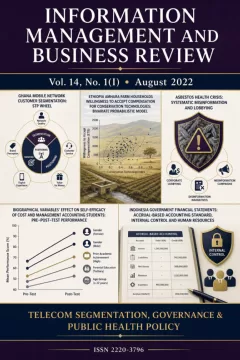 Vol. 14 No. 1(I) (2022)
Telecom Segmentation, Governance & Public Health Policy
View issue contents
Published
Submissions
Have research to publish? Information Management and Business Review welcomes submissions.
Make a Submission