Abstract
The purpose of this paper is to investigate whether biographical variables such as Gender, Race, Home District, School (urban/rural) and Language proficiency play any role in the Self-efficacy of Cost and Management Accounting (CMA) students and to assess whether Self-efficacy. A descriptive, longitudinal, and mixed-methods approach was used in this paper. In the current study, the quasi-experimental design used for the pre-test and post-test control groups was non-equivalent. The population targeted was CMA students. A census survey was performed. The comparative analysis between the variables revealed no significant difference. However, females, Africans, Urban Home District, Urban School, and English Second Language learners scored more in the post-test. The paper recommends that the implementation of General Education modules into the curriculum be instituted. Additionally, current learners appear to have very poor General Education skills, and respondents themselves believed that self-efficacy can have a positive impact on academic performance.
Keywords
- Financial Accounting Search this journal for Financial Accounting (opens in a new tab)
- Gender Search this journal for Gender (opens in a new tab)
- Home District Search this journal for Home District (opens in a new tab)
- Management Accounting Search this journal for Management Accounting (opens in a new tab)
- Race Search this journal for Race (opens in a new tab)
- Self-Efficacy Search this journal for Self-Efficacy (opens in a new tab)
References
- Angba, A. O., Adesope, O. M. & Aboh, C. L. (2009). Effects of socio-economic characteristics of rural youths on their attitudes towards participation in community development projects. International NGO Journal, 4(8), 348-351.
- Auyeung, P. K. & Sands, D. F. (1994). Predicting success in first-year university accounting using gender-based learning analysis. Accounting Education, 3(3), 259-72.
- Banda, F. (2003). A survey of literacy practices in black and colored communities in South Africa: Towards a pedagogy of multiliteracies. Language, Culture and Curriculum, 16(2), 106-129.
- Bandura, A. (1977). Self-efficacy: toward a unifying theory of behavioral change. Psychological Review, 84(2), 191-215.
- Bandura, A. (1994). Self-Efficacy in Ramachandran. V. S. eds. Encyclopedia of human. New York: Academic Press, 71-81.
- Beck, M. (2008). If at first, you don't succeed, you're in excellent company. Available: http://www.marketwatch.com/story/from-defeat-rejection-to-success (Accessed 08 August 2019).
- Best, J. W. & Kahn, J. V. (2006). Research in Education. 10th ed. Boston, Massachusetts: Allyn and Bacon/Pearson Education.
- Blaylock, A. & Lacewell, S. K. (2008). Assessing prerequisites as a measure of success in principles of finance course. Academy of educational leadership 12(1), 51-62.
- Bosire, J., Mondoh, H. & Barmao, A. (2008). Effect of streaming by gender on student achievement in mathematics in secondary schools in Kenya. Education, 28, 595-607.
- Brief, A. P. & Aldag, R. J. (1981). The ‘self’ in work organization: a conceptual review. Academy of Management Review, 6(1), 75-88.
- Brown, B. A. (2010). Teachers’ accounts of the usefulness of multi-grade teaching in promoting sustainable human-development-related outcomes in rural South Africa. African Studies, 36(1), 190-207.
- Carver Learning Systems. (2020). Definition of rauding. Available: http://www.carverlearning.com/our-story (Accessed 12 October 2020).
- Carver, R. P. (1978). Another look at rauding theory. Reading Research, 13(1), 116-132.
- Corrigan, T. (2009). Socio-economic problems facing Africa: insights from six APRM country review reports. Available: http://www.saiia.org.za/occasional-papers/socio-economic-problems-facing-africainsights-from-six-aprm-country-review-reports (Accessed 26 September 2018).
- Creswell, J. W. & Plano Clarke, V. L. (2011). Designing and conducting mixed research methods. Thousand Oaks, California: SAGE Publications.
- Cudia, C. P. (2009). Factors that influence the final grades of students in managerial accounting course at De La Salle University. Business research, 8(1), 39-59.
- Deloitte Global Services. (2020). Formation and membership of IFAC. Available: http://www.iasplus.com/en/resources/global-organisations/ifac (Accessed 26 September 2020).
- Doran, B. M., Benillon, M. L. & Smith, C. G. (1991). Determinants of student performance in accounting principles 1 and 2. Accounting Education, 6(1), 73-84.
- Du Plessis, A., Müller, H. & Prinsloo, P. (2005). Determining the profile of the successful first-year accounting student. Higher education, 19(4), 684-698.
- Equal Education. (2018). School infrastructure. Available: http://old.equaleducation.org.za/campaigns/minimum-norms-and-standards (Accessed 26 September 2018).
- Fawcett, A. (2015). Practical application of the international education standards (unpublished policy document).
- Ferla, J., Valcke, M. & Cai, Y. (2009). Academic self-efficacy and academic self-concept: reconsidering structural relationships. Learning and Individual Differences, 19(4), 499-505.
- Gardiner, M. (2008). Education in rural areas. Issues in Education Policy, 4, 1-34.
- Gist, M. E. & Mitchell, T. R. (1992). Self-Efficacy: a theoretical analysis of its determinants and malleability. Academy of Management Review, 17(2) 183-211.
- Gray, F. E. (2010). Specific oral communication skills desired in new accountancy graduates. Business Communication Quarterly, 73(1), 40-67.
- Greer, H. V. (2012). DUT curriculum glossary (unpublished policy document).
- Guba, E. G. & Lincoln, Y. S. (1994). Competing paradigms in qualitative research. In: Denzin, N. K. and Lincoln Y. S. eds. Handbook of qualitative research. London: SAGE Publications, 105-117.
- Guney, Y. (2009). Exogenous and endogenous factors influencing students’ performance in undergraduate accounting modules. Accounting education 18(1), 51-73.
- Hanushek, E. A. & Woessman, L. (2007). The role of education quality for economic growth. Policy Research Working Paper 02/2007. World Bank.
- Huh, S., Jin, J. J., Lee, K. J. & Yoo, S. (2010). Differential effects of student characteristics on performance: online vis-a-vis offline accounting courses. Academy of education leadership, 14(4), 81-89.
- Imoh, A. N., U-James, I. & Nwachukwu, E. O. (2009). Comparative analysis of poverty status of community participation in rural development projects of Akwa Ibom State, Nigeria. New York Science Journal, 2(6), 68-75.
- International Federation of Accountants. (2008). International education standard 3: professional skills and general education. New York, USA: International Accounting Education Standards Board.
- John, V. (2014). Provincial plans for school infrastructure should be made public to ensure correct needs are met. Mail & Guardian, 28 November: 1. Available: http://mg.co.za/article/2014-11-28-dodgy-dataleads-to-flawed-plans (Accessed 11 February 2018).
- Johnson, P. L. (2004). Mixed methods, mixed methodology health services research in practice. Qualitative Health Research, 14 (2), 259-279.
- Jiya, Z. (1993). Language difficulties of black BSC learners. Education, 7(1), 80-84.
- Kaighobadi, K. & Allen, M. T. (2008). Investigating academic success factors for undergraduate business students. Innovative education, 6(2), 427-436.
- Kiani, A. K. (2015). The role of education on economic growth in Pakistan. Available: https://www.researchgate.net/publication/228921856_The_Role_of_Education_On_Economic_Growth_in_Pakistan (Accessed 27 September 2020).
- Koh, M. Y. & Koh, H. C. (1999). The determinants of performance in an accounting program. Accounting Education, 8(1), 13-29.
- Krathwohl, D. (2002). A revision of Bloom’s taxonomy: an overview. Theory into Practise, 41(4), 212-225.
- Landy, B. (2012). Graph: For high-scoring learners, socioeconomic status still matters. Available: https://tcf.org/content/commentary/graph-for-high-scoring-learners-socioeconomic-status-stillmatters/ Accessed 20 July 2020).
- Lanier, P. A. & Tanner, J. R. (1999). A report on gender and gender-related issues in the accounting professoriate. Education for Business, 75(2), 76-82.
- Lipe, M. G. (1989). Further evidence on the performance of female versus male accounting students. Issues in Accounting Education, 4(1), 144-52.
- Mayer, R. E. (2002). Rote versus meaningful Learning. Theory into Practice, 41(4), 226-232.
- Mcleod, S. A. (2008). Information processing. Available: http://www.simplypsychology.org/informationprocessing.html (Accessed 29 September 2020).
- Meier, S., McCarthy, P. R. & Schmeck, R. R. (1984). Validity of self-efficacy as a predictor of writing performance. Cognitive Therapy and Research, 8(2), 107-120.
- Mitchell, C., Dillon, D., Wilson, T. S., Pithouse, K., Islam, F., O’Connor, K., Rudd, C., Staniforth, P. & Cole, A. (2010). Things fall apart and come together: Using the visual for reflection in alternative teacher education programs. Changing English, 17(1), 45-55.
- Mutchler, J. F., Turner, J. H. & Williams, D. D. (1987). The performance of female versus male accounting students. Accounting Education, 1(1), 63-68.
- Naidoo, S. K. & Garbharran, H. L. (2013). Communication skills as a subject in the program Cost and Management Accounting at a South African university. Journal of Economics and Behavioral Studies, 5(7), 484-495.
- National education evaluation and development unit. (2013). NEEDU National Report 2012: The State of Literacy Teaching and Learning in the Foundation Phase. Pretoria: National Education Evaluation and Development Unit.
- Oladipo, F. O. & Adekunle, O. A. (2010). Empirical determination of socio-economic status and its relationship with selected characteristics of rural male farmers in Kwara State, Nigeria. Agriculture and Biological Sciences, 6(1), 64-76.
- Ormrod, J. E. (2008). Human learning. 5th ed. Upper Saddle River, New Jersey: Pearson Education.
- Pajares, F. (2002). Self-efficacy beliefs in academic contexts: an outline. Available: http://www.uky.edu/~eushe2/Pajares/efftalk.html (Accessed 29 September 2020).
- Perumal, J. (2009). Reading and creating critically leaderful schools that make a difference: the post-apartheid South African case. Leadership in Education, 12(1), 35-49.
- Pickworth, G. (2001). Developing an instrument to identify MBCHB learners’ approaches to learning. Higher Education, 15(2), 140-145.
- Salomon, G. (1984). Television is "easy" and print is "tough": the differential investment of mental effort in learning as a function of perceptions and attributions. Educational Psychology, 76(4), 647-658.
- Schunk, D. H. (1989). Self-efficacy and cognitive achievements: implications for learners with learning problems. Learning Disabilities, 22(1), 14-22.
- Schunk, D. H. (1991). Self-efficacy and academic motivation. Educational psychologist, 26(3 &4), 207-231.
- Souter, C. W., Archer, M. & Rochford, K. (1992). Literal and inferential reading and comprehension skills. Higher Education, 6(3), 30-35.
- Taylor, S. & Yu, D. (2009). The importance of socioeconomic status in determining educational achievement in South Africa. Stellenbosch Economic Working papers: 01/09. Stellenbosch University: Department of Economics and Bureau for Economic Research.
- Thomas, T. (2011). Developing first-year learners’ critical thinking skills. Asian Social Science, 7(4), 26-35.
- Tumen, S., Shulruf, B. & Hattie, J. (2008). Student pathways at the university: patterns and predictors of completion. Studies in higher education, 33(3), 233-252.
- Tyson, T. (1989). Grade performance in introductory accounting courses. Why female students outperform males? Accounting education, (1), 153-60.
- United Nations Educational, Scientific and Cultural Organization. (1998). World declaration on higher education for the twenty-first century: vision and action. Available: http://www.unesco.org/education/educprog/wche/declaration_eng.htm (Accessed 30 September 2019).
- University of Central Arkansas. (2018). Objectives for the skills. Available: https://uca.edu/core/objectivesfor-the-skills/ (Accessed 30 September 2018).
- University of South Africa. (2012). How does socio-economic status impact educational outcomes in South Africa? Available: http://www.unisa.ac.za/cedu/news/index.php/2012/09/how-does-socioeconomic-status-impact-on-educational-outcomes-in-south-africa/ (Accessed 30 September 2019).
- Wall, L. J., Pettibone, T. J. & Kesley, K. D. (2005). The impact of socio-economic status on leadership potential in an agricultural leadership program. Southern Agricultural Education Research, 55(1), 153-161.
- Wallace, B. & Adams, H. B. (1989). Assessment and development of the potential of high school pupils in the third-world context of KwaZulu-Natal. Higher Education, 3(1), 83-94.
- Washington State University. (2020). Aims of general education. Available: http://gened.wsu.edu/overview/atWSU/ (Accessed 03 October 2020).
- Zimmerman, B. J. (2000). Self-efficacy: an essential motive to learn. Contemporary Educational Psychology, 25, 82-91.
Downloads
No downloads have been recorded for this article yet. Figures appear here once readers begin downloading the full text.
How to Cite
Share this article
License
Copyright (c) 2022 S.K. Naidoo (Author)

This work is licensed under a Creative Commons Attribution 4.0 International License.
Author (s) should affirm that the material has not been published previously. It has not been submitted and it is not under consideration by any other journal. At the same time author (s) need to execute a publication permission agreement to assume the responsibility of the submitted content and any omissions and errors therein. After submission of revised paper in the light of suggestions of the reviewers, the editorial team edits and formats manuscripts to bring uniformity and standardization in published material.
This work will be licensed under Creative Commons Attribution 4.0 International (CC BY 4.0) and under condition of the license, users are free to read, copy, remix, transform, redistribute, download, print, search or link to the full texts of articles and even build upon their work as long as they credit the author for the original work. Moreover, as per journal policy author (s) hold and retain copyrights without any restrictions.
Keywords
- Financial Accounting Search this journal for Financial Accounting (opens in a new tab)
- Gender Search this journal for Gender (opens in a new tab)
- Home District Search this journal for Home District (opens in a new tab)
- Management Accounting Search this journal for Management Accounting (opens in a new tab)
- Race Search this journal for Race (opens in a new tab)
- Self-Efficacy Search this journal for Self-Efficacy (opens in a new tab)
Section
Published in
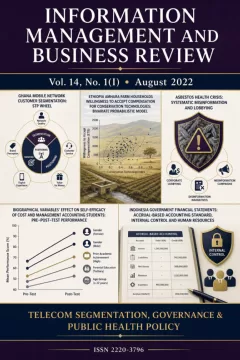 Vol. 14 No. 1(I) (2022)
Telecom Segmentation, Governance & Public Health Policy
View issue contents
Published
Submissions
Have research to publish? Information Management and Business Review welcomes submissions.
Make a Submission