Abstract
The purpose of this research paper is to examine the influential role of culture on leadership effectiveness and organizational performance in Pakistan. Culture is discussed with its two dimensions, national and organizational culture. In this competitive and globalized arena, culture plays a significane role in the organizational performance and leadership effectiveness. It was also found that supportive leadership style is frequent in most of the orgnaizations in Pakistan. Participative leadership style has also a positive impact on organizational performane and leadership effectiveness but to some extent, but instrumental leadership style has a negative impact. This research paper is exploratory in nature which explains the importance of leadership styles and its impact on decision making which influence the overall performance of the organization. Our study is limited regarding the national culture and organizational culture as a mediating role. Practically there is some diversity among cultures of the Pakistani organizations which leades to the diversity in the leadership behavior.
Keywords
- Organizational Culture Search this journal for Organizational Culture (opens in a new tab)
- National Culture Search this journal for National Culture (opens in a new tab)
- Leadership Effectiveness Search this journal for Leadership Effectiveness (opens in a new tab)
- Organizational Performance Search this journal for Organizational Performance (opens in a new tab)
- Leadership Styles Search this journal for Leadership Styles (opens in a new tab)
References
- Alvesson, M. (1990). On the Popularity of Organizational Culture. Acta Sociologica, 1, 31-49.
- Borman, W. C. & Motowidlo, S. J. (1993). Expanding the criterion domain to include elements of contextual performance. In N. Schmitt & W. Borman (Eds.). Personal Selection in organizations , 71-98. New York: Jossey-Bass.
- Casimir, G. (2010). Combinative aspects of leadership style and the interaction between leadership behaviors. Leadership & Organization Development Journal , 31 (6), 501-517.
- Daft, L. (2005). The Leadership Experience, 3rd Edition.
- Dag, A. S. (2006) Leadership Practices and Organizational Performance- a Norwegian study, EDAMBA Journal.
- Fenwick, F. J. & Gayle, C. A. (2008). Missing Links in Understanding the Relationship between Leadership and Organizational Performance. International Business & Economic Research Journal, 7(5), 67-78.
- Hogan, R., Curphy, J. G. & Hogan, J. (1994). What we know about leadership: Effectiveness and personality. American Psychological Association, 49(6), 493-504.
- Hofstede, G. (1991). Culture and organization: Software of the Mind. London: McGraw-Hill .
- Houghton, J. D. & DiLiello, T. C. (2010). Leadership development: the key to unlocking individual creativity in organizations. Leadership & Organization Development Journal , 31(3), 230-245.
- Ismael, Y. & Nor’y B. (2010). The Impact of Personality Traits and Leadership Styles on Leadership Effectiveness of Malaysian Managers . Academic leadership, The Online journal , 9(2).
- Kefela, T. G. (2010). Understanding Organizational Culture and Leadership-Enhance Efficiency and Productivity. PM World Today-The Featured Journal , 12(1), 1-14.
- Klagge, J. (1997). Leadership development needs of today’s organizational managers. Leadership & Organization Development Journa l, 18(7), 355–362.
- Liliana P. R., Emilio, R. & Juan, R. P. (2006). Leadership Styles and effectiveness: A study of Small Firms in Chile . Interciencia, 31(7), 500-504.
- Lok, P. & Crawford, J. (1999). The relationship between commitment and organizational culture, subculture, leadership style and job satisfaction in organizational change and development. Leadership & Organization Development Journal, 20(7), 365-373.
- Mannion, K. (2009). Leadership for success. Leadership & Organization Development Journal , 30 (7), 639-648.
- Marcoulides, G. & Heck, R. H. (1993). Organizational Culture and Performance: Proposing and Testing Model. Organizational Science , 4(2), 209-223.
- Nancy, P. & Galanaki, E. (2008). Leadership’s impact on employee engagement; Differences among entrepreneurs and professional CEOs. Leadership & Organizational Development Journal , 30(4), 365385.
- Ogbonna, E. & Harris, C. L. (2000). Leadership Style, organizational culture and performance: Empirical evidence from UK companies. Int. J. of Human Resource Management, 11(4), 766-788.
- Organ, D. W. (1988). Organizational Citizenship behavior: The good soldier syndrome. Lexington, MA: Lexington Books.
- Pervin, L. A., Cervone, D. & John, O. P. (2005). Personality: Theory and Research, USA. John Wiley & Sons.
- Popper, M. & Mayseless, O. (2007). The building blocks of leader development; A psychological conceptual framework. Leadership & Organization Development Journal , 28 (7), 664-684.
- Rajiv, M., Alan, J. & Rolph, E. (2001). Leadership Style, Motivation and Performance in International Marketing channels; An Empirical Investigation of the USA, Finland and Poland. European Journal of Marketing, 37 (1/2), 50-85.
- Savery, K. L. (1994). The Influence of the Perceived Styles of Leadership of a Group of Workers on their Attitudes to Work. Leadership & Organization Development Journal , 15(4), 12-18.
- Schein, E. H. (1992). Organizational Culture and Leadership (2nd Ed.). San Francisco: Jossey-Bass.
- Van Scotter, J. & Motowidlo, S. (1996). Interpersonal facilitation and job dedication as separate facets of contextual performance. Journal of Applied Psychology , 81, 525-531.
Downloads
No downloads have been recorded for this article yet. Figures appear here once readers begin downloading the full text.
How to Cite
Share this article
License
Copyright (c) 2011 Syed Kamran Ali Shah, Jam Javed Iqbal, Adeel Razaq, Muhammad Yameen, Suleman Sabir, Muhammad Asif Khan (Author)

This work is licensed under a Creative Commons Attribution 4.0 International License.
Author (s) should affirm that the material has not been published previously. It has not been submitted and it is not under consideration by any other journal. At the same time author (s) need to execute a publication permission agreement to assume the responsibility of the submitted content and any omissions and errors therein. After submission of revised paper in the light of suggestions of the reviewers, the editorial team edits and formats manuscripts to bring uniformity and standardization in published material.
This work will be licensed under Creative Commons Attribution 4.0 International (CC BY 4.0) and under condition of the license, users are free to read, copy, remix, transform, redistribute, download, print, search or link to the full texts of articles and even build upon their work as long as they credit the author for the original work. Moreover, as per journal policy author (s) hold and retain copyrights without any restrictions.
Keywords
- Organizational Culture Search this journal for Organizational Culture (opens in a new tab)
- National Culture Search this journal for National Culture (opens in a new tab)
- Leadership Effectiveness Search this journal for Leadership Effectiveness (opens in a new tab)
- Organizational Performance Search this journal for Organizational Performance (opens in a new tab)
- Leadership Styles Search this journal for Leadership Styles (opens in a new tab)
Section
Published in
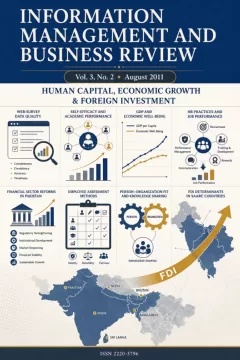 Vol. 3 No. 2 (2011)
Human Capital, Economic Growth & Foreign Investment
View issue contents
Published
Submissions
Have research to publish? Information Management and Business Review welcomes submissions.
Make a Submission