Abstract
In the digital era, marketing trends have undergone a significant transformation. A brand-new marketing channel that businesses are using to reach out to customers is social media. In this study, the effect of social media marketing methods on customers' desire to buy cosmetics is investigated. Entertainment, engagement, trendiness, personalization, and eWOM are the five social media marketing strategy dimensions that were examined in the study. Data were obtained using the convenience sample approach, and 260 valid questionnaires were gathered. Data analysis using the SEM-PLS method. The findings show that each of the five social media marketing strategy elements had a statistically significant impact on consumers' intention to make a purchase. Users' participation in online cosmetics purchases was found to be strongly influenced by entertainment.
Keywords
References
- Bilgin, Y. (2018). The effect of social media marketing activities on brand awareness, brand image and brand loyalty. Business & Management Studies: An International Journal, 6(1), 128-148.
- Cheung, M. L., Pires, G. D., Rosenberger III, P. J., & De Oliveira, M. J. (2020). Driving COBRAs: the power of social media marketing. Marketing Intelligence & Planning, 39(3), 361-376. https://doi.org/10.1108/MIP-11-2019-0583
- Choedon, T., & Lee, Y. C. (2020). The effect of social media marketing activities on purchase intention with brand equity and social brand engagement: Empirical evidence from Korean cosmetic firms. The Knowledge Management Society of Korea, 21(3), 141-160. 10.15813/kmr.2020.21.3.008.
- Cohen, J. (1992). Statistical power analysis. Current Directions in Psychological Science, 1(3), 98–101. https://doi.org/10.1111/1467-8721.ep10768783
- Dahnil, M.I., Marzuki, K.M., Langgat, J., & Fabeil, N.F. (2014). Factors influencing SMEs adoption of social media marketing. Procedia-Social Behavioral Sciences, 148, 119–126. https://doi.org/10.1016/j.sbspro.2014.07.025
- Dobele, A., Lindgreen, A., Beverland, M., Vanhamme, J., & Van Wijk, R. (2007). Why pass on viral messages? Because they connect emotionally. Business Horizons, 50(4), 291-304.
- Elseidi, R. I., & El-Baz, D. (2016). Electronic word of mouth effects on consumers’ brand attitudes, brand image and purchase intention: an empirical study in Egypt. The Business and Management Review, 7(5), 268-276.
- Faul, F., Erdfelder, E., Lang, A.-G., & Buchner, A. (2007). G*Power 3: A flexible statistical power analysis program for the social, behavioral, and biomedical sciences. Behavior Research Methods, 39, 175-191.
- Gautam, V., & Sharma, V. (2017). The mediating role of customer relationship on social media marketing and purchase intention relationship with special reference to luxury fashion brands. Journal of Promotion Management, 23, 872–888.
- Godey, B., Manthiou, A., Pederzoli, D., Joonas, R., Aiello, G., Donvito, R., & Singh, R. (2016). Social media marketing efforts of luxury brands: Influence on brand equity and consumer behavior. Journal of Business Research, 69(12), 5833-5841.
- Gvili, Y., & Levy, S. (2016). Antecedents of attitudes toward eWOM communication: differences across digital channels. Internet Research, 26 (4), 1030-1051.
- Hair, J. F. Jr., Hult, G. T. M., Ringle, C. M. & Sarstedt, M. (2017). A Primer on Partial Least Squares Structural Equation Modeling (PLS-SEM). Los Angeles, CA: Sage Publications.
- Hall-Phillips, A.; Park, J.; Chung, T.-L., Anaza, N.A., & Rathod, S.R. (2016). I (heart) social ventures: Identification and social media engagement. Journal of Business Research, 69, 484–491.
- Hudson, S., & Hudson, D. (2006). Branded entertainment: a new advertising technique or product placement in disguise? Journal of Marketing Management, 22(5-6), 489-504.
- Hussain, S., Ahmed, W., Jafar, R. M. S., Rabnawaz, A., & Jianzhou, Y. (2017). eWOM source credibility, perceived risk and food product customer’s information adoption. Computer in Human Behavior, 66, 96-102. doi: 10.1016/j.chb.2016.09.034
- Hutter, K., Hautz, J., Dennhardt, S., & Füller, J. (2013). The impact of user interactions in social media on brand awareness and purchase intention: The case of MINI on Facebook. Journal of Product Brand Management, 22, 342–351.
- Irfan, A., Rasli, A. M., Sami, A., & Liaquat, H. (2017). Role of social media in promoting education tourism. Advanced Science Letters, 23(9), 8728-8731. 10.1166/asl.2017.9959.
- Jamil, K., Dunnan, L., Gul, R. F., Shehzad, M. U., Gillamo, S. H. M., & Awan, F. H. (2022). Role of social media marketing activities in influencing customer intentions: a perspective of a new emerging era. Frontiers in Psychology, 12. https://doi.org/10.3389/fpsyg.2021.808525
- Kang, M. J. (2005). A Study on the effect of features of brand community using one-person media on consumers. Seoul: Seoul National University.
- Khan, M. M. (2019). The impact of perceived social media marketing activities: An empirical study in Saudi Context. International Journal of Marketing Studies, 11(1), 134-149.
- Kim, A.J., & Ko, E. (2010). Impacts of luxury fashion brand’s social media marketing on customer Relationship and purchase intention. Journal of Global Fashion Marketing, 1, 164–171. https://doi.org/10.1080/20932685.2010.10593068
- Kim, A.J., & Ko, E. (2012). Do social media marketing activities enhance customer equity? An empirical study of luxury fashion brands. Journal of Business Research, 65, 1480–1486. https://doi.org/10.1016/j.jbusres.2011.10.014
- Laksamana, P. (2018). Impact of social media marketing on purchase intention and brand loyalty: Evidence from Indonesia’s banking industry. International Review of Management and Marketing, 8(1), 13–18. https://econjournals.com/index.php/irmm/article/view/5838
- Luo, X. (2002). Uses and Gratifications Theory and e-consumer behavior: A Structural Equation Modeling Study. Journal of Interactive Advertising, 2(2), 34-41.
- Macharia, H., & Cheng, Y. (2019). How do social media Marketing activities influence customer equity and purchase intention: An empirical study of hotel industry based on Y-Generation. Master Theses. Retrieved from http://lnu.diva-portal.org/smash/get/diva2:1325898
- Manzoor, U., Baig, S. A., Hashim, M, & Sami, A. (2020). Impact of social media marketing on consumer’s purchase intentions: The mediating role of customer trust. International Journal of Entrepreneurial Research, 3(2), 41–48. https://readersinsight.net/IJER/article/view/1386/1077
- Muntinga, D. G., Moorman, M., & Smit, E. G. (2011). Introducing COBRAs: Exploring motivations for brand-related social media use. International Journal of Advertising, 30, 13-46. https://doi.org/10.2501/IJA-30-1-013-046
- Rapp, A., Beitelspacher, L.S., Grewal, D., & Hughes, D.E. (2013). Understanding social media effects across seller, retailer, and consumer interactions. Journal of the Academy of Marketing Science, 41, 547–566.
- Ringle, C. M., Wende, S. & Becker, J-M. (2015). Smartpls 3. Bönningstedt: SmartPLS.
- Schmenner, R. W. (1986). How can service businesses survive and prosper? Sloan Management Review, 27(3), 21-32.
- Seo, E.-J., & Park, J.-W. (2018). A study on the effects of social media marketing activities on brand equity and customer response in the airline industry. Journal of Air Transport Management, 66, 36–41. https://doi.org/10.1016/j.jairtraman.2017.09.014
- Sharma, S., Singh, S., Kujur, F., & Das, G. (2020). Social media activities and their influence on customer-brand relationship: an empirical study of apparel retailers’ activity in India. Journal of Theoretical and Applied Electronic Commerce Research, 16, 602–617. doi: 10.3390/jtaer16040036
- Sokolova, K., & Kefi, H. (2020). Instagram and YouTube bloggers promote it, why should I buy? How credibility and parasocial interaction influence purchase intentions. Journal of Retailing and Consumer Services, 53, 101742.
- Starngage (2020). Influencer Marketing in Malaysia. Retrieved from https: www.starngage.com/influencer-marketing-Malaysia/
- Tam, K.Y., & Ho, S.Y. (2006) Understanding the Impact of Web Personalization on User Information Processing and Decision Outcomes. Management Information Quarterly, 30, 865-890.
- Taylor, C. R. (2018). The new era of electronic word of mouth (eWOM): ‘Be More Chill’ overrules the critics. The Review of Marketing Communications, 37(6), 849-851.
- Yadav, M. & Rahman, Z. (2017). Measuring consumer perception of social media marketing activities in e-commerce industry: Scale development & validation. Telematics and Informatics, 34, 1294–1307.
- Yadav, M. & Rahman, Z. (2018). The influence of social media marketing activities on customer loyalty: A study of the e-commerce industry. Benchmarking: An International Journal, 25(9), 3882-3905.
Downloads
No downloads have been recorded for this article yet. Figures appear here once readers begin downloading the full text.
How to Cite
Share this article
License
Copyright (c) 2023 Soo-Cheng Chuah, Azitadoly Mohd Arifin, Mohammad Nazreen Mayaddin, Mohd Farez Othman (Author)

This work is licensed under a Creative Commons Attribution 4.0 International License.
Author (s) should affirm that the material has not been published previously. It has not been submitted and it is not under consideration by any other journal. At the same time author (s) need to execute a publication permission agreement to assume the responsibility of the submitted content and any omissions and errors therein. After submission of revised paper in the light of suggestions of the reviewers, the editorial team edits and formats manuscripts to bring uniformity and standardization in published material.
This work will be licensed under Creative Commons Attribution 4.0 International (CC BY 4.0) and under condition of the license, users are free to read, copy, remix, transform, redistribute, download, print, search or link to the full texts of articles and even build upon their work as long as they credit the author for the original work. Moreover, as per journal policy author (s) hold and retain copyrights without any restrictions.
Keywords
Section
Published in
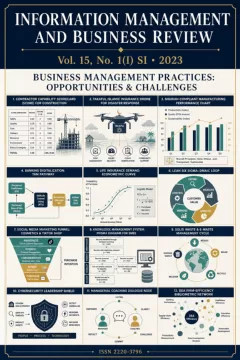 Vol. 15 No. 1(I)SI (2023)
Business Management Practices: Opportunities & Challenges
View issue contents
Published
Submissions
Have research to publish? Information Management and Business Review welcomes submissions.
Make a Submission